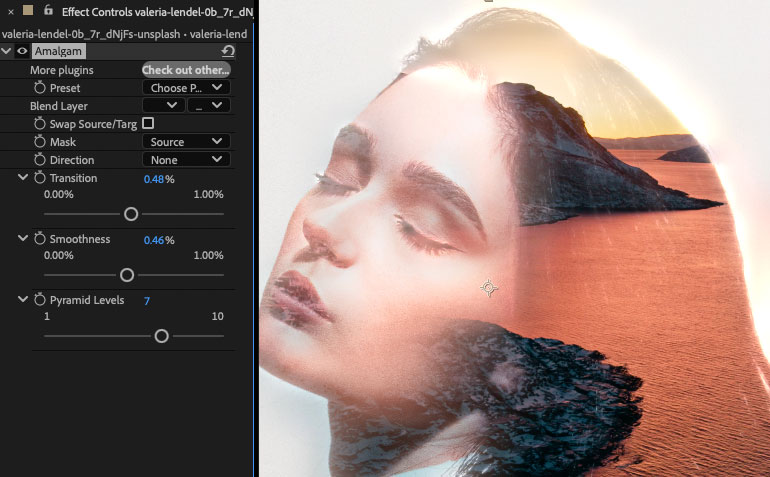
What Amalgam does
Amalgam blends two images by separating each source into frequency bands with a Laplacian pyramid, then rebuilding a single frame. Broad, low-frequency tones cross-fade to soften the join, while fine detail such as edges, hair and grain is merged band by band. Use it for double-exposure composites or image mixes where you want to retain texture and detail.
Amalgam Blend and Amalgam Transition
The product page identifies Amalgam Blend for After Effects and Premiere Pro. It combines two images into one blended frame, which suits layered composites and double-exposure looks. Amalgam Transition is a separate component described as a quick transition for Premiere Pro only.
The page also lists parameters to follow target-layer transforms, useful when a target layer moves or scales in a composition. Its compatibility list includes additional hosts, but the feature descriptions do not specify which component those hosts expose.
Compatibility and license terms
| Host | Versions listed |
|---|---|
| After Effects | 2022 to 2027 |
| DaVinci Resolve | 16 to 21 |
| Media Encoder | 2022 to 2027 |
| Nuke/NukeX | 13.0, 13.1, 13.2, 14, 15, 16 and 17 |
| Premiere Pro | 2022 to 2027 |
The product listing names DaVinci Resolve, Media Encoder and Nuke/NukeX as compatible, but does not map those hosts to Blend or Transition. Confirm the specific component you need before building a workflow around one of them.
The listed EULA allows one copy on one computer at a time and one archival copy on a storage medium other than a hard drive, for reinstallation only. Additional users or computers require appropriate licensing for each user and copy. A trial is also listed.