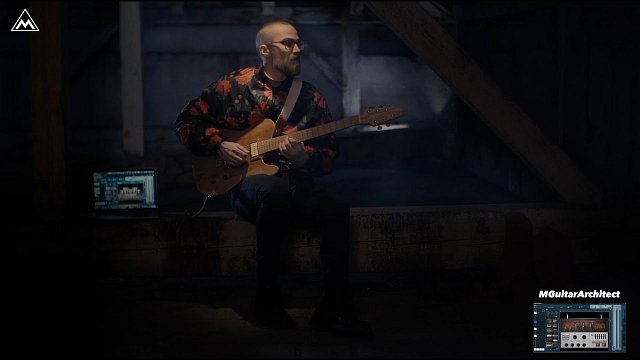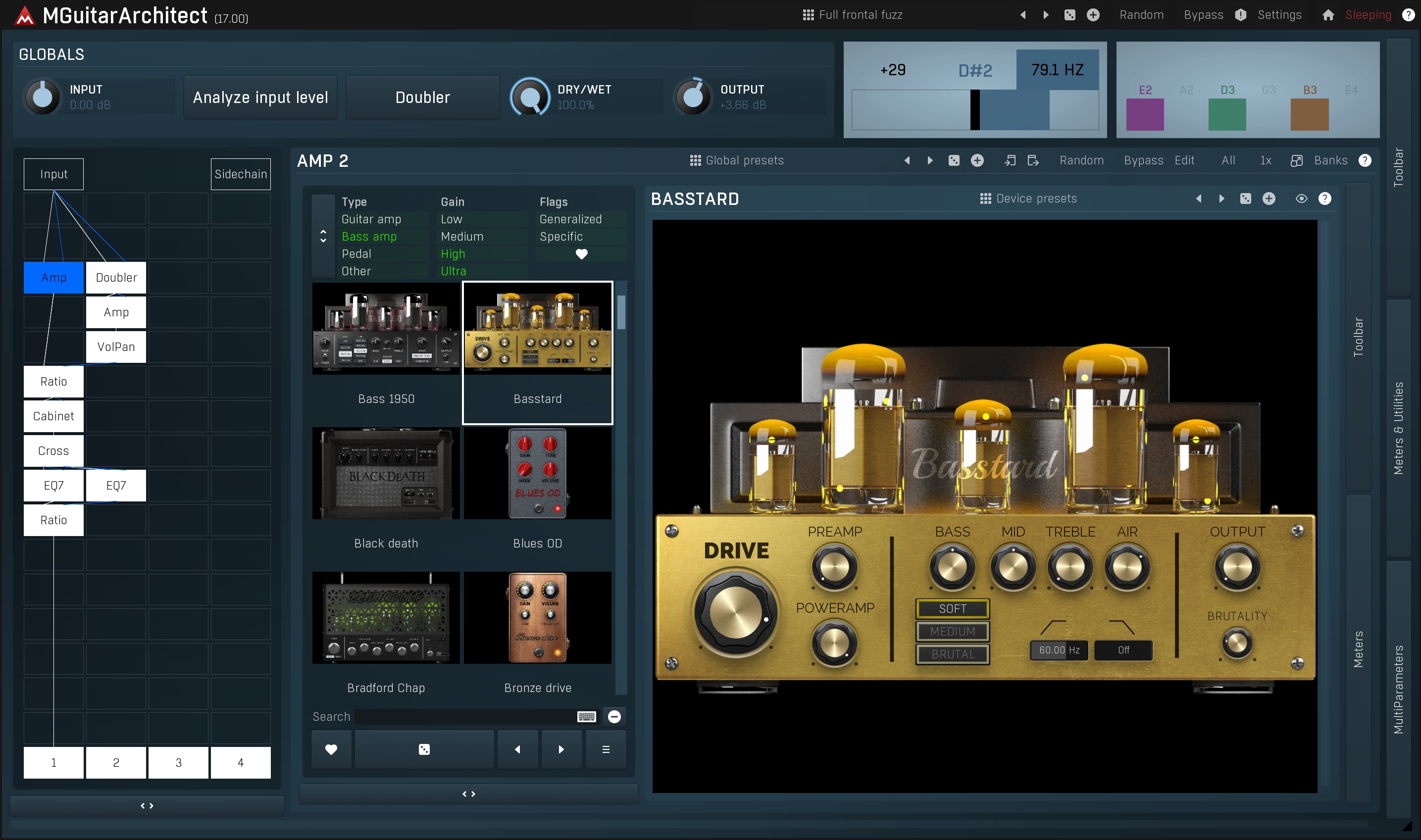
MGuitarArchitect is MeldaProduction’s guitar-chain plug-in for shaping direct-input guitar and bass recordings or processing guitar tracks recorded through an amp. Players and producers can build, adjust and save multi-effect chains.
Build a chain with separate paths
The chain section has three customizable 16-slot chains and a fourth sidechain group, with up to 64 effects across the groups. Paths can run in series or parallel. Each slot can hold a guitar, stomp, studio or utility effect, and you can add or reorder effects as the sound develops.
The library includes amp and cabinet devices, stompbox simulations, 10 studio-style processors and eight utility processors. Effects have adjustable parameters and their own presets. You can also save presets for a complete chain. The product includes the MTurboAmp and MCabinet devices.
Shape and compare sounds
MGuitarArchitect organizes effects by category, with some processors grouped by style, such as country or metal. For a direct-input recording, you can build a path from amp and cabinet processing through stompboxes and other effects. The same chains can process a guitar track recorded through an amp.
For sound design and automation, you can switch among up to eight plug-in instances using A-H slots, and an XY pad can morph among the first four slots. Four modulators can act as LFOs, level followers, MIDI or audio-triggered envelopes, randomizers or pitch detectors. They can also listen to the sidechain. MIDI learn maps a controller to plug-in parameters.
Check effects, formats and license terms
Some Melda studio effects can be used in a chain when you hold their separate licenses. MTurboEQ, MTurboComp, MTurboDelay, MTurboReverb and MDynamicEQ are examples that are sold separately and are not included with an MGuitarArchitect license. See the MGuitarArchitect feature details for the product’s full effect and control information.
Melda lists Windows 10 or 11 (64-bit) with VST, VST3 or AAX hosts, and macOS 10.14 or newer (64-bit) with VST, VST3, AU or AAX hosts. The vendor’s system requirements page has additional host notes. Commercial software has a 15-day fully functional trial; afterward it enters demo mode with limitations until a license is purchased and activated. The license is registered to one person, who alone may use the software and can activate it on any number of computers they personally own. Melda uses license files, so activation does not require an internet connection or hardware dongle. See the license terms and MGuitarArchitect support page before installing or buying.