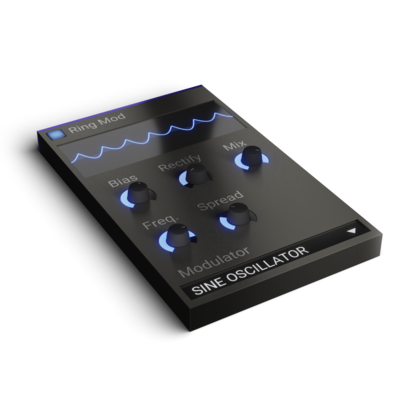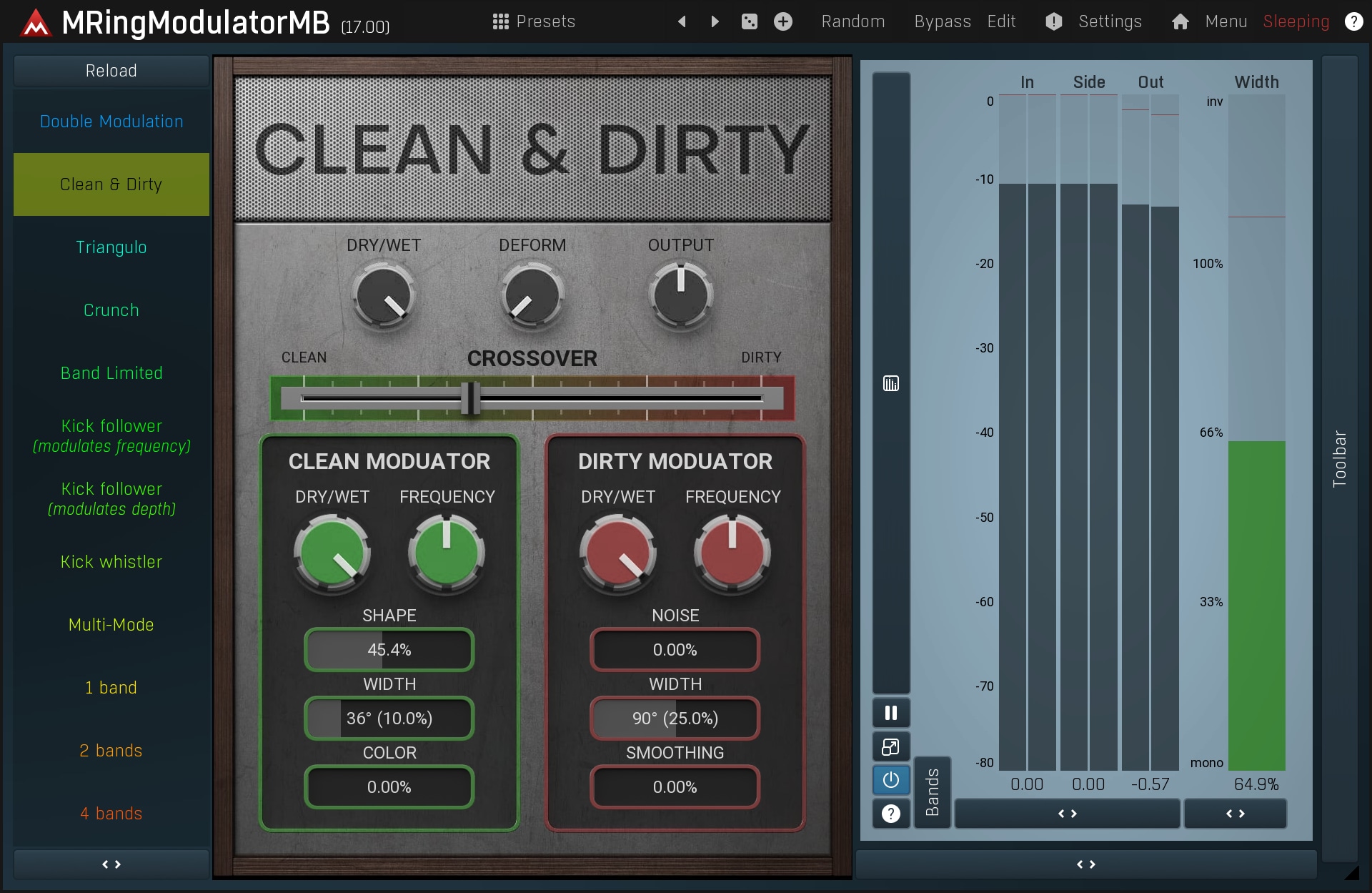
MRingModulator is MeldaProduction’s ring-modulation effect, using one or two oscillators to shape an audio signal. It suits producers and sound designers who want to control the modulation source itself, or use an external side-chain signal in place of an internal oscillator.
Shape and combine the oscillators
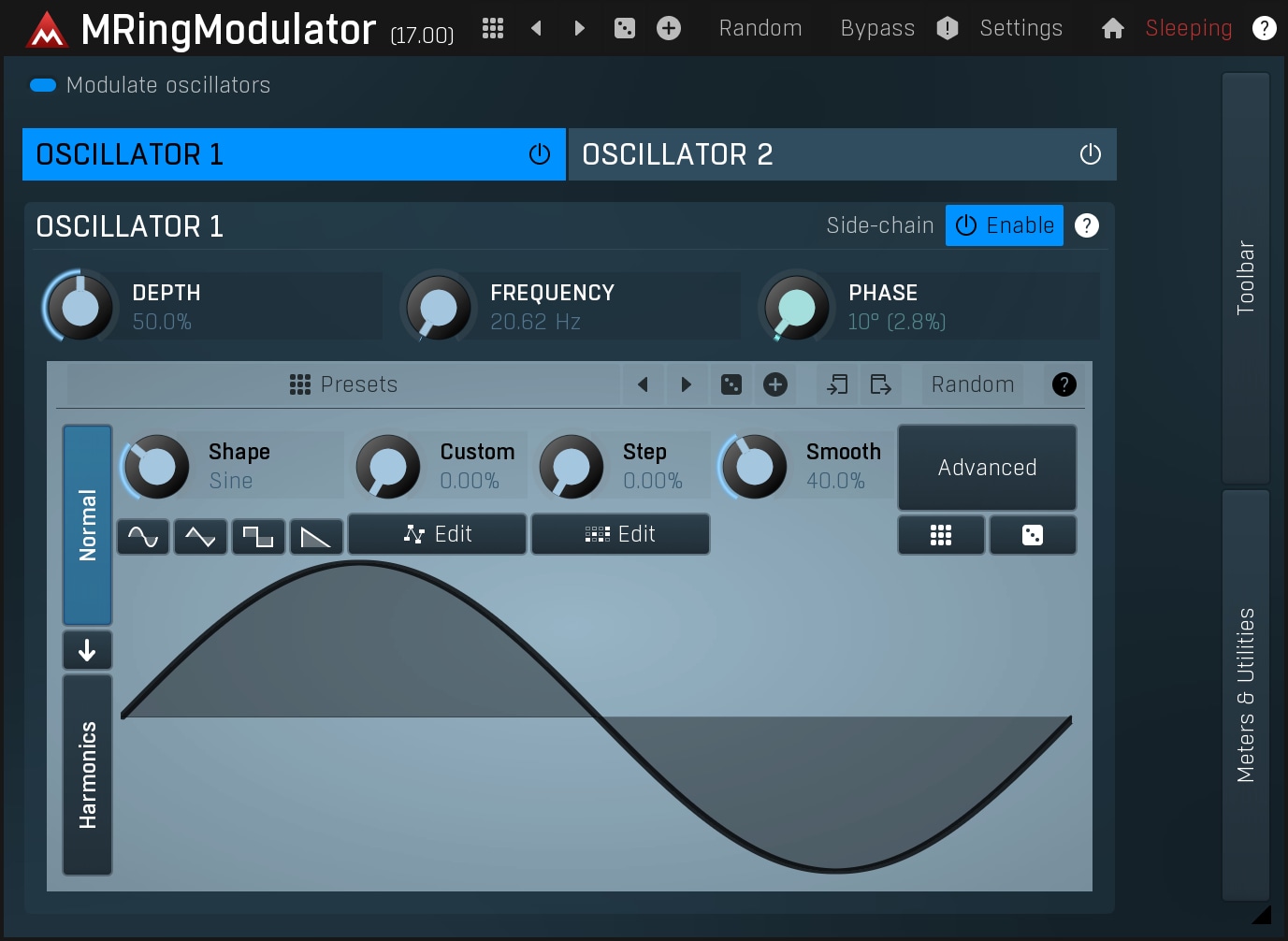
Each oscillator has depth, frequency, and phase controls. The documented ranges are 0-100% depth, 20 Hz-20 kHz frequency, and 0-360 degrees phase. The phase difference between channels can create a stereo expansion effect.
For low-frequency modulation, Normal mode lets you work with oscillator shapes. You can blend a predefined shape with a custom curve, a step sequence, or a custom sample. The sample represents one period of a waveform, not a playable sample; when used, it is stored in the plug-in settings. Smoothness softens abrupt shape changes.
For high-frequency oscillators, Harmonics mode gives direct control over the levels and phases of individual harmonics. Converting a shape from Normal mode to Harmonics mode may change it because the harmonic representation is limited.
The Modulate switch changes how two enabled oscillators are applied. When enabled, their signals are combined to modulate the source. When disabled, each oscillator processes the source separately in series. A side-chain switch can replace an internal oscillator with a signal from another source, if the host provides a suitable side-chain input.
Audition and control settings
MRingModulator has eight A-H setting slots. A/B switches between the current and previously selected slot, and an X/Y control can morph among the first four slots. MIDI learn can assign hardware controls to parameters, while multiparameters can group several parameters under one control for automation.
Automatic gain compensation can help compare settings at similar loudness. The manual warns that it can counter slow level changes, so turn it off when that movement is part of the intended effect. An optional safety limiter keeps output peaks below 0 dB; MeldaProduction notes that it uses processing power and changes the output signal.
Channel modes and compatibility
In addition to left-and-right processing, channel modes include separate left or right, mid/side, surround up to 8 channels, and ambisonics up to 64 channels. Multichannel use depends on the host and its bus support. The manual requires global activation and a host restart for VST2 surround; ambisonics also requires activation and a restart.
The support page lists Windows 10 or 11 (64-bit) with VST, VST3, or AAX hosts, and macOS 10.14 or later (64-bit) with VST, VST3, AU, or AAX hosts. Check MeldaProduction’s system requirements for host-specific details. The feature overview and MRingModulator manual describe the controls and routing in more detail.