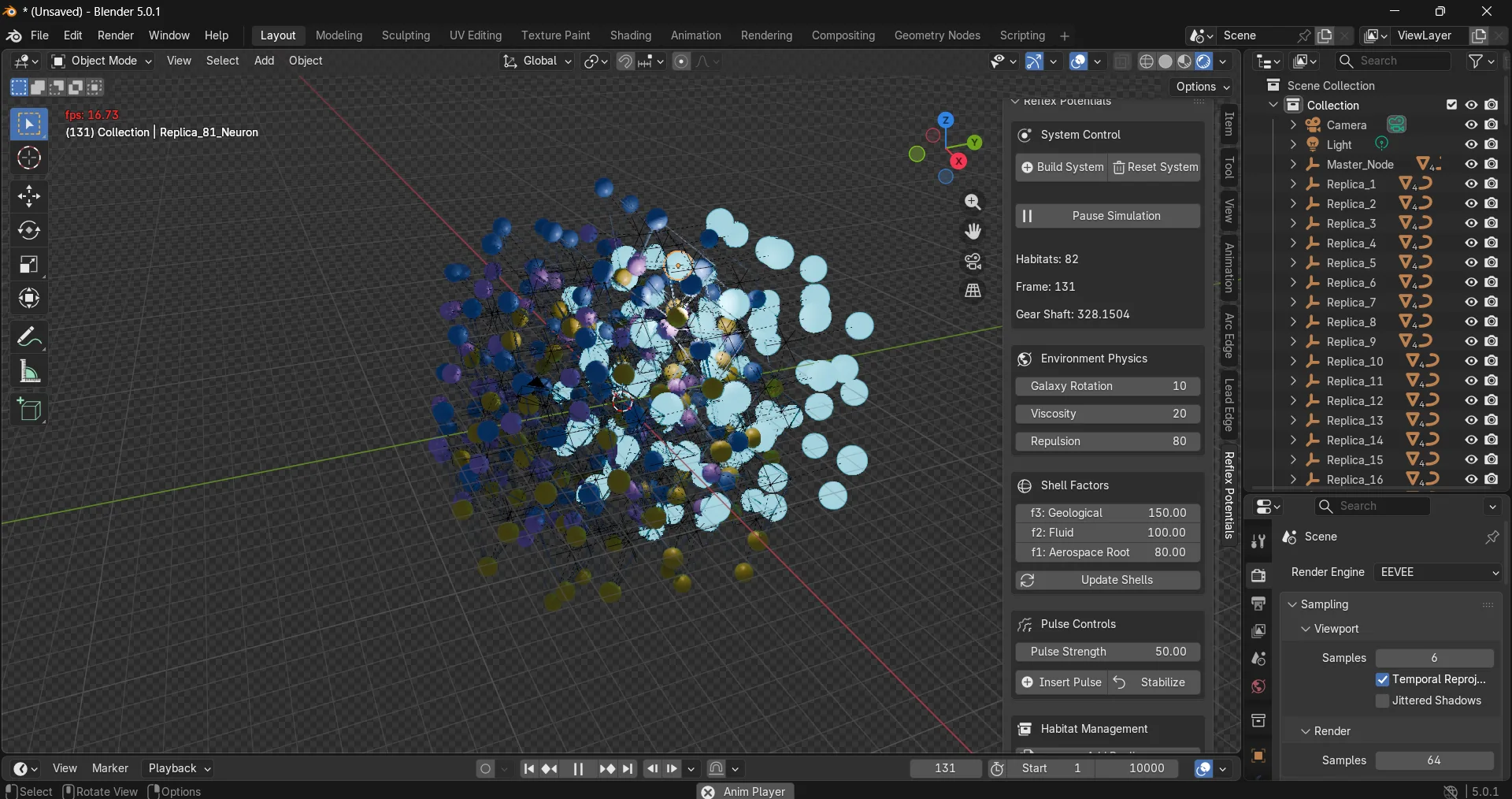
Reflex Potentials is a Blender add-on by dartmeadow built around the developer’s LEATR (Gravitational Neuron Source Potentials) concept. Its description presents three “natural buoyancies” as a way to process and optimize an AI neural network, in contrast to weight-tagging the most optimal data transported between neurons: Aerospace (zero gravity or vacuum), Maritime (fluid dynamics), and Geological (solids and positioning). The listing describes the framework’s intent, but does not provide benchmark results showing its effect on a network.
How the framework is described
The add-on represents these buoyancy categories as shells around connected data. Each shell follows three ordered stages: Foundation, Reflex, and Performance, abbreviated as FRP, before processing the input data it contains. The developer gives Global Variable = (frp √ frp) as the elementary math foundation, though the listing does not explain how to apply the expression in a Blender task.
Gravity Potentials are described as part of the same framework, assisting with measurement alongside the shell logic. The stated use includes AI neural network research with connected data and assets, plus 3D visual feedback and simulation measurements.
Who might use it
Reflex Potentials may interest Blender users exploring dartmeadow’s buoyancy model for neural network design. The available listing does not describe a repeatable network setup, a worked research example, or measured simulation results. Read the developer’s project page to assess whether its approach fits your work.
Version and installation
The Blender Extensions listing identifies version 1.0.3 and compatibility with Blender 5.0.1 and newer. It lists the GNU General Public License v3.0 or later, says the add-on requires no special permissions, and provides a 34.7 KB download. The listing offers drag-and-drop installation or Blender’s Install from Disk workflow. Check the listing for release or compatibility changes before installing. It links to the GitHub project for issue reports.