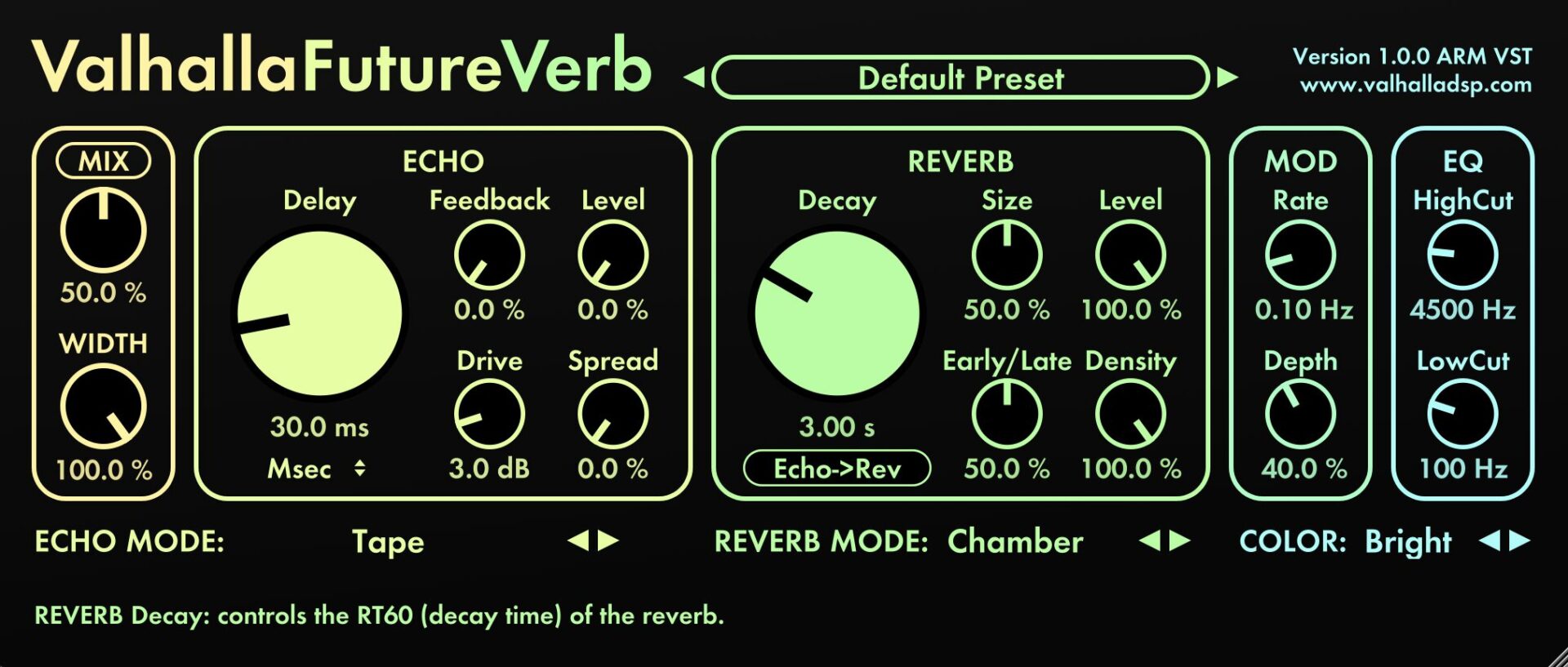
Valhalla FutureVerb combines reverb and echo in one 64-bit DAW plugin. Its eight reverb modes cover enclosed rooms, chambers, plates, halls and cathedrals, as well as long ambient tails and gated effects. Twelve echo modes can add predelay, pitch-shifted texture or dirt, and can be routed before or after the reverb.
Choose a reverb space or effect
Acoustic-space modes
- Room models an enclosed space, with a fast attack and adjustable early reflections.
- Chamber has a faster onset than Room, with greater resonance and a boomier low end.
- Plate is based on a steel plate, with a fast onset and a metallic character.
- Hall uses dense echoes and resonance; its Early/Late control adjusts the attack and apparent listener position.
- Cathedral creates a large, slow-building space with a long low-frequency decay.
Ambient and gated modes
- Space covers large, transparent effects and lets you set attack from instant to very slow.
- Raising Size lets Frozen hold a tail for several seconds or tens of seconds, with Attack controlling whether it starts immediately or fades in.
- Nonlin produces gated reverb from tens of milliseconds up to one second; Attack moves the sound forward in the mix or lets it blend in.
The algorithms are designed to work without modulation, with modulation available when you want movement in the tail.
Echo modes and routing
Modern is a clean choice for predelay. Tape adds gentle chaotic modulation and warm overdrive without the noise of real tape echoes. Digital is based on a companded 12-bit delay, using 8 bits in the Dark and Studio Color modes; its Drive control adds crunchy distortion and quantization noise. Analog is an idealized bucket-brigade delay, brighter and cleaner than a real BBD. Detune and the Reverse modes create pitched or reversed layers. ReverseOctUp, ReverseOctDown and ReverseOctUpDown add octave-shifted delays, while Sparkle uses granular pitch shifting for clear octave-up shimmer. Swarm can build dissonant clusters, and LoFi adds overdrive, low-frequency drift and chaotic high-frequency flutter.
Selecting an Echo Mode can change which controls appear. Use the echoes as predelay, route Echo into Reverb or Reverb into Echo, or raise Spread and Feedback to make a sparse reverb from the echo section alone. Spread can also expand some modes into multiple parallel delays.
Set the overall tone
Four Color modes adjust equalization and high-frequency decay. Bright allows very long high-frequency decay; Neutral limits high-frequency RT60 to the 1 to 1.5 second maximum Valhalla DSP gives for real acoustic spaces. Dark adds a steep 8 kHz low-pass filter. Studio combines a steep 10 kHz high cut with a 600 Hz low cut for a duller, thinner sound that can sit behind other elements in a mix.
Compatibility and licensing
FutureVerb supports Windows 7, 8, 10 and 11; on Mac, it supports OS X 10.9, 10.10 and 10.11, macOS 10.12 through 10.15, Big Sur, Monterey, Ventura, Sonoma, Sequoia and Tahoe. On Mac, FutureVerb supports Intel and Apple Silicon M1, M2, M3, M4 and M5 processors. The 64-bit formats are VST2.4, VST3 and AAX on Windows and Mac, plus AU on Mac. Valhalla DSP says one purchase covers all FutureVerb formats and every DAW you own and personally use. You can install the plugin on as many computers as you own and personally use. FutureVerb is priced at USD 50. Purchasers download the installer and a .vkeyfile license key from their Valhalla DSP account.