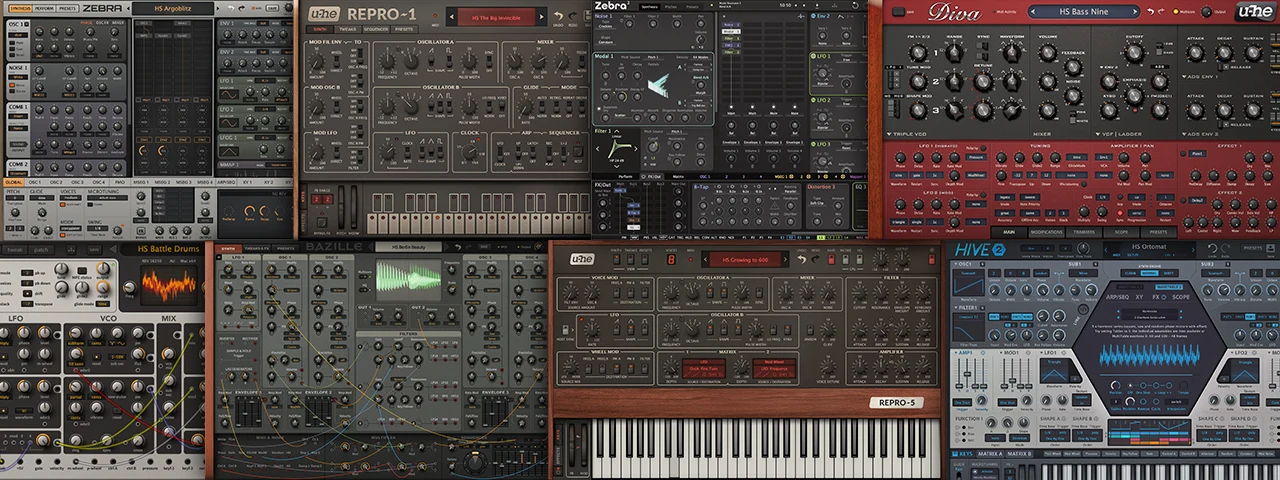
Zebra 3 is u-he’s modular software synthesizer for building sounds from virtual analogue, wavetable, additive, FM and physical-modeling sources. Its adaptive interface reveals modules as you add them, while the patch grid lets you combine and modulate sources within one voice. Producers and sound designers can start from more than 1,200 factory presets or build patches by shaping the signal path.
Build sounds from multiple oscillator types
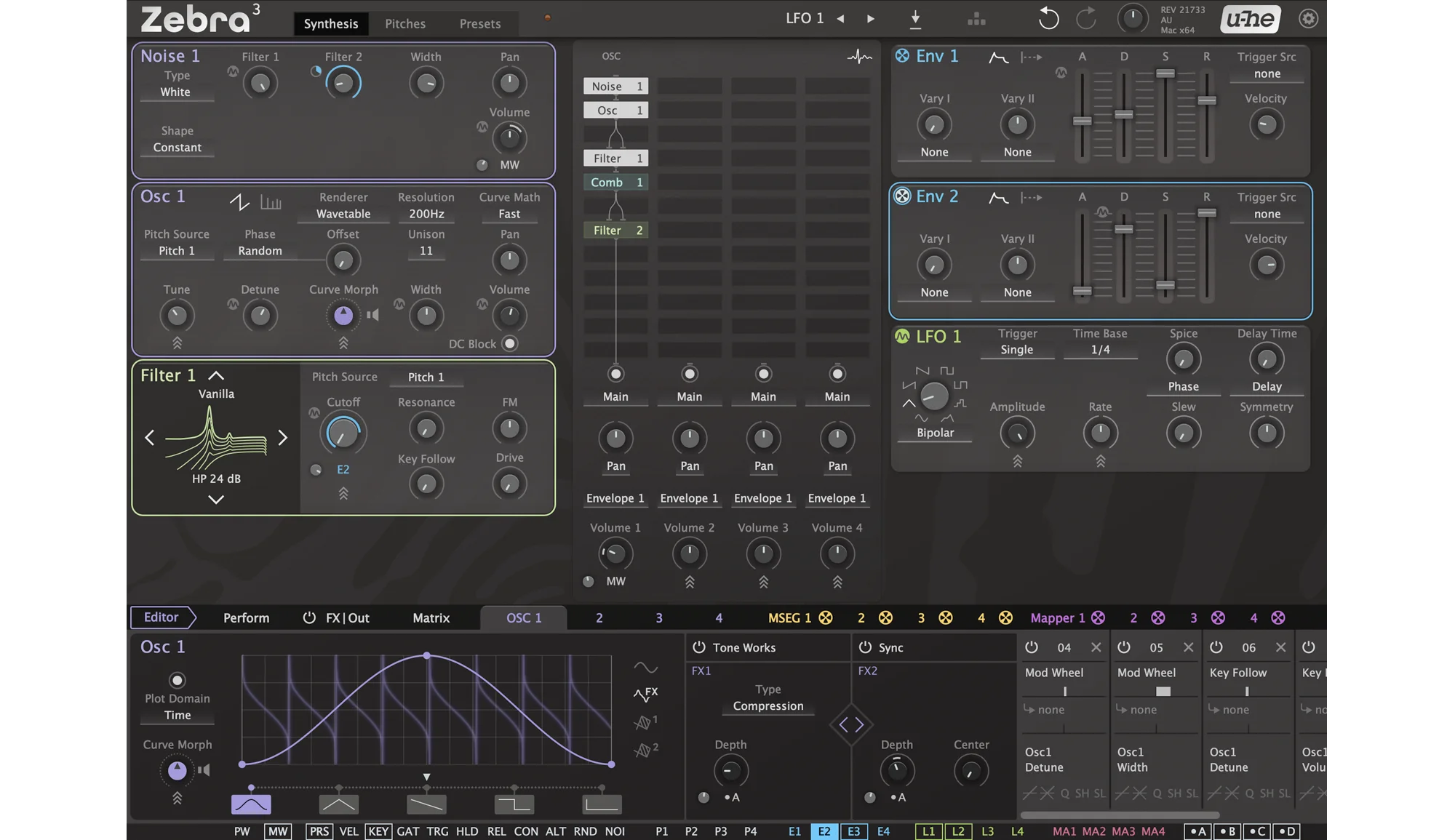
The Generator Rack has four main oscillators. Draw spline waveforms in the shared editor, then use them as classic wavetables with up to 16-voice unison or as additive engines with up to 1,024 partials, including inharmonic partials. Each oscillator has two serial effect slots with processes such as spectral decay, sync, phase remapping, filtering and phase distortion. For FM, four oscillators form freely chainable modulator-carrier pairs, and each can accept a rack signal as a third operator.
For physical-modeling patches, combine Noise or Exciter modules with Modal Resonators and comb filters. For example, a shaped noise burst or patterned pluck can excite a marimba or bell profile; route the result through a filter or comb reverb, or into an FM oscillator as a modulator. Vector mixers crossfade or XY-morph between four sources, while Scan mixers move through them in sequence.
Shape movement and performance
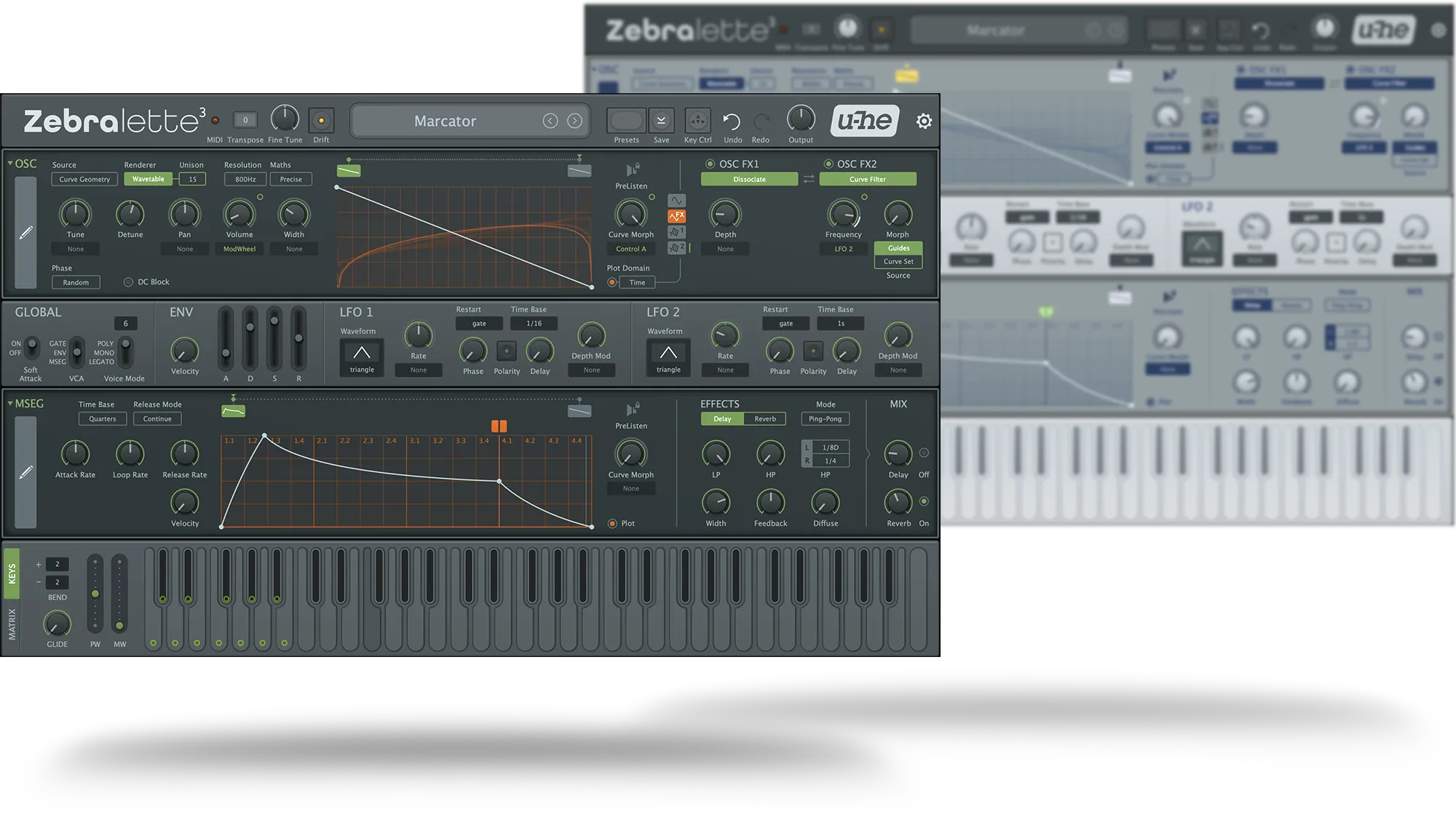
The Modulation Rack includes four ADSR envelopes, four LFOs and four MSEGs. MSEGs use the oscillator spline editor and can hold up to eight morphable curves along a shared timeline, with freely positioned loop points and attack, loop and release controls. An MSEG can also trigger an Exciter, so a shaped curve can create a patterned physical-modeling sequence.
Four Mappers reshape modulation through custom transfer curves, or act as step sequencers when triggered. Four Mod Math modules combine or transform signals before they reach a target. Separate Pitch modules control tuning, glide and quantization for up to four pitched parts within one voice.
Route effects after the voice
The FX Grid receives audio from four voice lanes through a Main bus and three auxiliary buses. Send levels are modulatable per voice, allowing effect depth to change across notes while the effects remain global. The grid includes tempo-synced delays, two reverb models, modulation effects, EQ, filters and compressors. Compressors can be placed in the grid to shape a reverb tail, control dynamics after modulation effects or create sidechain-style pumping within a patch.
Compatibility and license notes
Zebra 3 is a plug-in and requires a compatible host application; u-he says its plug-ins do not include standalone apps. The product page lists CLAP, VST3, AU and AAX formats and downloads for macOS, Windows and Linux; Zebra 3 requires OS X 10.13 or later in every format. u-he classifies its Linux plug-ins as beta and says Linux support is more limited, so check the current product requirements for your host and system.
Owners of a Zebra 2 license purchased before November 1, 2022 should check My Licenses for upgrade options. u-he says it does not currently offer a crossgrade path for Zebra Legacy owners.