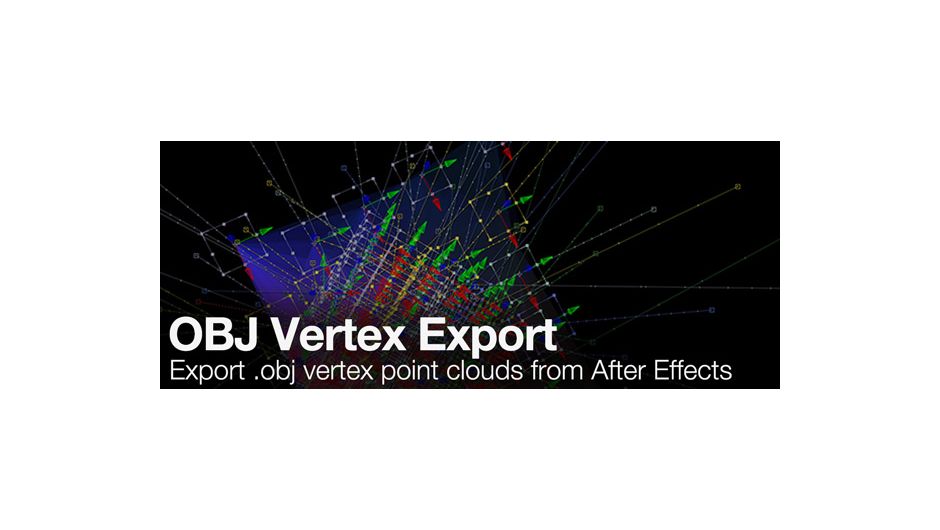
OBJ Vertex Export is an After Effects script by Fabian Morón Zirfas. It exports selected layer positions as a Wavefront OBJ vertex point cloud. The aescripts product listing describes its export options and the limits of several 3D applications.
Choose a frame or the work area
Select at least one layer. With the “seq” option unchecked, the script exports the selected layer positions at the current time. With “seq” checked, it exports positions across the work area and calculates expressions. In both modes, the export uses the selected layers.
Working with parented layers
The script calculates parented layer positions, though the listing says this takes longer. If you run into problems with parented animation, the author suggests baking it first with Bake Parented Transform.
Import behavior and limits
- Plexus: The listing says the exported OBJ files work out of the box.
- Trapcode Form: It can read the files, but its 3D space does not match After Effects exactly. The listing suggests turning off Normalize, matching Form’s X, Y and Z settings to the OBJ comp, then adjusting the Base Form center’s Z offset. The result may still be imperfect.
- Element 3D: The exported files contain vertices without faces, while Element 3D needs faces to read an OBJ. The listing also says Element 3D appears to read only positive values, and that its scale and position are offset.
- Blender: The author reports importing an OBJ as a point cloud but says they cannot provide reliable Blender import guidance. The listing says other 3D applications have not been tested.
Listed After Effects compatibility
The compatibility list names After Effects CC 2015, CC 2014, CC, CS6, CS5.5, CS5 and CS4. The version history shows version 0.3.1, dated June 22, 2015, with a note that it was ready for CC 2015. The listing does not confirm compatibility with later After Effects releases, so check the product page before relying on it in a newer setup.