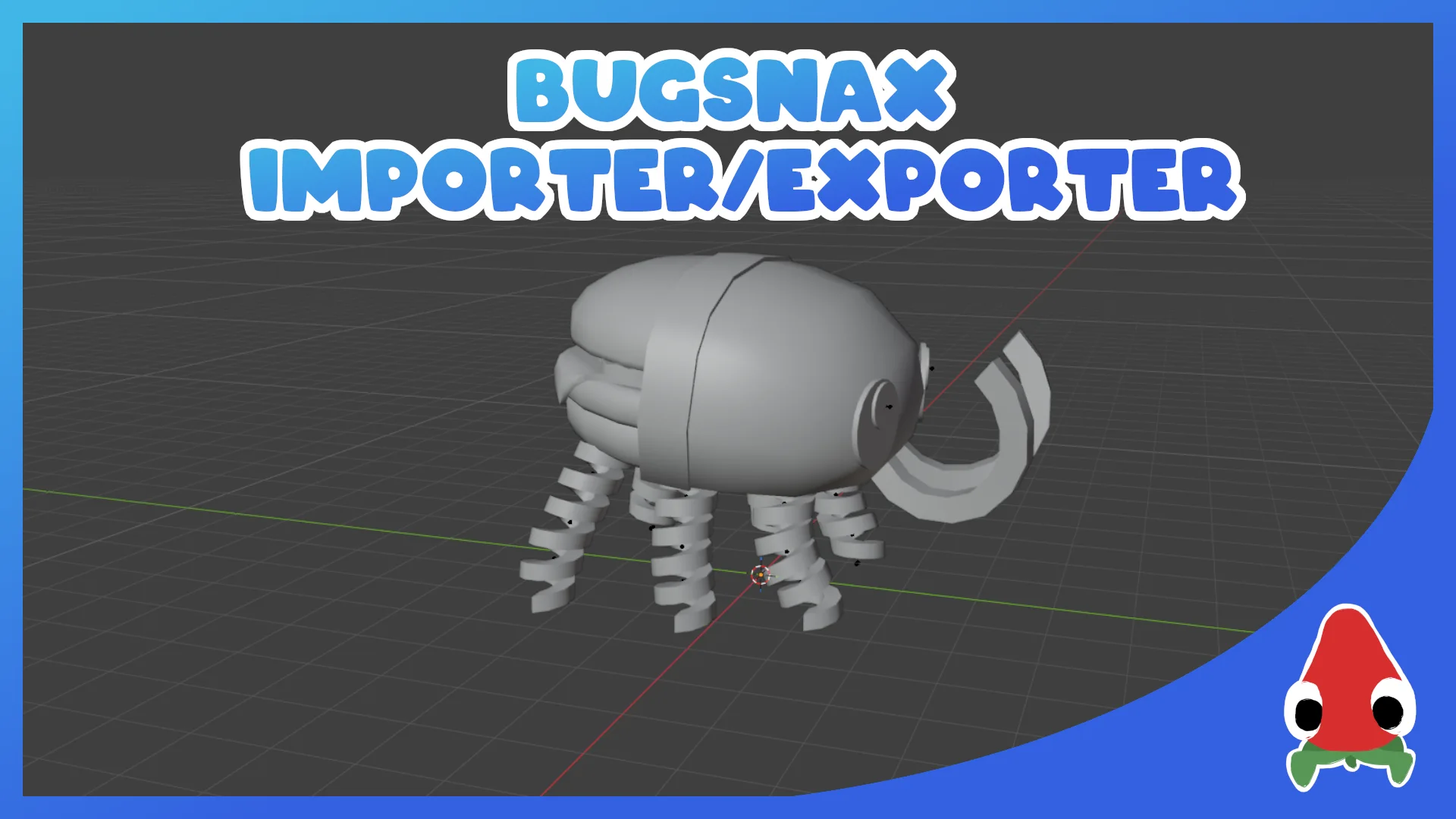
Bugsnax Cache Importer/Exporter is a Blender add-on for the cache files used by Bugsnax and Horsepower Engine. It reads and writes three formats through separate entries in Blender’s File > Import and File > Export menus. The choice of format matters: two store static meshes, while .xcache carries skinned-character data.
Supported cache formats
All three formats share the SEMS binary magic. Their contents differ:
| Format | Contents |
|---|---|
.objcache | Static mesh positions, normals, color and UV coordinates. |
.daecache | Static mesh positions, normals, color, UV coordinates, tangents and additional UV2 and UV3 layers. |
.xcache | Skinned-character mesh, skeleton, skin weights and animation. |
Importing static meshes and textures
For .objcache and .daecache, the importer creates a mesh object with a Principled BSDF material. It connects diffuse images to Base Color, normal images through a Normal Map node, and specular values to Specular IOR Level. Cache files use Y-up coordinates, so imported meshes are rotated to Blender’s Z-up convention.
Texture import and diffuse alpha handling are on by default. When a diffuse image contains transparency, the add-on connects its alpha channel and sets Alpha Clip with a 0.5 threshold. Fully opaque images stay solid. This supports cutout materials such as foliage and fences without making ordinary props transparent.
Importing skinned characters
The .xcache importer can build a rig with an armature, vertex-group weights and an animation action. You can import several .xcache files at once, split a file’s internal sub-meshes into separate Blender objects, weld coincident vertices and infer sharp edges from the imported normals. Options also control normals, UVs, materials and textures.
Bind Pose is the default rest-pose source. It reads inverse-bind matrices from the file’s SkinWeights data, which is the intended interpretation for Bugsnax .xcache files. Frame Hierarchy follows the FrameTransformMatrix chain; use it only if a file imports with a broken rest pose under Bind Pose.
Export behavior and format limits
The static formats hold a single mesh. During export, the add-on samples the current frame, bakes armature modifiers into vertex positions, evaluates shape keys at their current values, drops skin weights and ignores animation actions. For static export, Selected Only is off by default; otherwise, the exporter uses the first mesh in the scene. The export report notes when it strips data.
Static-cache round trips preserve structure, including vertex and face counts, texture references and the bounding box. The exported file may differ at the byte level because some metadata is regenerated, though the engine reads the result identically. The extra UV layers in a .daecache appear as Blender UV layers; keep their names intact to preserve them on export.
Use .xcache when the output needs a skeleton, weights or animation. Its exporter can write those elements, with frame start and end options for animation. The developer says .xcache imports and exports were validated against a large development corpus through Blender’s armature and pose system.
Version and compatibility
The Blender Extensions listing identifies version 1.0.2, Blender 4.2.0 as the minimum version, SaintBaron as the maintainer and GPL-3.0-or-later as the license. The 1.0.2 release notes include a fix that applies object transforms to exported vertices and normals, along with corrections to axis conversion and root-bone rotation for rigs with a non-identity rest pose.