EMT 140 style plate reverb
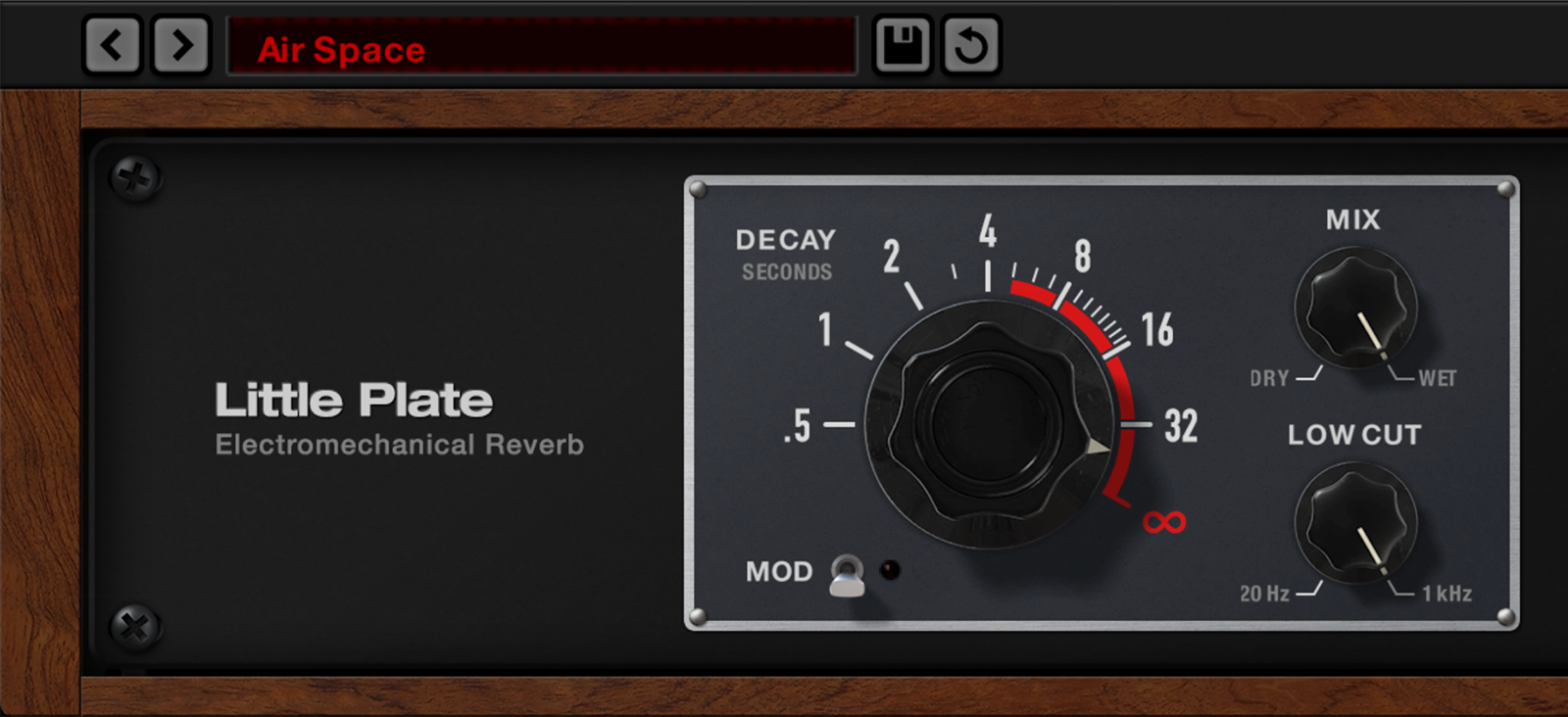
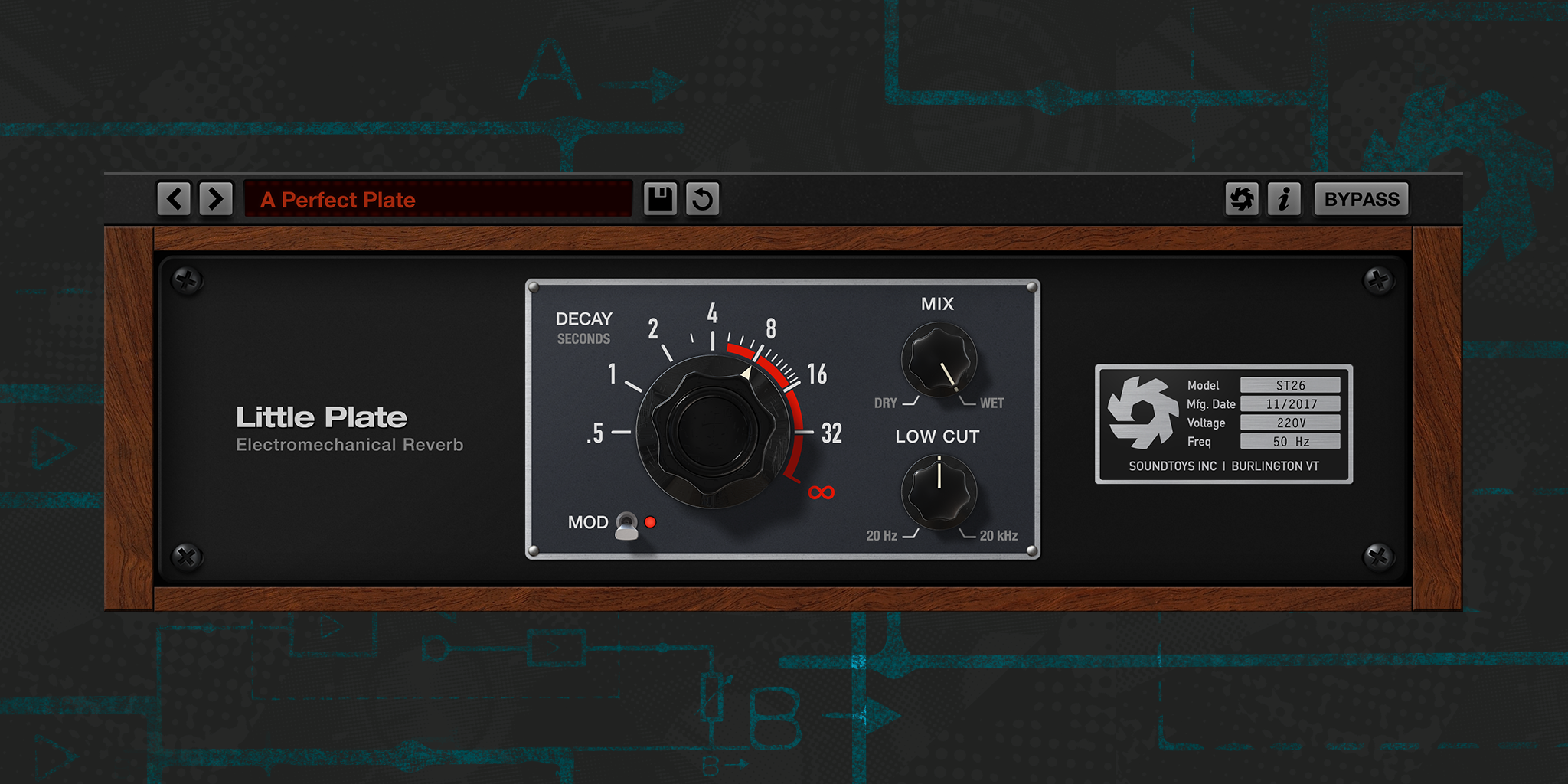
Little Plate is Soundtoys’ software take on the EMT 140 plate reverb. Its tail is dense, smooth and slightly dark, with a recognizable plate character rather than the reflections of a real room. The Little Plate manual explains how its Decay, Low Cut, Mod and Mix controls shape that sound.
Decay ranges from short settings for a tight tail to extended times. The longest finite setting is about one minute; the manual’s labeled decay times are RT60 measurements at 500 Hz. High frequencies fade faster than low frequencies, so longer settings can build up bass energy. Low Cut reduces low frequencies entering the reverb and leaves the dry signal unchanged.
Mod adds subtle pitch movement to the reverb tail. Soundtoys’ manual says this is especially audible on pitched sources such as keys, guitar and voice, and at longer decay settings. The product page lists 25 presets for starting points.
Aux send or insert
For a shared reverb, put Little Plate on an aux bus, set Mix to fully wet, and send several tracks to it. The manual recommends this setup: the tracks share one reverb return, which you can balance with its fader.
Little Plate can also run as an insert. Its Mix control is designed to bring up the reverb while keeping the dry signal mostly steady at first. Past about 70 percent, the dry signal begins to fall; at 100 percent, the output is fully wet. You can automate Decay to move into and out of infinite mode and hold a passage in the reverb.
Infinite decay and its limits
At infinity, the reverb tail does not fade away. It continues to change and darken, and later audio continues to affect it. This can work as a sustained texture or a live performance effect. Watch levels when feeding it sustained, loud material, since energy can build up in the reverb.
How to get Little Plate
Soundtoys says Little Plate is included with SuperPlate and the Soundtoys 5 bundle, and is not sold individually. SuperPlate includes Little Plate alongside five plate styles, including its Classic 140 model. If you already own a Soundtoys 5 license, check its bundle version: Soundtoys’ bundle version guide says Little Plate entered the bundle at version 5.3. The installer’s software version and your license’s bundle version can differ.
Formats and compatibility
Soundtoys lists 64-bit AAX Native, AAX AudioSuite, VST 2, VST 3 and Audio Units formats. Its product page lists OS X 10.15 or later and Windows 10 or later, Apple Silicon compatibility, and no support for ARM-based Windows machines. An internet connection is required during activation.
The Soundtoys compatibility list gives these minimum host versions: Pro Tools 2020, Logic Pro 10.7, Ableton Live 11, Studio One 5, Cubase 12, Nuendo 12, Reaper 7, Bitwig Studio 5 and FL Studio 2025.1. The plug-in format depends on the host and operating system; also check your DAW’s own system requirements, since Soundtoys cannot guarantee support when the computer or operating system falls outside the DAW’s supported setup. Soundtoys says an unlisted host or older host version may still work, but those configurations are untested; its free trial can check compatibility on your computer, and support cannot guarantee a solution if something goes wrong.
Little Plate fits a mix that calls for one EMT 140 style reverb with extended decay, modulation and a practical aux workflow. Compare it with SuperPlate if you need a wider selection of plate models.