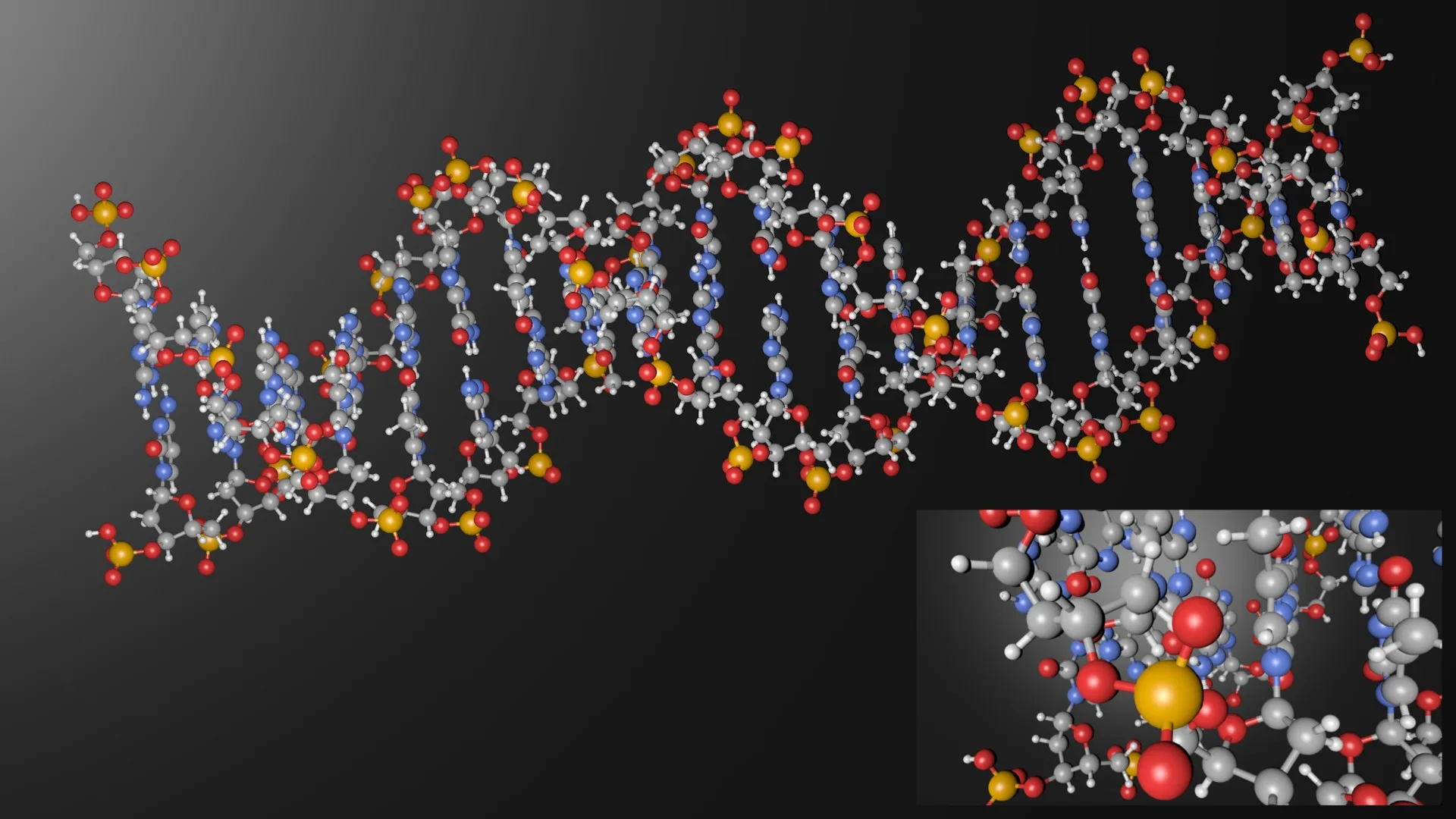
Point Cloud I/O adds import and export for E57, PLY, LAS, LAZ, PCD, XYZ and PTS files in Blender. It creates native Blender PointCloud objects and carries supported per-point data, including color, normals, intensity, classification and return numbers, into attributes you can use with Geometry Nodes or shaders.
Version 0.6.0 supports Blender 5.1 and newer. The extension uses Blender's optimized PointCloud geometry, which its listing says handles million-point datasets smoothly.
Supported point-cloud formats
| Format | Import and export details |
|---|---|
| E57 | Reads and writes E57 files, including multi-scan files. Each imported scan can become its own PointCloud object, or you can merge the scans. Export writes one scan per selected PointCloud. |
| PLY | Reads ASCII and binary files in little- or big-endian form. Positions, colors, normals and other per-vertex scalar properties become point attributes. This importer creates a PointCloud object; Blender's built-in Stanford PLY importer creates a mesh. |
| LAS and LAZ | Reads positions, RGB, intensity, ASPRS classification and optional multi-return information. LAZ decompression uses the bundled lazrs codec. Export writes LAS 1.2 Point Data Record Format 3, with an option to compress as LAZ. |
| PCD | Supports ASCII, binary and binary_compressed (LZF) data, including packed RGB or RGBA, normals, intensity and other per-point scalar fields. |
| XYZ | Accepts .xyz, .txt and .csv files. It detects comma or whitespace separators and infers common column layouts for positions, intensity, color and normals. Other columns can be retained as extra float attributes. |
| PTS | Reads and writes Leica Cyclone text files with a point-count header. The importer detects 3, 4, 6 or 7 columns. Intensity is normalized to 0–1 on import and scaled back to the Leica 0–2047 range on export. |
Point attributes and export controls
Version 0.6.0 adds a Source Attributes section to export dialogs. For each channel supported by the chosen format, you can use automatic matching, omit the channel, or select a compatible attribute, including one created with Geometry Nodes. Automatic matching ignores case and punctuation and recognizes common aliases such as scalar_Intensity, reflectance, amplitude, Col and diffuse_color.
The exporter lists attributes the output file will leave behind before export and reports them again afterward. For PLY, otherwise unclaimed vector and color attributes are written as component columns. Scalar channels can use integer and Boolean attributes, while color channels can use three-component vectors and byte colors.
Viewport display and point radius
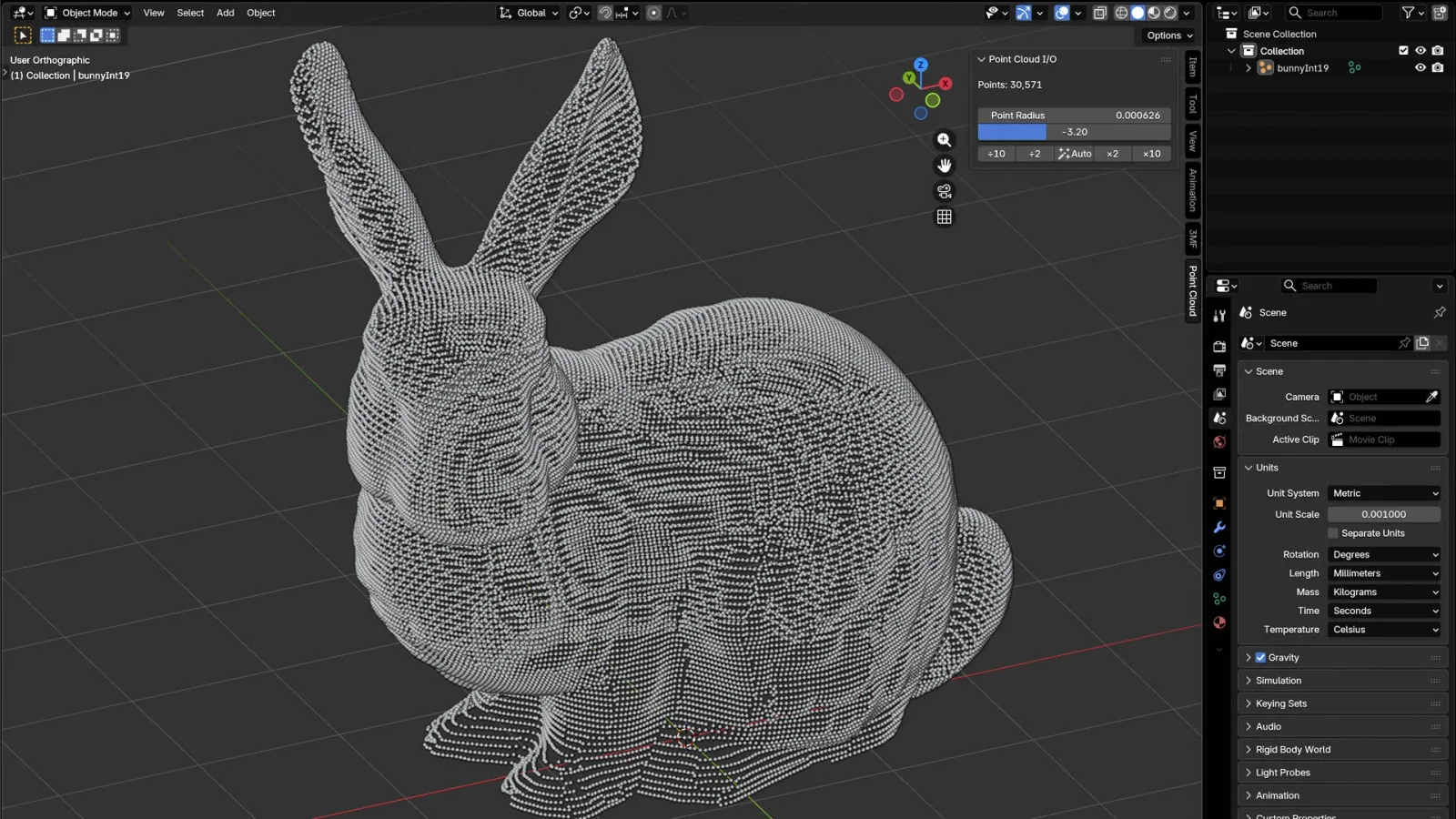
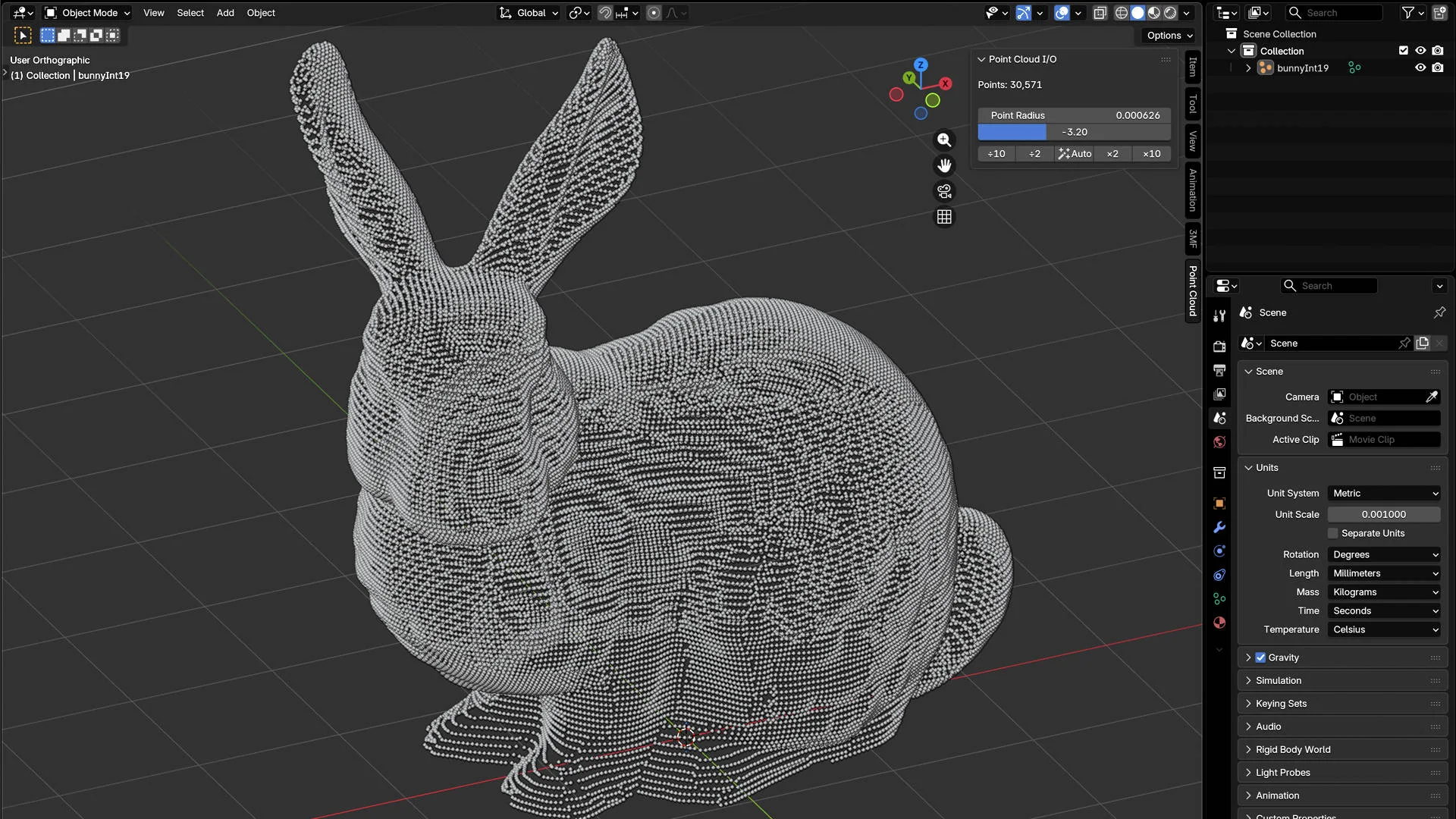
On import, the extension can create a Principled BSDF material connected to the imported color or normal attribute, so points display in Material Preview and Rendered shading. Auto Point Radius estimates a usable radius from the cloud's bounds and density. Press N in the 3D Viewport and open the Point Cloud tab to see point count and attributes, then adjust radius with its logarithmic slider or quick controls. The panel also works with active PointCloud objects made by Geometry Nodes or other add-ons.
LAS coordinates and format limits
Georeferenced LAS data can have coordinates far from Blender's origin. With Center on Origin enabled, the importer subtracts the data minimum and stores the offset as las_origin_offset. Export adds that offset back to preserve the original coordinate reference system.
- E57 export does not write normals because the pye57 writer does not expose the required fields. The imported normals remain available as an attribute inside Blender.
- LAS export uses a fixed 1 mm scale, which quantizes positions to millimeter precision. The listing warns that very large coordinate ranges may clip.
- Points with NaN positions are dropped on import.
- The bundled pye57 and lazrs wheels cover macOS Apple Silicon, Linux x86_64 and Windows x86_64. The listing says Intel Mac users need to build those wheels from source.
Installation and requirements
In Blender, open Edit > Preferences > Get Extensions, search for Point Cloud I/O and select Install. The extension requests permission to read and write point-cloud files. It bundles pye57, pyquaternion, laspy and lazrs wheels for the listed platforms, so installation does not require internet access or a manual pip step. PCD and XYZ use Python and numpy without additional wheels. The extension is licensed under GNU GPL version 3.0 or later.
Check the Blender Extensions listing for the current version and installation details, or visit StudioMedio's source repository for code and development information.