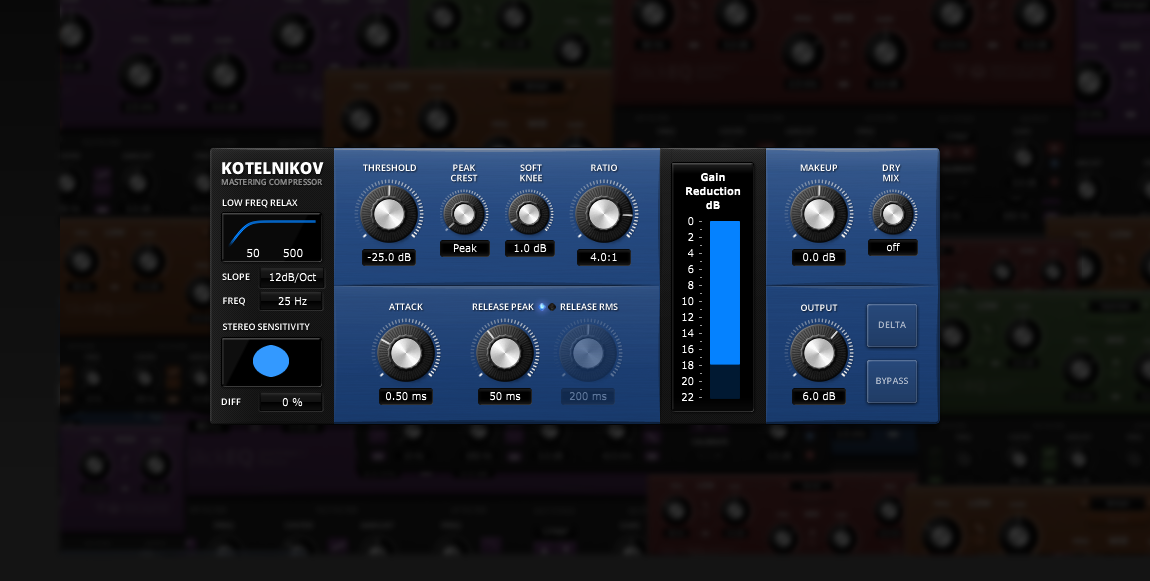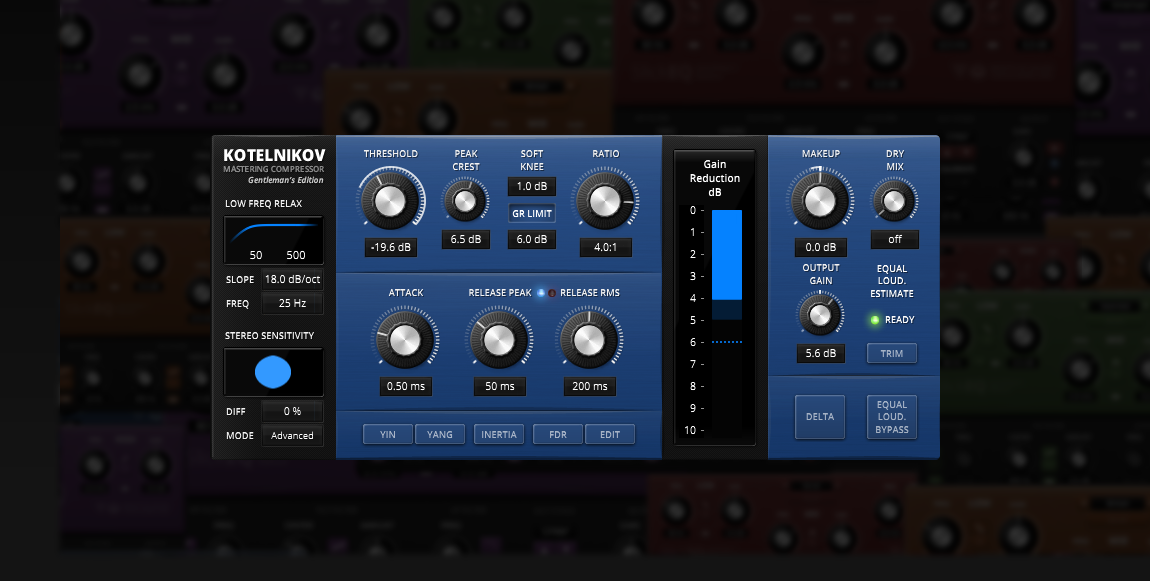
TDR Kotelnikov GE is a wideband compressor for stereo bus compression, mastering, and other mix work. It is designed to control dynamics while retaining the signal’s tone and punch. Its peak and RMS detection paths, stereo linking controls, and frequency-dependent ratio give more control over complex material than a single attack-and-release pair. The Kotelnikov GE manual explains how those controls interact.
Tokyo Dawn Labs lists the standard Kotelnikov separately as freeware and sells Kotelnikov GE as a licensed edition. GE adds frequency-dependent ratio, equal-loudness functions, and additional quality modes. Its external sidechain input lets a separate key signal drive compression; route that signal through the host and select EXT SC. Setup varies by format and host: VST2 requires a host that supports multi-input plug-ins, and AAX sidechains are mono. See the official product page for current product details.
Separate control for peaks and sustained levels
Kotelnikov GE runs peak and RMS compression paths in parallel. The peak path responds to short, high-level events; the RMS path follows sustained energy. The path asking for more gain reduction controls the compressor at that moment. Separate Peak Release and RMS Release settings let you shape recovery from transients and sustained compression independently. Peak Crest shifts the peak path’s threshold relative to the RMS threshold, changing how strongly the compressor responds to transients.
For complex material such as full mixes, the manual gives Peak Release values of 25-100 ms and RMS Release values above 150 ms as starting guidance. These are suggestions to adjust by ear for the source, Peak Crest setting, and desired compression.
Frequency shaping and level-matched comparison
The Low Frequency Relax control changes how much low-frequency content affects compression detection. Its filter ranges from 25 to 500 Hz, with selectable slopes, so you can reduce low-end triggering without using an audio equalizer on the signal itself. Frequency Dependent Ratio (FDR) changes the compression ratio across a selected frequency curve, including shelf, bell, and equal-loudness shapes. It works differently from sidechain filtering, and its audible effect increases with gain reduction.
GE adds equal-loudness trim and bypass for comparing processed and unprocessed levels. Wait for the estimation indicator to settle before relying on those functions: the manual identifies green as a stable estimate and blue as a close input/output loudness match. Delta monitoring plays the difference between the original and compressed signals. Dry Mix blends the original signal with the compressed signal for parallel compression without separate DAW routing.
Processing and compatibility
Stereo linking controls how detection follows the left and right channels. Basic is the legacy mode; Advanced offers greater fidelity in complex stereo and uses less CPU, but DIFF no longer affects the RMS path in Advanced. Eco, Precise, and Insane quality modes trade CPU use for inter-sample accuracy; Live is the low-latency option. The vendor lists Windows 7 or later, macOS 10.9 or later, OpenGL support, and a VST2, VST3, Audio Unit, or AAX-compatible host.
The product page offers a demo, which blocks automatic recall. Tokyo Dawn Labs asks buyers to confirm the demo runs on their system before purchase and states that sales are final. Its EULA describes a personal or small-business license for one user, usable on up to five single-user computers; each user on a multi-user server or network needs a separate license.