What TDR Kotelnikov does
TDR Kotelnikov is a wideband compressor for controlling dynamics while preserving a signal's tone, timbre and punch. Tokyo Dawn Labs recommends it for stereo bus compression and other critical dynamics work. Its digital processing does not emulate vintage hardware. The developer says the oversampled Delta path is bit-transparent when gain reduction is at 0 dB.
How its dynamics controls work
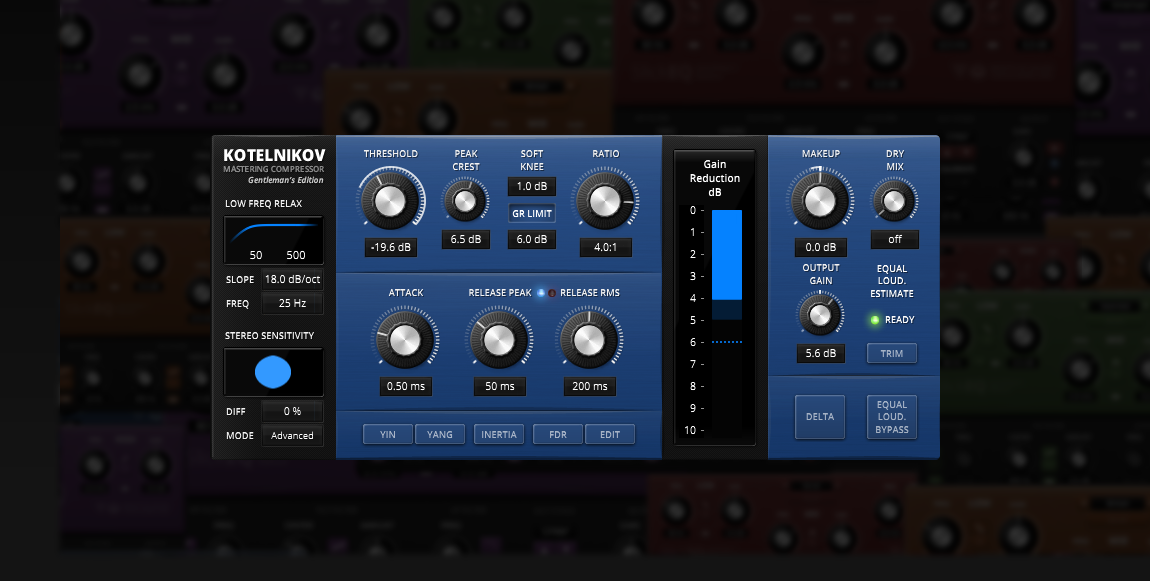
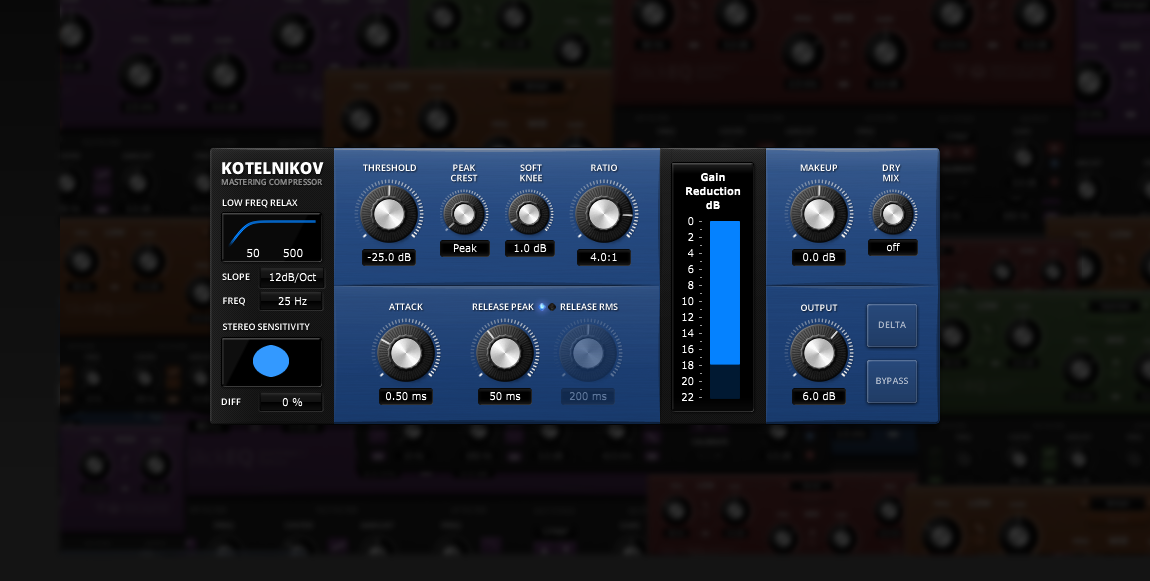
Kotelnikov runs separate peak and RMS detection paths in parallel. The peak path responds to short transients; the RMS path follows sustained signal energy. Peak Crest changes the threshold relationship between the two paths. Separate Release Peak and Release RMS controls let transients recover quickly while sustained material recovers more slowly. The plug-in selects the path producing the greater reduction, and its release LEDs show which path is active.
Low Frequency Relax adjusts how strongly bass affects the compressor's detector. Stereo Sensitivity changes how left and right channel content feeds detection. The manual says Kotelnikov never changes the left and right channel gains independently because doing so would blur the stereo image. These sidechain controls affect compression behavior rather than directly changing the signal's tonal balance.
A practical mix workflow
- Load the default preset, play the material and lower Threshold until the gain-reduction meter responds on louder passages. Use Ratio to set how strongly the signal is compressed above threshold.
- Set Attack to shape transient response. Faster attacks can tame peaks, while slower attacks let short events pass with less reduction. The manual cautions that very fast attack times can distort low-frequency content.
- Adjust Release Peak for brief overloads and Release RMS for sustained reduction. For complex full mixes, the manual suggests Release Peak between 25 and 100 ms and Release RMS above 150 ms; the effective timing depends on the signal and Peak Crest setting.
Use Makeup to compensate for level lost through compression, then use Delta mode to hear the difference between the original and processed signal. Dry Mix blends the unprocessed signal back in for parallel compression without separate DAW routing. The Kotelnikov manual covers the controls in detail and includes a starter walkthrough.
The manual describes Eco and Precise processing modes with approximately 100 kHz and 200 kHz internal bandwidth. Higher-quality processing uses more CPU, so the modes give you a choice when balancing processing quality against available resources.
Compatibility and editions
Kotelnikov runs inside an audio plug-in host rather than as a standalone application. The product page states requirements of Windows 7 or later and Mac OS X 10.9 or later. It lists a Windows installer, a Windows no-installer archive and a macOS package. Its format table includes 32-bit VST2 and VST3, along with 64-bit VST2, VST3, AAX and AU builds. Check that your host supports the format and architecture you plan to install.
Tokyo Dawn Labs lists standard Kotelnikov as freeware. Its installation guide says TDR Collector prompts users to accept the freeware EULA before installation. The separate Kotelnikov Gentleman's Edition adds equal-loudness workflows and frequency-dependent ratio, which are not listed as features of the standard edition.