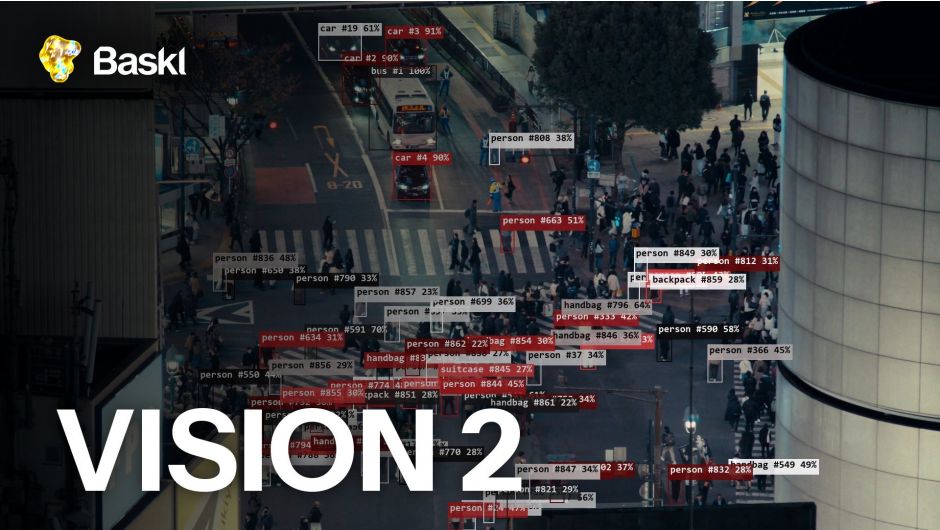
Vision 2 is Baskl.ai’s AI vision plugin for After Effects, Premiere Pro, DaVinci Resolve and Nuke. It processes footage locally on the CPU or GPU; the listing specifies Windows with an NVIDIA GPU and macOS on Apple Silicon. By analyzing frames and drawing what its models detect, it creates graphic overlays and glitch effects for surveillance-style interfaces, object-led effects and other VFX treatments.
Turn detections into graphic elements
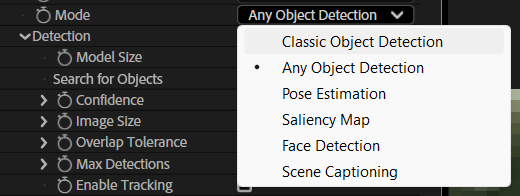
The developer describes six detection modes, with examples that include classic object detection, pose estimation, saliency mapping, face detection and scene captioning. Classic detection covers 80 everyday object classes and tracks them frame to frame, keeping each object’s number. Pose estimation draws a skeleton over each body, while a saliency map shows the model’s attention as a heatmap. Face detection can add boxes and network lines, and scene captioning places a sentence about the frame on screen.
Use Search for Objects to limit detection to items selected with a few words. This can keep the overlay focused when a shot contains several kinds of objects. Network Lines can connect nearby detections with straight or curved lines for a control-room style graphic.
Customize detection overlays and render output
Presets include Faces Network, Terminator and Floating Boxes On Transparent. Ten palettes are available, and the visual controls include fonts, line width, fill, corner radius and label colors. Confidence, model size and maximum detections are exposed as effect controls, so they can be adjusted or keyframed with the rest of an After Effects composition.
Render options include On Image, On Black and On Transparent. With a black or transparent output, the detection boxes can sit on their own layer and work as a matte for other effects. For example, a distortion effect can use the detections as its mask so the glitch follows objects through the shot.
Read the performance figures in context
Baskl’s published comparison measures Vision 2.1.14 against 2.2.0 on an Apple M1. It reports pose estimation at HD going from 809 to 35 milliseconds per frame, and tracking at 4K going from 580 to 134 milliseconds per frame. These are Baskl’s figures for those modes on an Apple M1; the comparison does not report results for other hardware.