What TEOTE changes
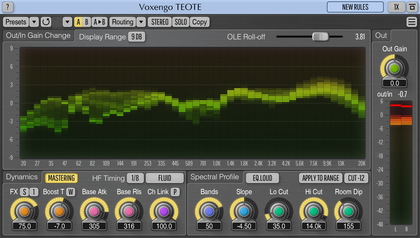
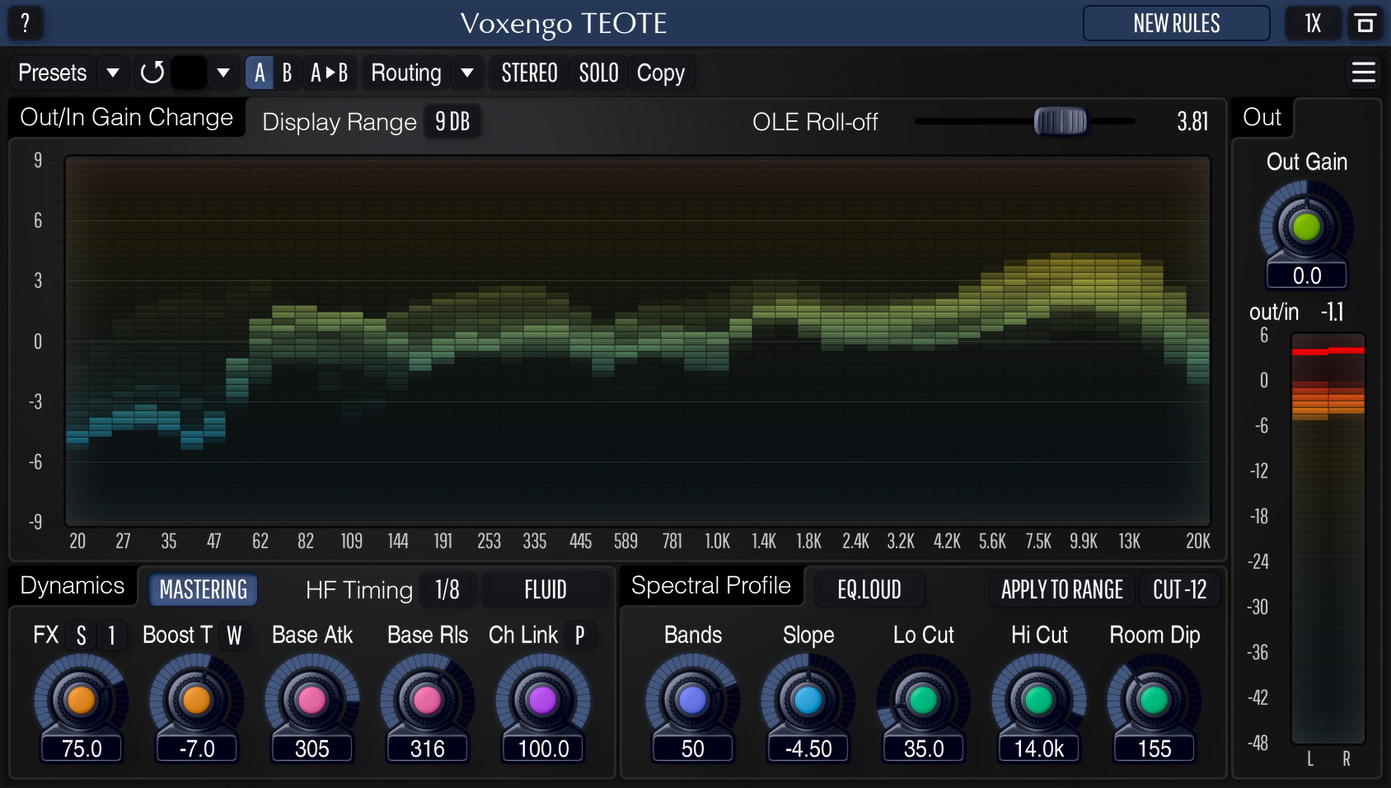
Voxengo TEOTE is a dynamic multiband spectral balancer for mixing and mastering. It estimates the momentary spectrum against an overall weighted loudness level, then adjusts gain across bands to move the material toward a target spectral profile. Its supplied profile is aimed at contemporary mastering, with Slope controlling the overall tilt. The user guide identifies -4.5 dB per octave as a common mastering slope.
TEOTE uses multiband dynamics rather than conventional EQ filters. Its profile controls set a reference for gain changes; they do not apply static filters. Voxengo describes uses such as gentle resonance smoothing, de-essing, and tilt-style tonal adjustment.
Set the processing to the source
- Band count trades detail for CPU use. Voxengo suggests higher values for mastering and lower values on individual tracks. A low count may miss sharp resonances, while a high count can make material sound overly sterile. TEOTE generally smooths resonances rather than removing them completely.
- FX sets the strength of the effect. Boost T controls how band gain changes behave after reaching a threshold: they can return to unity, become limited, or taper gradually, depending on the selected mode. The manual recommends tuning this control for highly dynamic or narrow-band material to avoid over-boosting quiet passages and the noise floor. Setting Boost T to zero enables compression-only operation.
- Lo Cut and Hi Cut shape the target profile with frequency roll-offs; Apply to Range instead restricts processing to a selected frequency range. Lo Cut and Hi Cut can reduce over-reaction when a source lacks spectral content, while Apply to Range can be used on narrow-band input. The guide warns that sparse material can cause its few existing components, such as cymbal hits, to receive large boosts.
Place it in the processing chain
Voxengo recommends putting TEOTE after EQ and dynamics processing, then before the final clipper or mastering limiter. A follow-up EQ can shape the spectrum after balancing, and a preliminary static tilt EQ may be needed. Since TEOTE follows the momentary spectrum, its output may not match the target profile over an entire track; adjust Slope or use preliminary tilt EQ when needed.
TEOTE supports stereo and multichannel processing, with internal routing and channel grouping. In stereo, Ch Link controls how much the channels follow each other. Fully unlinked processing adjusts channels independently and uses more CPU; it can skew the stereo image and may miss TEOTE’s overall spectral-balance goal. Voxengo suggests keeping channel linking near 100 for most material.
Compatibility and trial limits
Voxengo provides plug-in builds for AudioUnit, AAX, VST, and VST3 hosts. Its Mac download is AU, AAX, and VST3; its Windows download is VST, VST3, and AAX. Choose a format supported by your host. Voxengo lists native Apple Silicon support and macOS Sonoma, Sequoia, and Tahoe support. Its stated minimum computer requirements are a 2.5 GHz dual-core processor and 4 GB of RAM.
TEOTE is offered as trial software. In demo mode, output is muted briefly every 45 seconds. Voxengo says demo authorization uses a text product key and does not require an internet connection or a dongle.