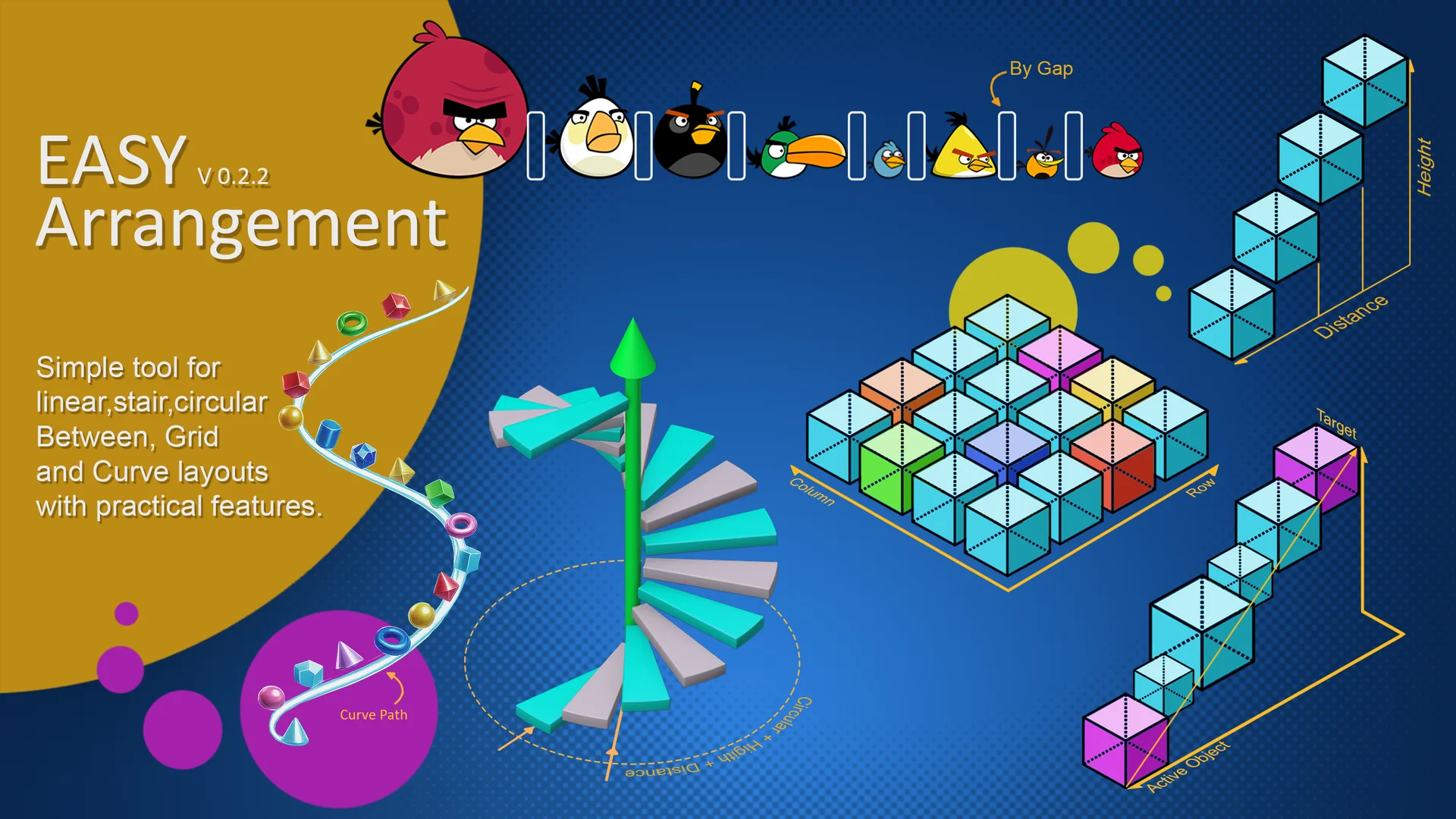
Circular Stacker is a Blender add-on by Hydrocallis that distributes selected objects in a circular, donut-shaped pattern. It creates as many circles as needed to fit the selection, making it useful for arranging repeated objects around a center or across stacked rings.
Shape the arrangement
Radius controls the size of the arrangement, height increment sets the vertical step between stacked circles, and the overall rotation changes the arrangement's angle. The Face Center option turns objects toward the middle.
For variation between objects, use per-object Z rotation or Z offset. Z rotation changes individual object orientation. A Z offset per object changes height through the sequence and can produce a spiral-like arrangement. Sorting by name before placement can make the order more predictable.
Control which positions are filled
Skip Mode provides two ways to leave spaces in the layout. By Count skips a specified number of positions. The custom Skip pattern List uses 1s and 0s: 1 places an object, while 0 skips a position. For example, 101011 describes a repeating sequence with gaps at the zero positions.
Use the count option when the gap size should stay regular. Choose a custom pattern when you want the placement sequence to repeat in a particular way. These controls can be combined with the radius and rotation settings to adjust the overall ring layout.
Run the operator in Blender
Select the objects in the 3D Viewport, then run Object > Transform > Distribute Objects in Circular Stack. Set the radius, height increment and rotation for the layout. Enable Face Center when the objects should turn toward the middle, or use per-object Z settings for additional variation.
For a simple ring, start with the radius and overall rotation. Add a height increment when you want multiple circles at different levels. Use Skip Mode to introduce gaps or a repeating placement pattern.
Compatibility and download
The Blender Extensions listing for Circular Stacker identifies version 1.0.0, Blender 4.2.0 as the minimum version, and a GNU GPL v3.0 or later license. The listing provides the extension download. For installation from an archive, see the Blender Manual's Install from Disk instructions. The developer's issue tracker is available for reporting problems.