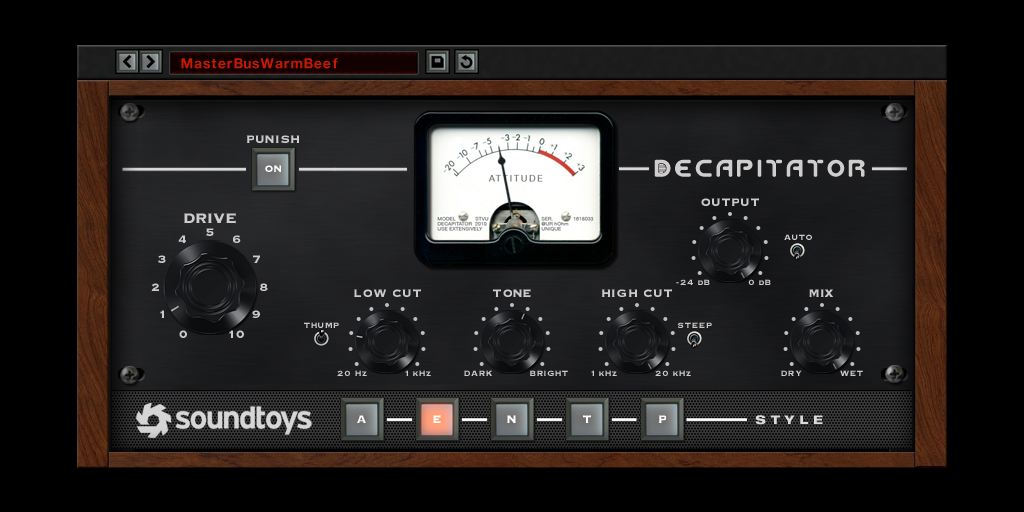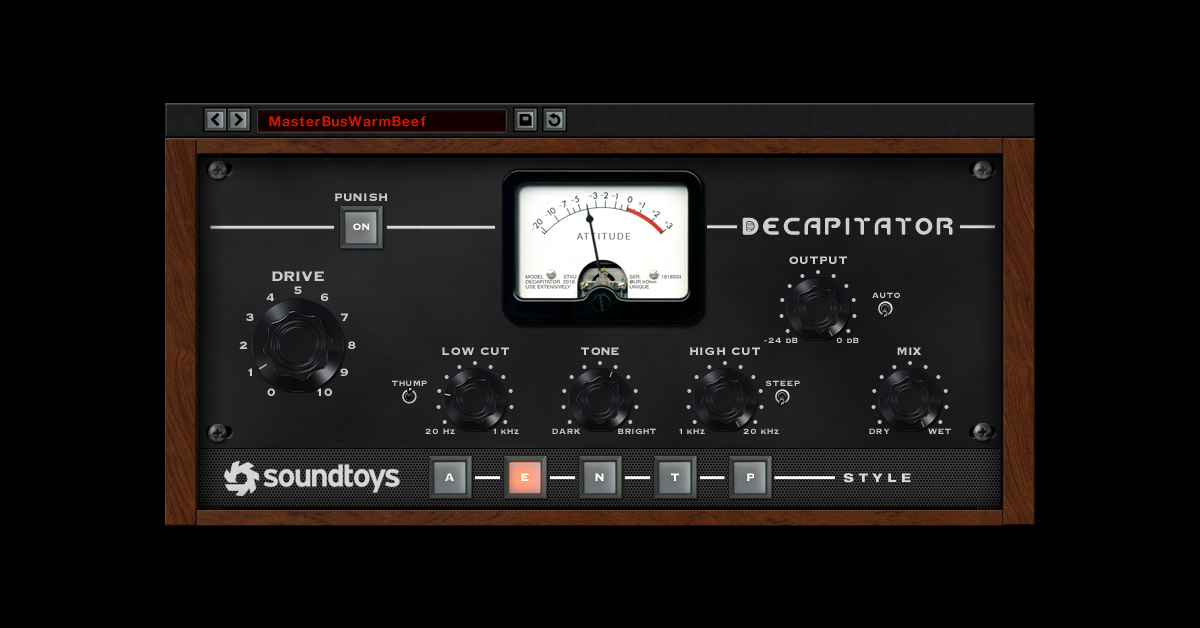
Decapitator is a saturation and distortion plug-in for adding analog-style character to tracks. Its five models respond differently as you raise Drive. Tone and Low Cut shape which frequencies reach saturation; High Cut filters the distorted signal afterward, while Mix blends the dry and saturated signals. Soundtoys lists vocals, drums, guitars and synths as possible sources. See the Decapitator product details and the user guide.
Five modeled styles
The user guide describes these hardware-derived models:
- A models an Ampex 350 tape preamp, with smooth tube-driven distortion.
- E models the Chandler/EMI TG Channel, with a weighty low end and smooth, airy top end.
- N models a Neve 1057 input channel, with weighty lows, focused mids and germanium-transistor character.
- T models the Culture Vulture triode setting. The guide describes it as warm and punchy. Triodes typically add even harmonics, and this setting can add attitude to drums and other percussion.
- P models the Culture Vulture pentode setting, which has a different, odd-harmonic distortion character.
Shape the saturation
Choose a style, then raise Drive to push more signal into its model. Drive also raises the output level, so use Auto to reduce output as Drive increases, or trim the Output control yourself. Punish adds 20 dB of gain to the signal sent through the plug-in, making it useful when you want more extreme distortion; watch the output level when you engage it.
Tone is a gentle tilt control before the saturation stage. Its Dark setting boosts lows and reduces highs; Bright does the reverse, changing which frequencies are driven into distortion. Low Cut also filters before saturation. High Cut works after saturation to tame bright or fizzy distortion. Thump adds a low-frequency boost at the Low Cut frequency. The Steep switch changes the High Cut slope from 6 dB to 30 dB per octave.
Mix blends the dry signal with the saturated signal for parallel processing without separate DAW routing. This can bring back some of the original transients when heavy saturation softens them.
Who it suits
Decapitator fits producers and mixers who want to add anything from restrained saturation to obvious distortion on individual tracks. The five styles provide different tonal starting points, and the pre- and post-saturation controls let you shape how the effect treats a source.
It is not a guitar amp emulator. The guide describes one cabinet-like filtering approach for direct guitar: switch Steep on and set High Cut around 4 to 5 kHz.
Compatibility and activation
Soundtoys lists 64-bit AAX Native, AAX AudioSuite, VST 2, VST 3 and Audio Units formats, with sample rates from 44.1 to 192 kHz. Its stated system requirements are macOS 10.15 or later and Windows 10 or later. The product is Apple Silicon compatible, does not support ARM-based Windows machines, and requires an internet connection during activation.
Check Soundtoys' supported host list for DAW and version details. Soundtoys says an older or unlisted host may still work, but has not been tested; it recommends using the free trial to check compatibility with your setup.