Kilohearts Ensemble creates a unison-style layer from delayed copies of an audio signal. It also modulates each voice’s phase to reduce the metallic flanging that can come from near-identical waveforms. This suits producers who want to make one source sound like several voices or add stereo spread.
Shape the layered sound
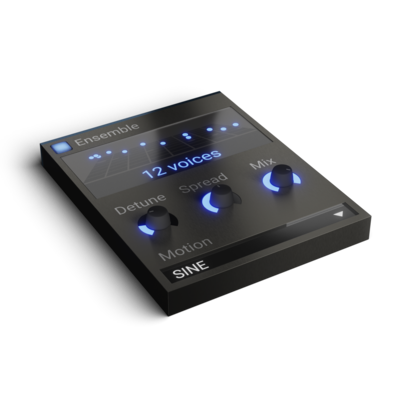
Set Voices to choose how many voices play at once. Detune controls how quickly each voice’s delay is modulated, which affects how detuned the layers sound. Spread pans voices across the stereo field, while Motion selects a modulation pattern. Use Mix to balance the processed sound with the original signal.
For a light widening effect, keep some of the dry signal in the mix and adjust Spread to taste. For a more pronounced unison layer, raise the voice count and adjust Detune. The Ensemble manual describes each control.
Use it as a plugin or Snapin
Ensemble can run as a regular DAW plugin or load as a Snapin inside Kilohearts hosts such as Phase Plant, Multipass and Snap Heap. In a host, Snapins can be combined and modulated as part of a larger effect or instrument patch.
Kilohearts lists VST2, VST3, AAX and Audio Unit support. Its minimum recommended system requirements call for a 64-bit x86 processor with SSE3 support, or Apple M-series support on macOS, and a DAW that supports one of those plugin formats. Kilohearts recommends keeping the OS up to date and cannot support OS versions their manufacturers no longer support; check the current system requirements if you use an older OS.
Access and licensing
Ensemble is included in Kilohearts Essentials, which Kilohearts offers free with an account. Kilohearts’ standard system requirements list no licensing hardware. Its Slate Digital installer versions use iLok licensing and require a valid Slate Digital license. See the Kilohearts Essentials details for the collection and the installation instructions for account and installer setup.