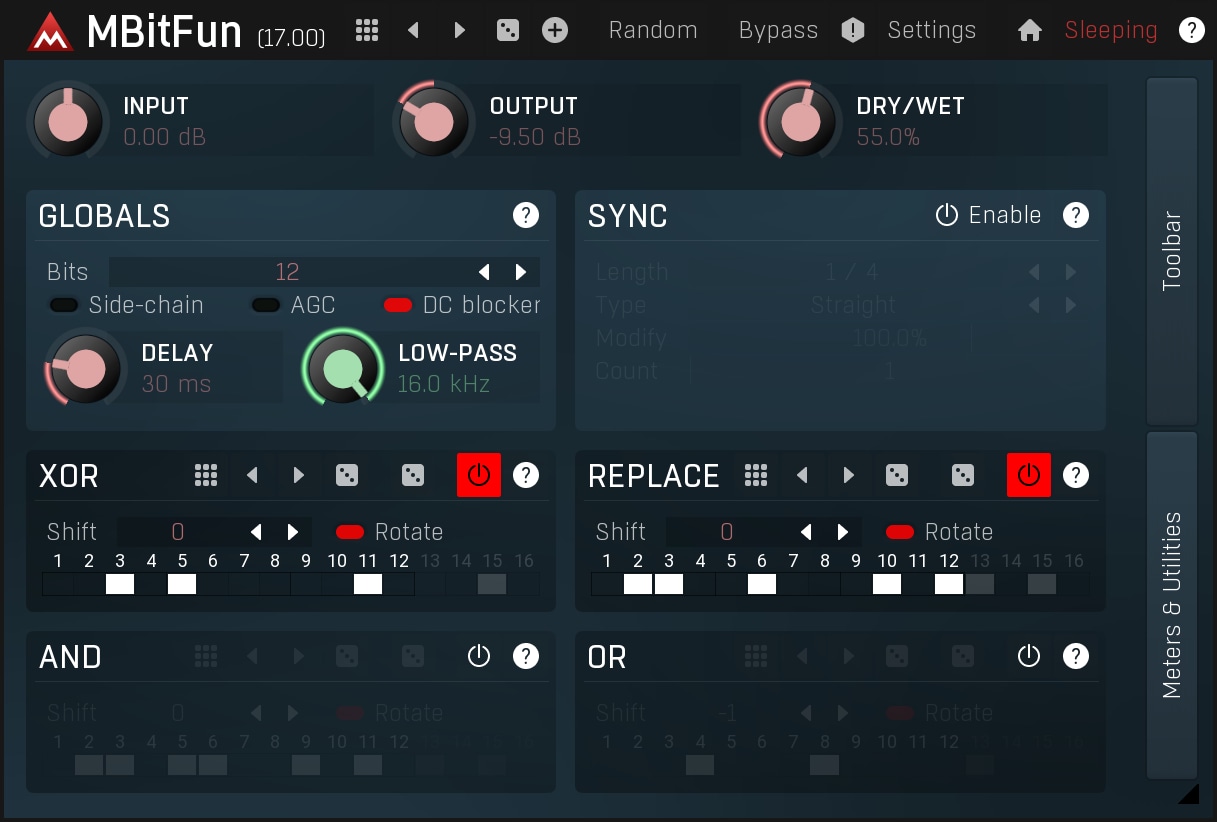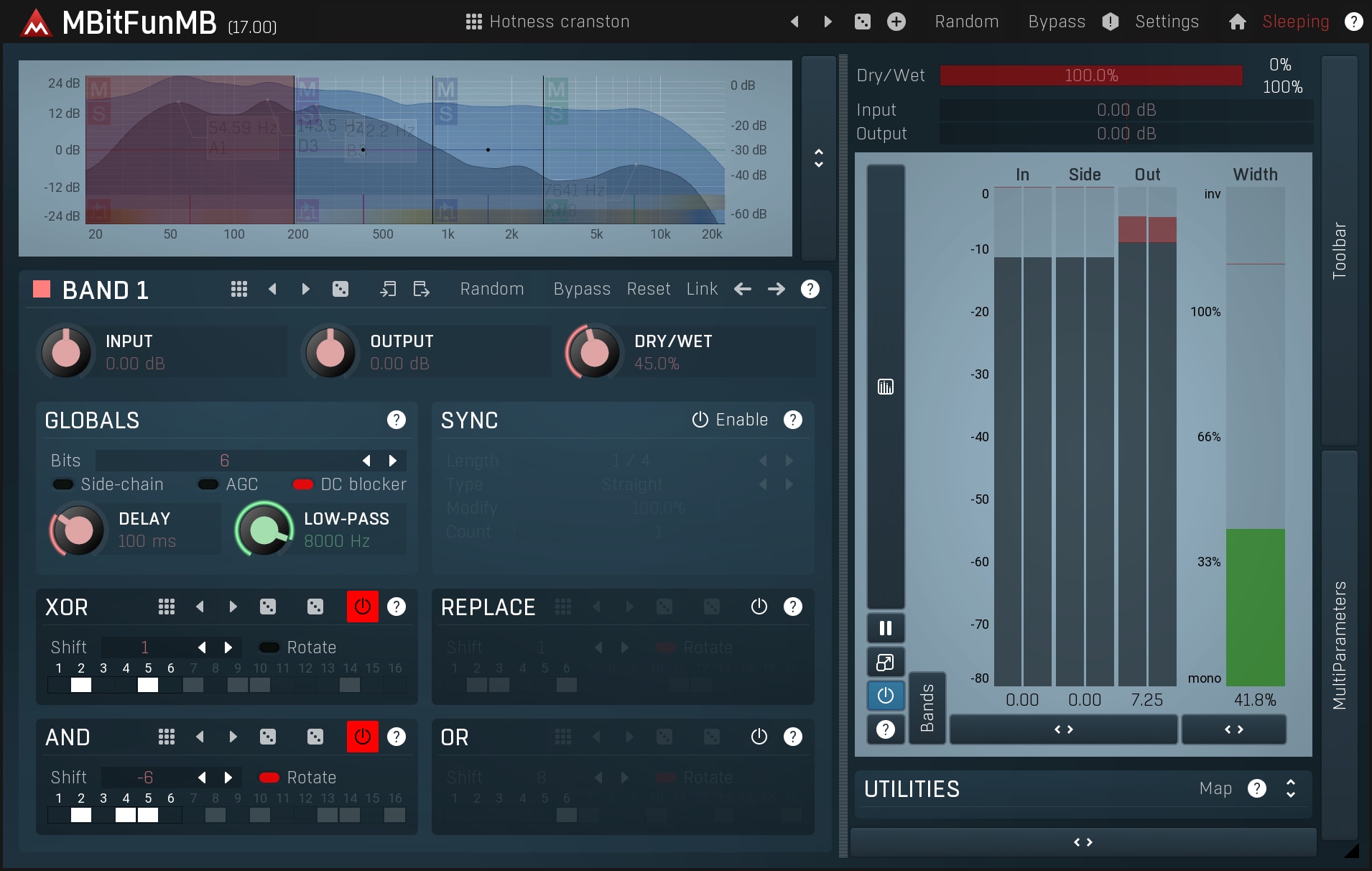
MBitFunMB is a multiband distortion plugin for deliberately degraded or changing sounds. It reduces incoming audio to a selectable 1 to 16 bits per sample, then applies bit operations and a low-pass filter to the processed signal. The manual lists 8 bits as the default. Lower settings reduce sample precision and produce a more lo-fi sound.
Shape the bit changes
Four operations change selected bits, with different results depending on whether the processor has a separate control signal:
- XOR flips selected bits in each sample when there is no separate control signal. With one, a selected bit flips only where that bit is set in the control signal.
- Replace substitutes selected bits with bits from the control signal. It has no effect when that signal is identical to the input, so shifting, delaying or routing a side-chain can make the operation useful.
- AND keeps selected bits from the input when there is no separate control signal; with one, a selected bit survives only if the corresponding control bit is also set. Disabling every bit without a control signal can silence the output.
- OR sets a selected bit to 1 if that bit is set in either input. Without a control signal, it sets the bit in every output sample, which can create a DC offset. MBitFunMB includes a DC blocker; the manual also suggests a high-pass or DC filter.
A side-chain, global delay or bit shift can provide a control signal that differs from the main input. This lets you process audio against another signal or a shifted or delayed version of the input. The plugin also has a low-pass control for the processed signal.
Split processing across bands
MBitFunMB can divide audio into as many as six bands and process each band separately. Its multiband modes can divide audio by frequency, level, panorama, mid-side position, transient or tonal/noise content. Parallel mode instead processes the full input in each band. You can apply different bit changes to a frequency range or another part of the signal.
For frequency crossovers, analog types add no latency and usually shift phase; the manual describes the 6 dB/oct type as zero-phase and linear-phase by nature. Analog LP, linear-phase and hybrid types add latency. The manual cautions that some crossover settings may not be fully transparent, particularly with small bass bands and steep slopes.
Modulate and compare settings
Four modulators can act as LFOs, level followers, MIDI or audio-triggered ADSR envelopes, randomizers or pitch detectors, and can listen to the plugin's side-chain. They can control plugin parameters, and oscillators and modulators can synchronize to the host tempo. The A-H slots help compare settings, while an X-Y pad can morph among the first four.
Automatic gain compensation matches output loudness to the input for easier preset comparisons. The manual notes that its nonlinear adjustment can add distortion and takes time to settle after a change. A safety brickwall limiter is also included to keep the output below 0 dB.
Compatibility and licensing
The manufacturer lists 64-bit VST, VST3 and AAX support for Windows 10 and 11, with an Intel or AMD processor that supports SSE2. For macOS 10.14 or newer, it lists 64-bit VST, VST3, AU and AAX support on Intel, AMD or Apple Silicon CPUs. Check the manufacturer's system requirements for host details.
MeldaProduction says the licence is assigned to a person and can be used on that person's computers. Activation does not require a dongle or an internet connection, and purchases include free updates for life. The MBitFunMB product page offers a trial download. The product manual explains the bit controls and crossover settings.