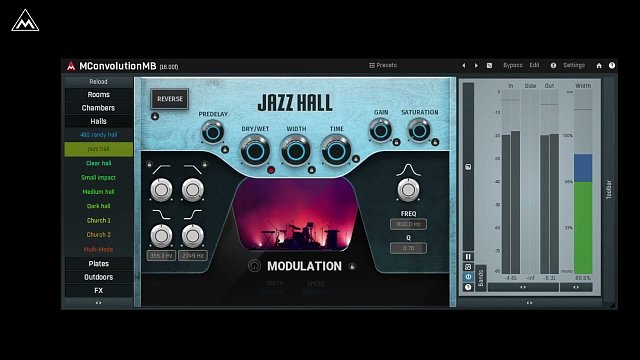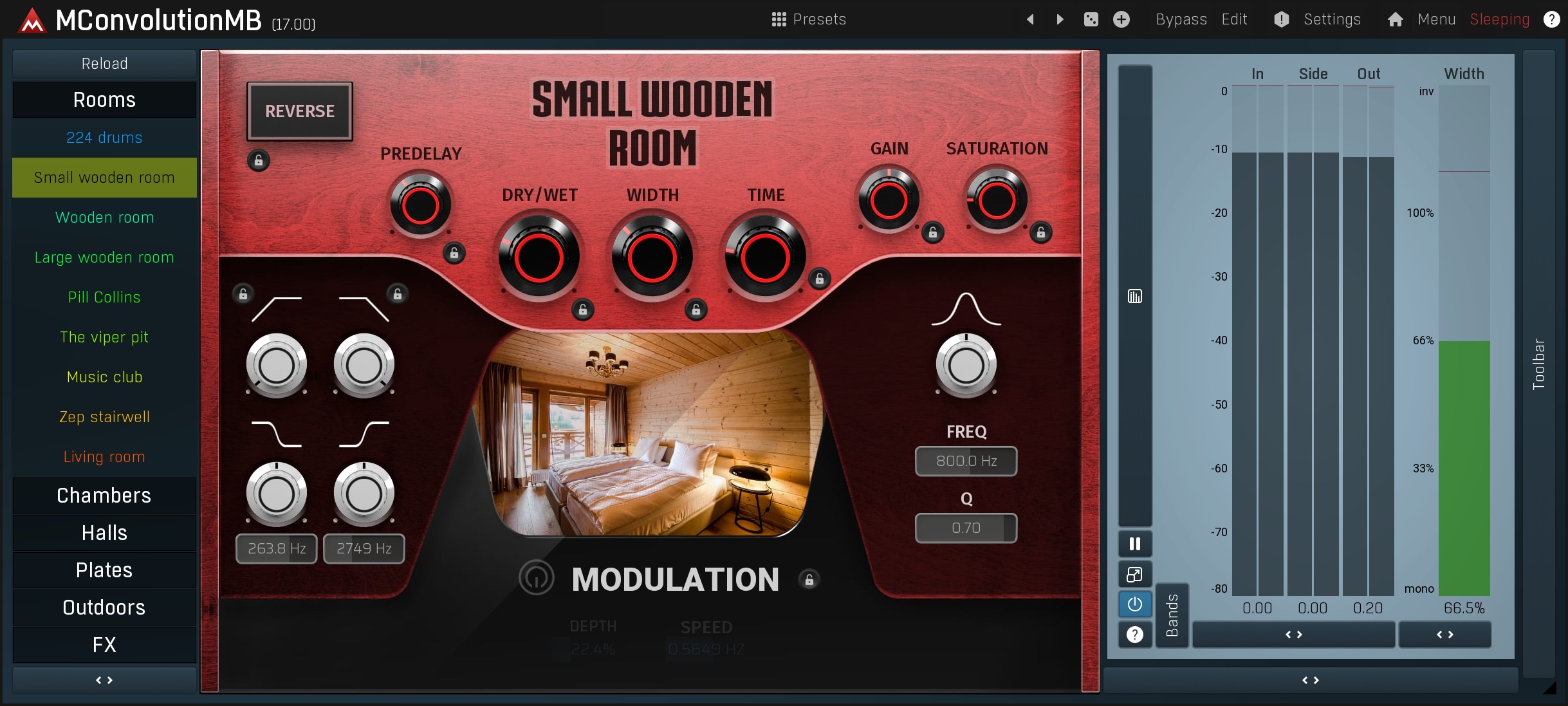
MConvolutionMB is MeldaProduction’s multiband convolution processor for adding recorded room, cabinet or microphone responses to a track, or creating reverbs and filters inside the plug-in. It suits mixing and sound-design work where you want to shape different parts of a signal separately, or use more than one impulse response in a band.
Blend or chain two responses per band
Each of up to six bands has two processing kernels, A and B. Each can use an impulse-response file, a generated reverb or a generated filter. In the default parallel mode, both process the input and a ratio control blends their results. For example, you can move between two room responses, or assign that ratio to a modulator so the blend changes over time. Serial mode sends the result of A through B.
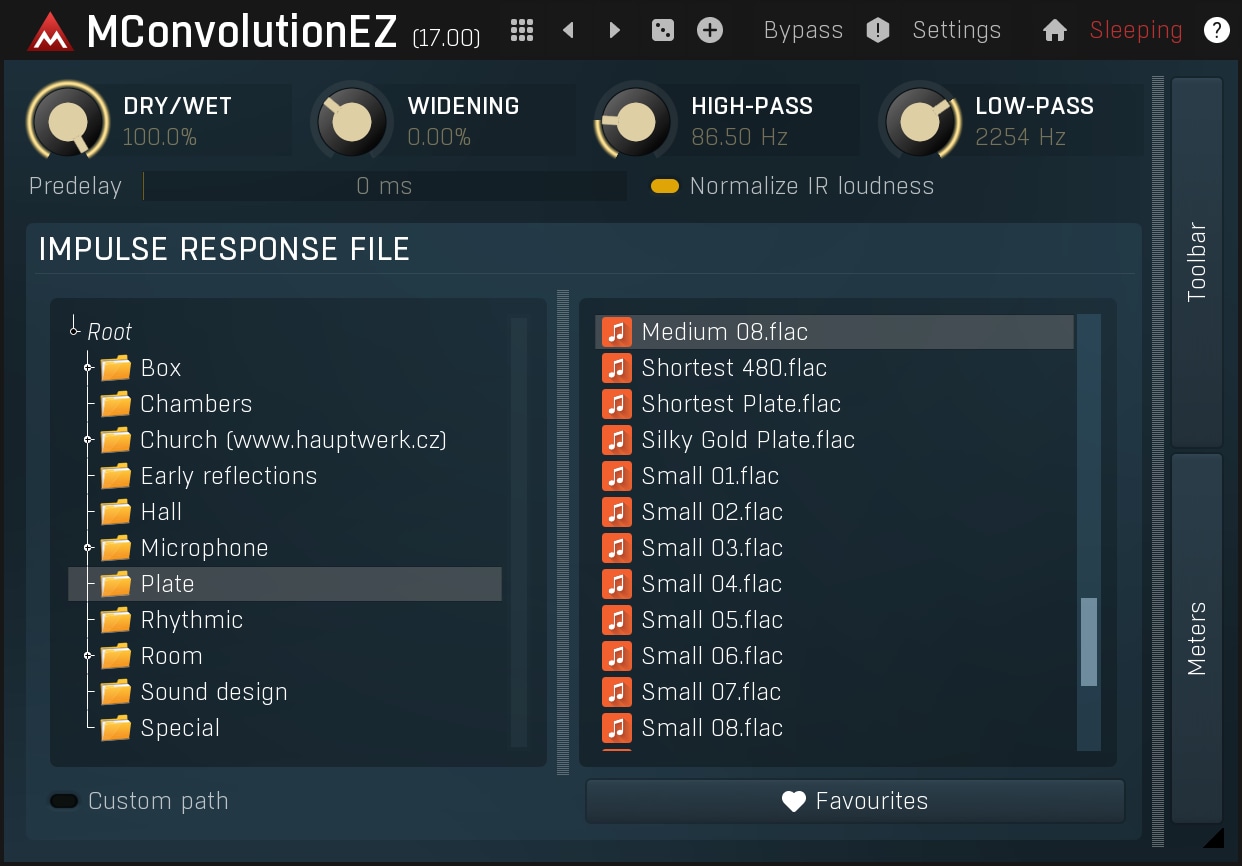
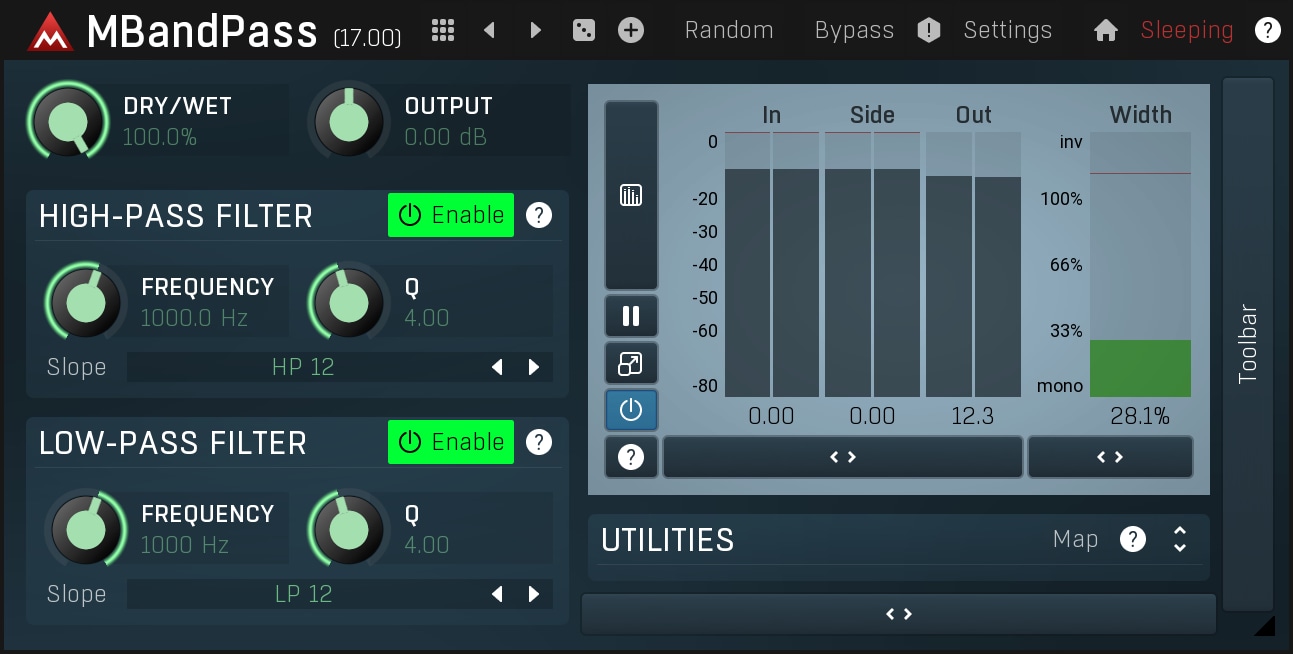
The built-in file manager loads WAV, FLAC and MP3 impulse responses. It recognizes multichannel WAV files and can combine suitably named files for multichannel setups, including true-stereo topologies. Reverb mode generates a response with controls for room size, length, predelay, early and late reflections, density, decay and damping. Filter mode generates filters such as low-pass or high-pass, but all dry/wet controllers must be set to 100% for it to work. Longer filter kernels use more CPU; they add latency equal to half the filter length, which the plug-in cannot compensate.
Shape bands by more than frequency
Alongside frequency splitting, the crossover offers level, panorama, mid/side and spectral modes. Level crossover assigns bands according to signal level; panorama and mid/side modes separate audio by stereo position, while spectral modes sort frequencies by level or transient content. Parallel crossover mode sends the full input to every band, which can create layered processing such as several reverbs in parallel. The manual cautions that this can raise the output level. The plug-in also provides four modulators that can work as LFOs, level followers, envelopes, randomizers or pitch detectors, and can control parameters including the A/B blend.
Channel handling includes mono, stereo and mid/side processing, surround up to eight channels, and ambisonics up to 64 channels. That makes the routing options relevant to music mixing as well as movie, game and VR audio projects.
Compatibility and licensing
MConvolutionMB is a 64-bit plug-in. MeldaProduction lists VST, VST3 and AAX support for Windows 10 or 11, and VST, VST3, AU and AAX support for macOS 10.14 or newer. Linux is not directly supported; Melda says Wine may work if .wine/drive_c/windows/Fonts/ contains Microsoft True Type Fonts. Check the current system requirements for host-specific details.
The product page says activation uses a per-user licence file, with use on that user’s computers, and does not require a dongle or internet connection. The MConvolutionMB quick-start guide explains its screens, band controls, crossover choices and impulse-response setup.