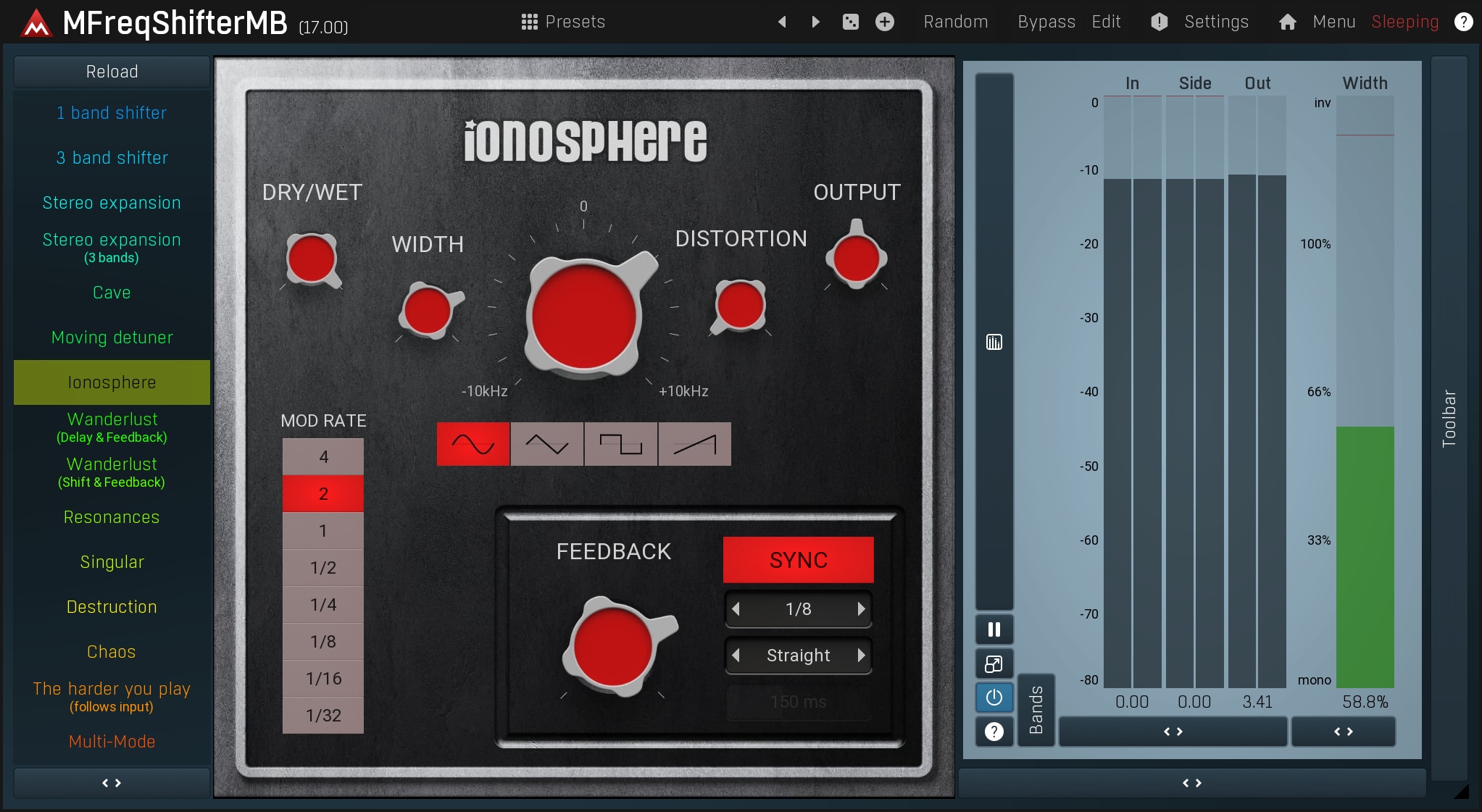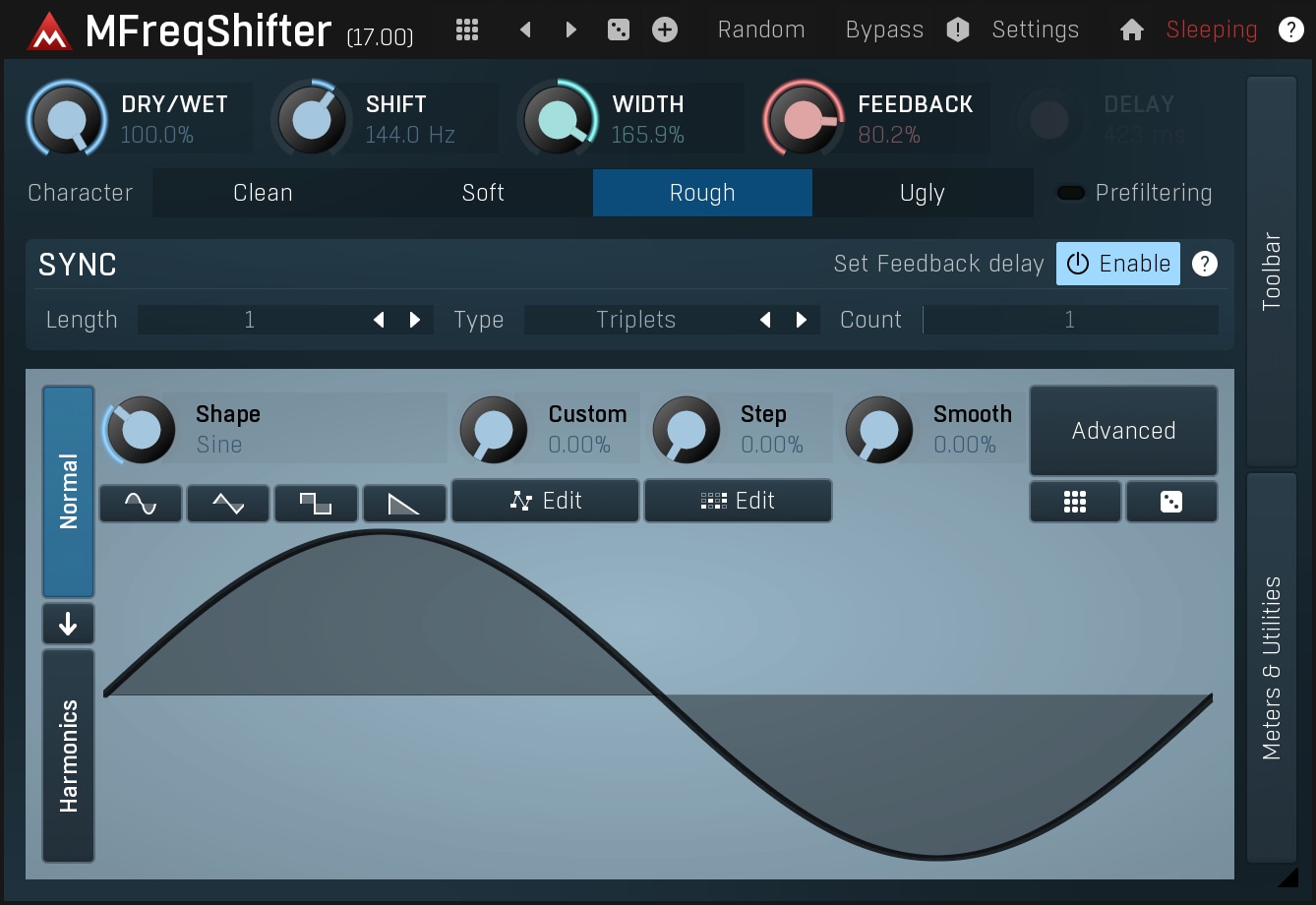
MFreqShifter is a frequency-shifting effect from MeldaProduction. Unlike a pitch shifter, it does not preserve harmonic relationships, so notes can take on inharmonic, distorted qualities as the shift increases. It can also be set for more restrained stereo movement.
Set the shift, width and feedback
The Shift control moves frequencies by an offset from -10 kHz to +10 kHz, with 0 Hz as its default. Depth sets the balance between the dry and processed signals. Width changes the shift applied across channels: for example, a 100 Hz shift with Width at -100% shifts the left channel by +100 Hz and the right by -100 Hz. Other Width values can give channels different shifts and widen the sound.
Feedback sends delayed output back through the shifter. Each pass shifts it again, creating a sequence with a changing spectrum. Set the delay from 0 to 1000 ms or sync it to the host tempo using note length, note type and count.
Shape and control the effect
The signal generator offers predefined oscillator shapes, custom waveforms drawn in MeldaProduction's envelope editor, and a step sequencer. Its Harmonics mode lets you adjust harmonic levels and phases, which is useful when shaping higher-frequency oscillators. The plugin can sync its oscillators and modulators to the host tempo. MIDI learn can map a controller to a parameter, while multiparameters can group several controls for automation or performance.
For quick comparison, A-H slots store alternate settings. A/B switches between the active and previously active slots, so select the two you want to compare first. Morph blends automatable or modulatable parameters across A-D and writes the result to the currently selected slot. The features page lists adjustable 1x to 1024x upsampling and a prefilter. The manual recommends leaving prefiltering on for cleaner results; frequencies that cannot be represented after shifting may otherwise alias.
Channels, compatibility and access
MFreqShifter supports mono, stereo, mid/side and separate left/right processing. MeldaProduction lists up to 8-channel surround and up to 64-channel, seventh-order ambisonics. The manual notes that ambisonics support is still rare among DAWs. Ambisonics requires its global switch to be activated and the host restarted. VST2 surround requires a separate global activation and host restart; VST3, AU and AAX do not require that surround activation.
The documented formats are VST, VST3 and AAX on 64-bit Windows 10 or 11, and VST, VST3, AU and AAX on 64-bit macOS 10.14 Mojave or newer. The listed processor requirements are Intel or AMD with SSE2 on Windows, and Intel, AMD or Apple Silicon on macOS. Linux is not directly supported; the vendor says running through Wine may be possible with Microsoft TrueType fonts installed in Wine's Windows Fonts directory. Check the support page for current requirements and the MFreqShifter manual for setup details.
MeldaProduction lists MFreqShifter as a free effect available through MFreeFXBundle. Activation uses licence files, with no dongle or internet connection required. The licence is personal to the user and can be used on that user's computers.