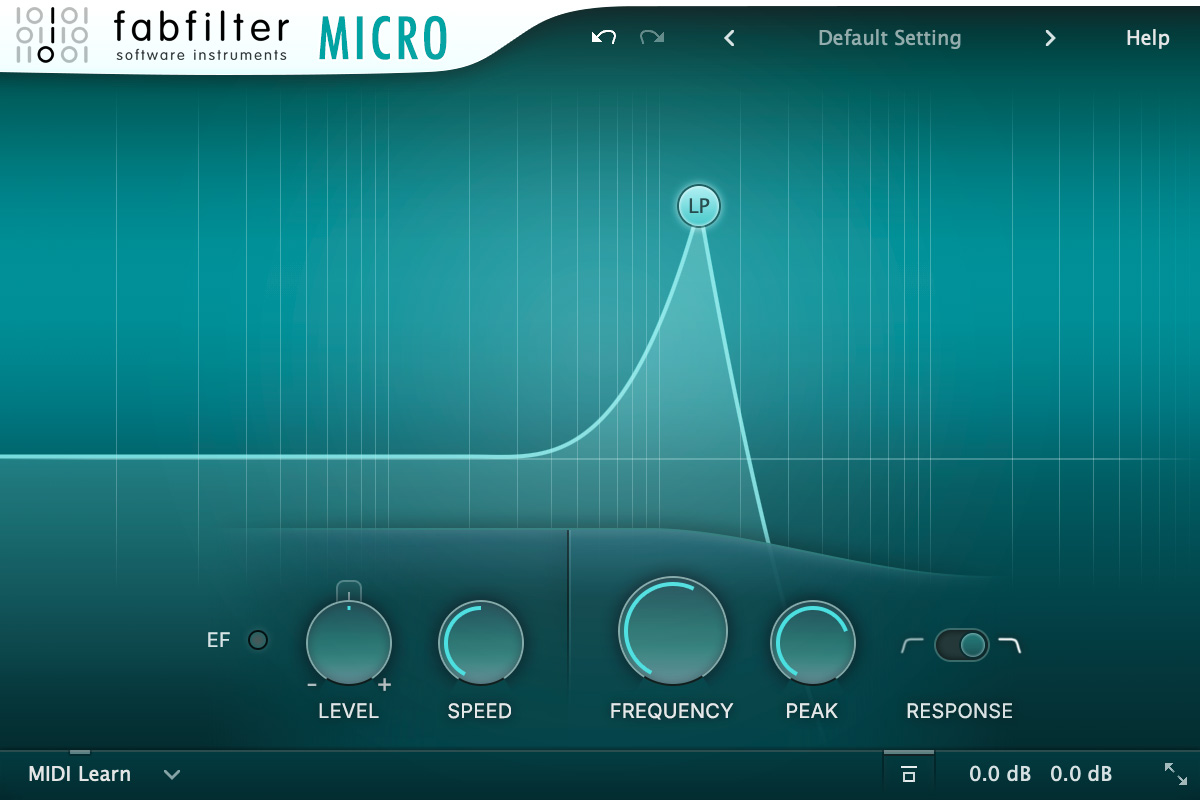
FabFilter Micro is a single-filter effect for straightforward tone shaping and resonant color. It switches between low-pass and high-pass responses, each with a 12 dB-per-octave slope. The Peak control adds resonance; at its maximum, the filter can self-oscillate.
Adjust the filter and its movement
Insert Micro on an audio track, instrument track, or bus, then drag the filter curve to set frequency and resonance. Ctrl-click (Command-click on Mac) at the peak to switch between low-pass and high-pass. You can automate changes made in the display. See FabFilter's quick start and interactive filter display guide.
The built-in envelope follower moves the cutoff in response to incoming audio. Set its modulation amount above or below zero, then adjust its speed: faster settings react aggressively, while slower settings smooth the response. This suits filter sweeps that follow a track's level. The filter controls guide explains the frequency, resonance, and envelope settings.
Set saturation
The input gain sets the level before the filter and controls its saturation; the output gain adjusts the final signal level. Micro can handle basic filtering, warmer resonant tones, and more pronounced distortion from the same filter.
Compatibility and licensing
FabFilter lists Micro in VST, VST3, CLAP, Audio Units, AAX Native, and AudioSuite formats. Its system requirements list Windows 11, 10, 8, 7, or Vista in 32-bit or 64-bit, and macOS 10.13 or later in 64-bit for Intel or Apple Silicon. Supported hosts include VST 2/3 or CLAP hosts, Audio Units on macOS, and Pro Tools.
The evaluation period lasts 30 days; continued use requires a license key. FabFilter's license terms allow a Personal License for its named user on three devices and cover minor updates to the licensed major version. A later major version requires a new license. Using a Personal or Site License for server-based automated processing requires FabFilter's prior permission and a custom licensing subscription contract; the plug-in must run as a black box, with no controls or parameters exposed to end users.