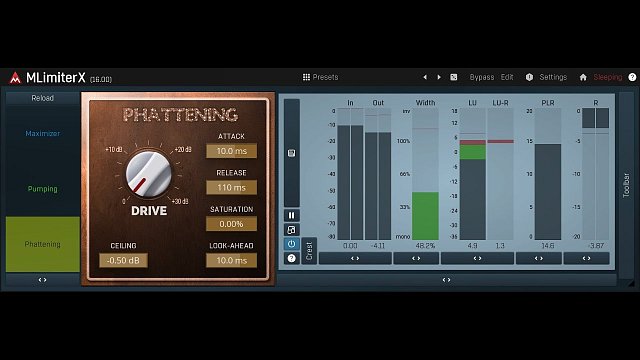
MLimiterX is a brickwall limiter from MeldaProduction for reducing peaks and raising loudness in mixes or masters. It pairs a four-control Easy screen with a deeper Edit screen, plus a safety limiter that keeps the output below 0 dB. Its mix of quick controls and detailed shaping suits users who want to move between simple limiting and more specific adjustments.
Quick controls and detailed shaping
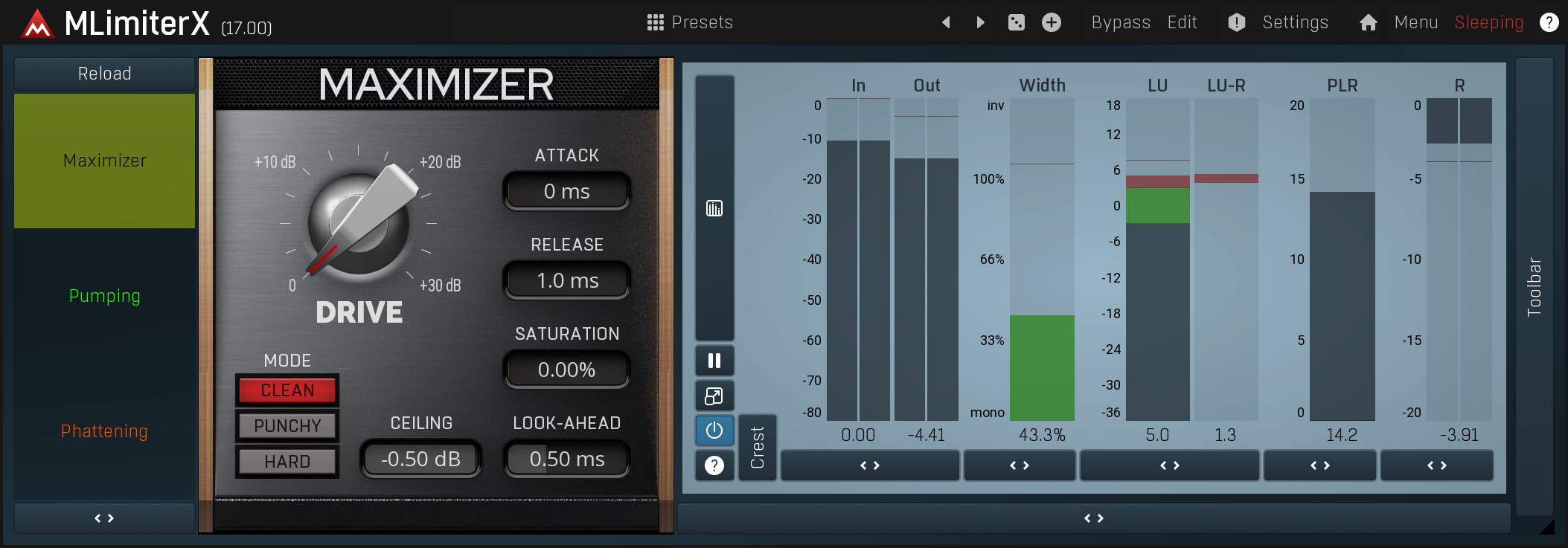
The Easy screen gives access to four main controls. Melda describes using the Drive control to change loudness and character. Switch to Edit for parameters such as threshold, output ceiling, attack and release shapes, and saturation after limiting. The manual explains that saturation can add harmonics and loudness, while also distorting the signal.
Attack and release shapes let you change how the limiter responds to peaks. The manual describes a tradeoff between pumping and distortion, so the settings need to be judged against the material. MLimiterX also has adjustable upsampling from 1x to 1024x, with minimum-phase and linear-phase options. Higher rates can use more CPU, and high-quality oversampling can add latency.
The feature list includes psycho-acoustic pre-filtering and spectral smoothing. Melda's manual cautions against using either for limiting: pre-filtering changes how the detector weights frequencies, while spectral smoothing can slow its response.
Compare settings and monitor the result
Automatic gain compensation (AGC) adjusts output loudness to match the input, using a 400 ms measurement that takes time to settle after a setting change. A level match helps listeners compare presets and setting changes without mistaking extra loudness for better sound. The A-H selector stores up to eight settings, A/B switching compares two settings, and an X-Y control can morph among the first four.
Input, output and gain-reduction meters show levels and how hard the limiter is working. The manual recommends using as little gain reduction as needed when aiming for maximum transparency. See the MLimiterX feature list and product manual for the available controls and metering details.
Channels, compatibility and licensing
MLimiterX supports mono and stereo, mid-side processing, surround up to eight channels, and ambisonics up to 64 channels. These modes require a host that supports the relevant channel layout. Ambisonics support is uncommon among DAWs; using it requires enabling MeldaProduction's global ambisonics option and restarting the host.
Melda lists Windows 10 or 11 (64-bit) with VST, VST3 or AAX hosts and an Intel or AMD processor with SSE2 support; macOS 10.14 Mojave or later (64-bit) supports VST, VST3, AU or AAX hosts on Intel, AMD or Apple Silicon CPUs. Linux is not directly supported; Melda says running the plugins through Wine may be possible with Microsoft TrueType fonts installed in Wine's Windows fonts directory. Check the MLimiterX support page for system details and use the trial to check compatibility if your system is below the listed requirements.
Melda says activation does not require a dongle or internet access. The licence is assigned to a person and can be used on that user's computers. The product page also lists free updates for the life of the licence.