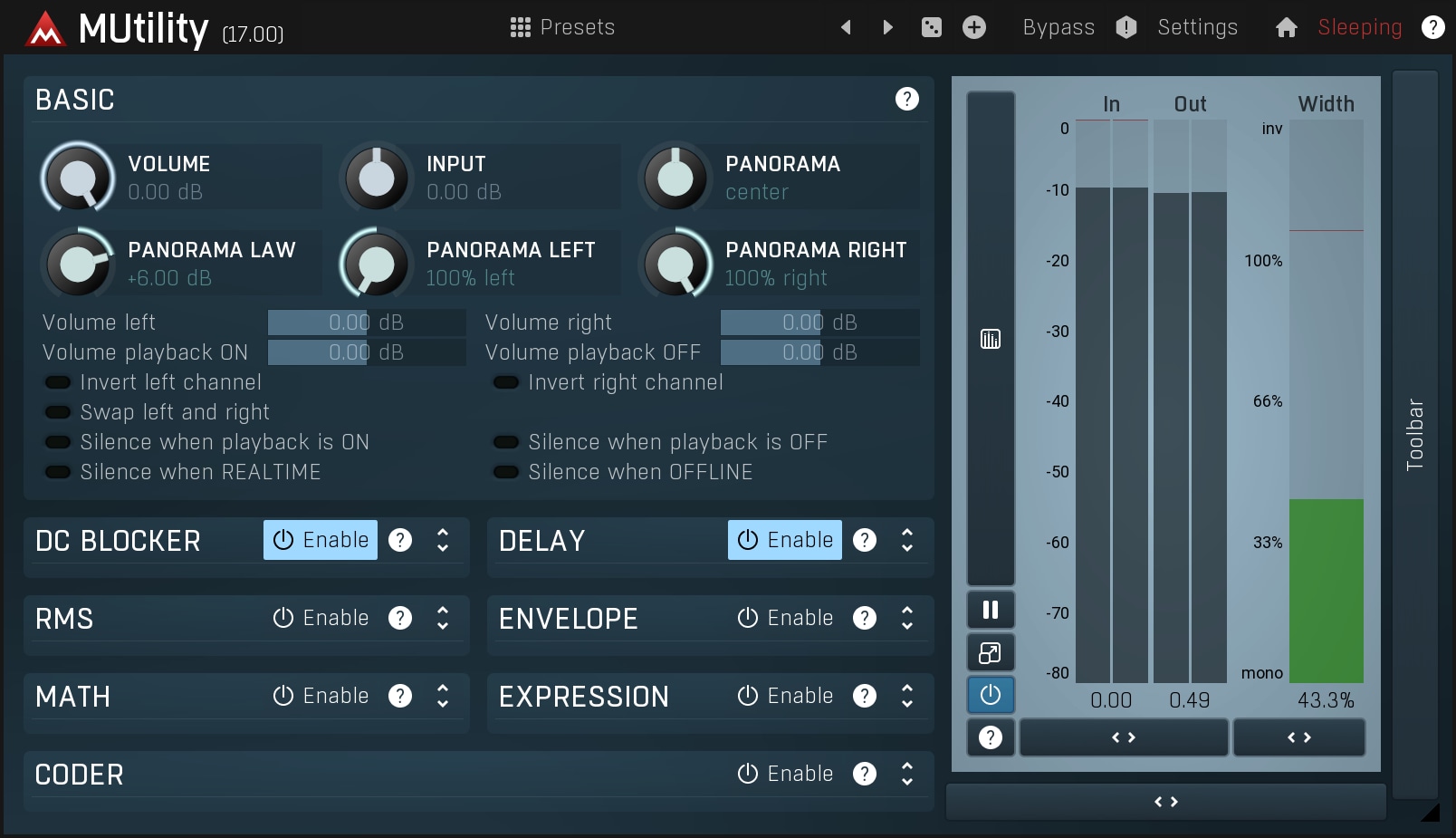
MUtility is a MeldaProduction audio effect for track-level controls and signal utilities. It combines volume and pan controls with phase inversion, left/right channel swapping, delay, a DC blocker, level detection, mathematical processing and mid/side encoding. It suits mixing and editing workflows where these adjustments recur across tracks, as well as more technical work with stereo and multichannel signals.
MeldaProduction labels MUtility a free effect and directs users to get it with the MFreeFXBundle. Its feature page says licences are assigned to a person and may be used on that person's computers, provided only that person operates the software; activation does not require a dongle or internet access.
Track, phase and timing adjustments
Use the volume and input-gain controls to adjust level inside the plugin, with separate volume and pan controls for the left and right channels. You can also swap the stereo channels or invert the phase of either side. The manual describes channel inversion as useful for out-of-phase recordings; it warns that putting the stereo channels out of phase to widen them can sound tiring and may leave the signal nearly silent in mono.
The delay panel can delay audio by samples or milliseconds. Its Report as latency mode works differently: MUtility reports a requested delay to the host and relies on host latency compensation to shift the track forward. This is useful when aligning a track against other material, but it depends on the host applying that compensation. The DC blocker removes a zero-frequency offset; the manual recommends enabling it when needed rather than treating it as a default filter.
Stereo processing and level checks
MUtility can process left and right channels separately, or work on the mid or side component of a stereo signal. For example, a gain change to the mid signal affects the centered content while leaving the side signal intact. Its meters show input and output levels and stereo width, with time graphs for following those values over time. The manual warns that very high width readings can indicate phase-coherence and mono-compatibility problems.
The developer lists support for mono and stereo, surround processing up to 8 channels, and ambisonics up to 64 channels. These modes depend on a compatible host and track configuration. The manual says VST2 surround needs to be enabled globally, followed by a host restart; VST3, AU and AAX do not require that activation step for surround. For ambisonics, the manual requires enabling the mode globally and restarting the host, then selecting the mode and configuring its order on a compatible ambisonics track.
Level matching, detection and expression processing
Automatic gain compensation (AGC) can help compare settings or presets at similar loudness, so a louder output does not automatically seem better. The manual says its level measurement uses a 400 ms RMS period, so it takes time to respond. It can work against effects that deliberately change level, such as slow tremolo, and may cause pumping with slower compression settings. The Set control measures during playback and adjusts output gain to bring input and output levels closer.
An optional safety limiter catches peaks above 0 dB, but the manual notes that limiting changes the signal and uses additional processing. MUtility also includes RMS and envelope detection controls, MIDI learn for controlling parameters from a MIDI device, and a mathematical expression panel. Expressions are evaluated for every sample, run more slowly than standard components, and may have lower audio quality; their output is limited to the range from -1 to +1. These tools are useful for specific routing, control or processing experiments, while the ordinary gain, pan and delay controls cover routine track work.
Compatibility
MeldaProduction's support page lists Windows 10 or 11 (64-bit) with VST, VST3 or AAX hosts, and macOS 10.14 or newer (64-bit) with VST, VST3, AU or AAX hosts as the minimum requirements; it notes that the plugins may still work below them. It lists Intel or AMD processors with SSE2 support for Windows and Intel, AMD or Apple Silicon CPUs for macOS. Linux is not directly supported; the developer says running the plugins through Wine may be possible, with additional font setup.
For detailed controls and routing behavior, see the official MUtility manual.