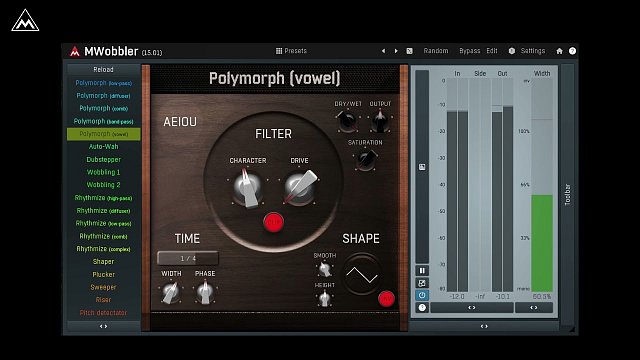
MWobbler is a MeldaProduction filter effect designed for moving, distorted sounds. It was originally designed for dubstep wobbling bass, and the developer also describes using it on rhythmic pads, rotary organs and drums. It has two filter processors, each with 98 filter types, including low-pass, band-pass, harmonic, formant, comb, diffusion and polymorph options. MeldaProduction’s product page also says the multiband version, MWobblerMB, is included.
Shape the filter and its movement
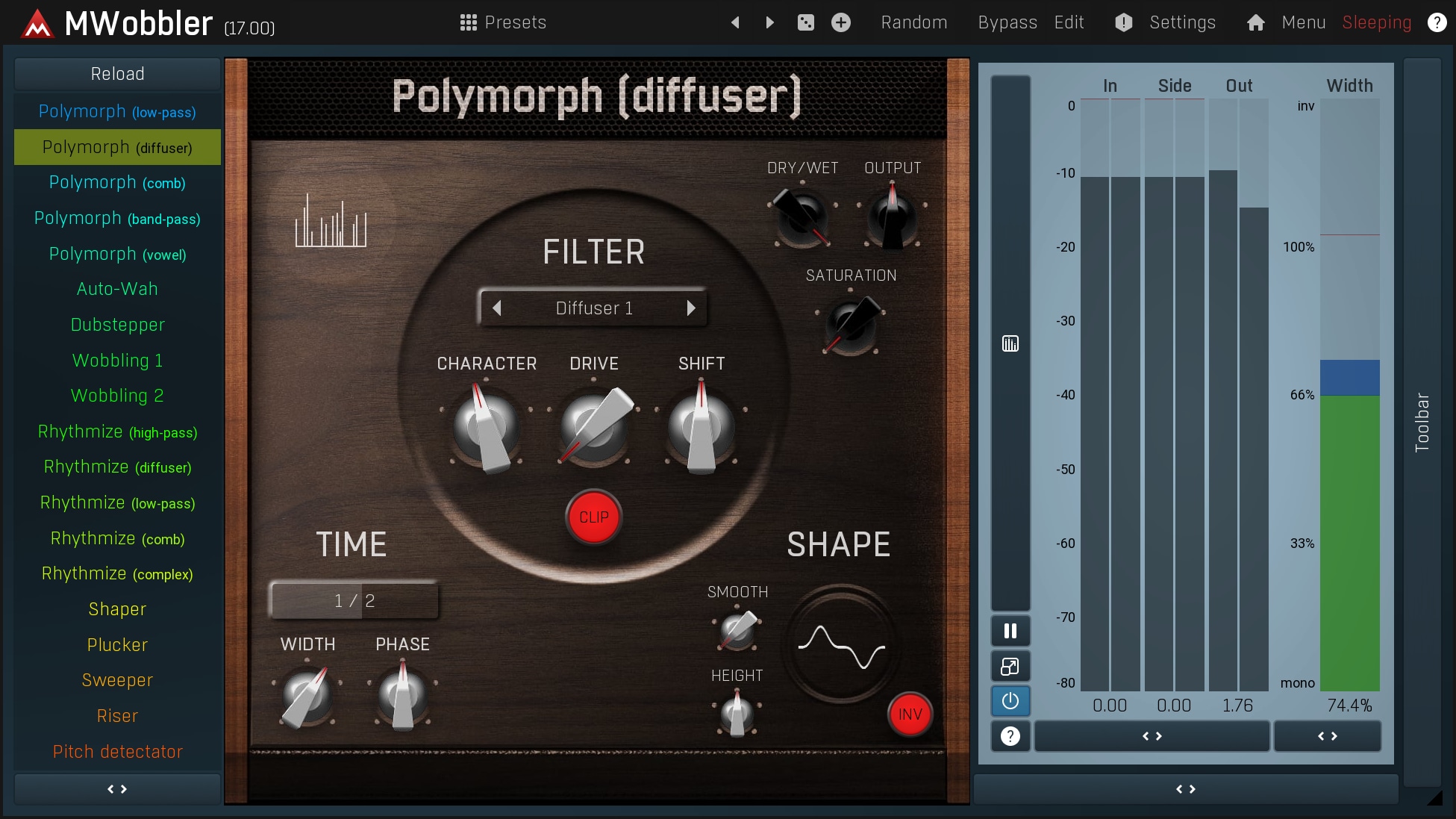
Each filter has Drive for adding distortion before filtering and Saturation for adding harmonics after filtering. If filtering removes harmonics added by Drive, Saturation can add some back afterward.
For rhythmic movement, the LFO can follow host tempo. Its oscillator shape can be edited, including with a step sequencer. The level follower can respond to the audio level, and its detector has an adjustable EQ to focus on selected frequencies. You can combine the follower with the LFO or feed the follower from an external sidechain signal. For example, the MWobbler quick start guide describes using a low-pass detector EQ around 100 Hz to make the follower react to a bass drum.
Four additional modulators can work as LFOs, level followers, MIDI or audio-triggered envelopes, randomizers, pitch detectors, or combinations of these. The plug-in also supports mono and stereo, mid/side, up to 8-channel surround, and up to 64-channel ambisonics processing.
Choose a simple or detailed workflow
The Easy screen presents a smaller set of controls for common tasks. Switch to Edit for access to the full parameter set. The quick start guide explains how to build a saved preset with your own named multiparameter controls for the Easy screen; these custom presets do not appear in the factory Devices list.
Check compatibility and activation
MeldaProduction lists Windows 10 or 11 (64-bit), with VST, VST3 or AAX hosts and an Intel or AMD processor with SSE2 support. On macOS, it lists version 10.14 or later (64-bit), VST, VST3, AU or AAX hosts, and Intel, AMD or Apple Silicon processors. Linux is not directly supported; the support notes that Wine may work if its Windows fonts directory contains Microsoft TrueType fonts. See the MWobbler support page and system requirements for details. The developer says a trial can help check systems below the listed minimums.
Activation uses licence files. MeldaProduction says a licence is assigned to a person and can be used on that person’s computers; activation does not require a dongle or internet access.