Pose2Sim Blender is a Blender add-on for visualizing Pose2Sim results and rigging characters with markerless kinematics. Pose2Sim is an open-source pipeline for 3D motion analysis using consumer-grade cameras such as phones, webcams and GoPros. The add-on brings camera, marker and OpenSim data into a Blender scene. The maintainer’s README describes its inputs and tools.
Camera calibration, markers and OpenSim data
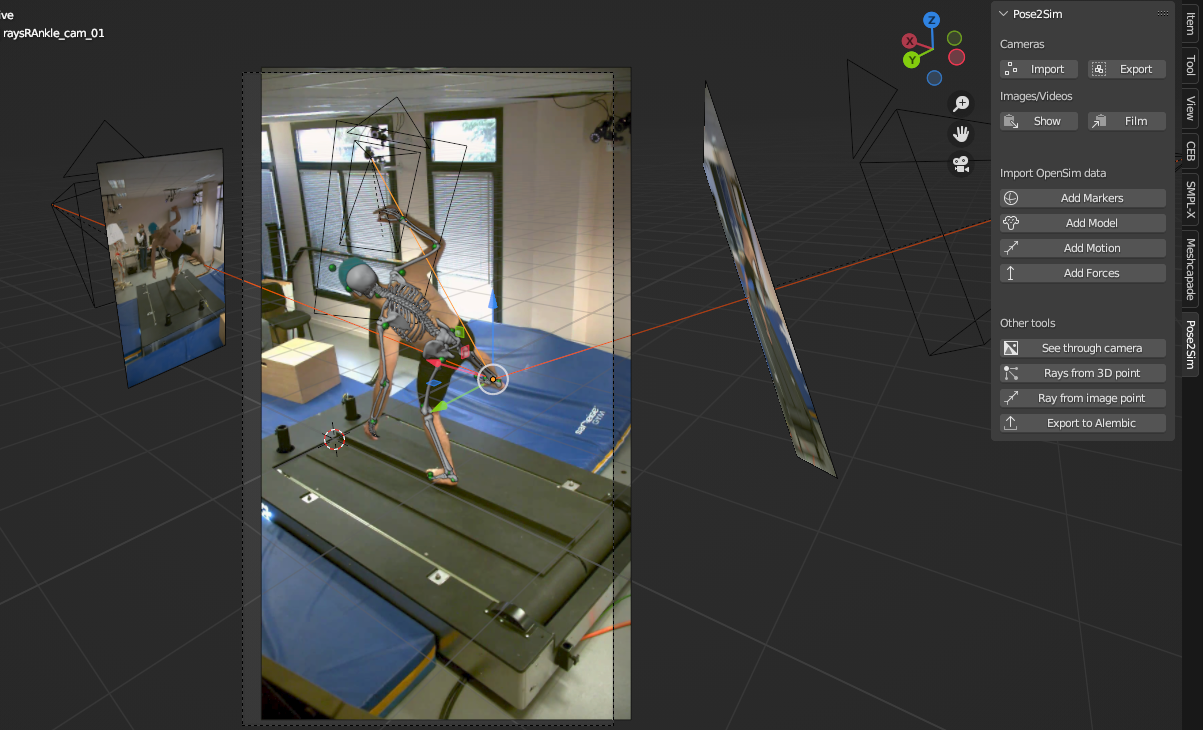
For camera work, the add-on imports a Pose2Sim calibration file in .toml format and can export updated camera data. It can show videos, image sequences and still images in the camera frame, then render from selected or all cameras as a movie or image sequence.
- Marker trajectories: Import marker data from
.trcor.c3dfiles, including trajectories produced by Pose2Sim triangulation. - OpenSim data: Import
.osimmodels,.motmotions and force files. Loading a model with a motion creates an animated skeleton and an armature that can be saved as.bvh.
Character retargeting can use an OpenSim model with one or more .bvh files. Marker-based rig creation is available, but the current README says rigging from .c3d markers is not supported yet.
Inspecting a motion scene
Other tools show a camera view with markers and OpenSim skeletons overlaid, trace rays from 3D points onto image views, and display the motion path of selected points. These can help when checking whether a triangulated point lines up with 2D keypoints in the camera images. The add-on also exports a baked .glb file for import into other software.
Installation and compatibility
The maintainer’s README explains how to download the add-on ZIP, install it from Blender’s Preferences, enable it and open the tool in the 3D View sidebar. Required dependencies install in the background, which may take a few minutes. Superhive lists Blender 4.0 and 3.6; the current README says versions below 4.4 use an older installation procedure. Check the current README for the setup path for your Blender version.
The project is free and open source; its Superhive listing identifies an MIT license. The project README asks researchers to cite Pagnon et al. (2022b).