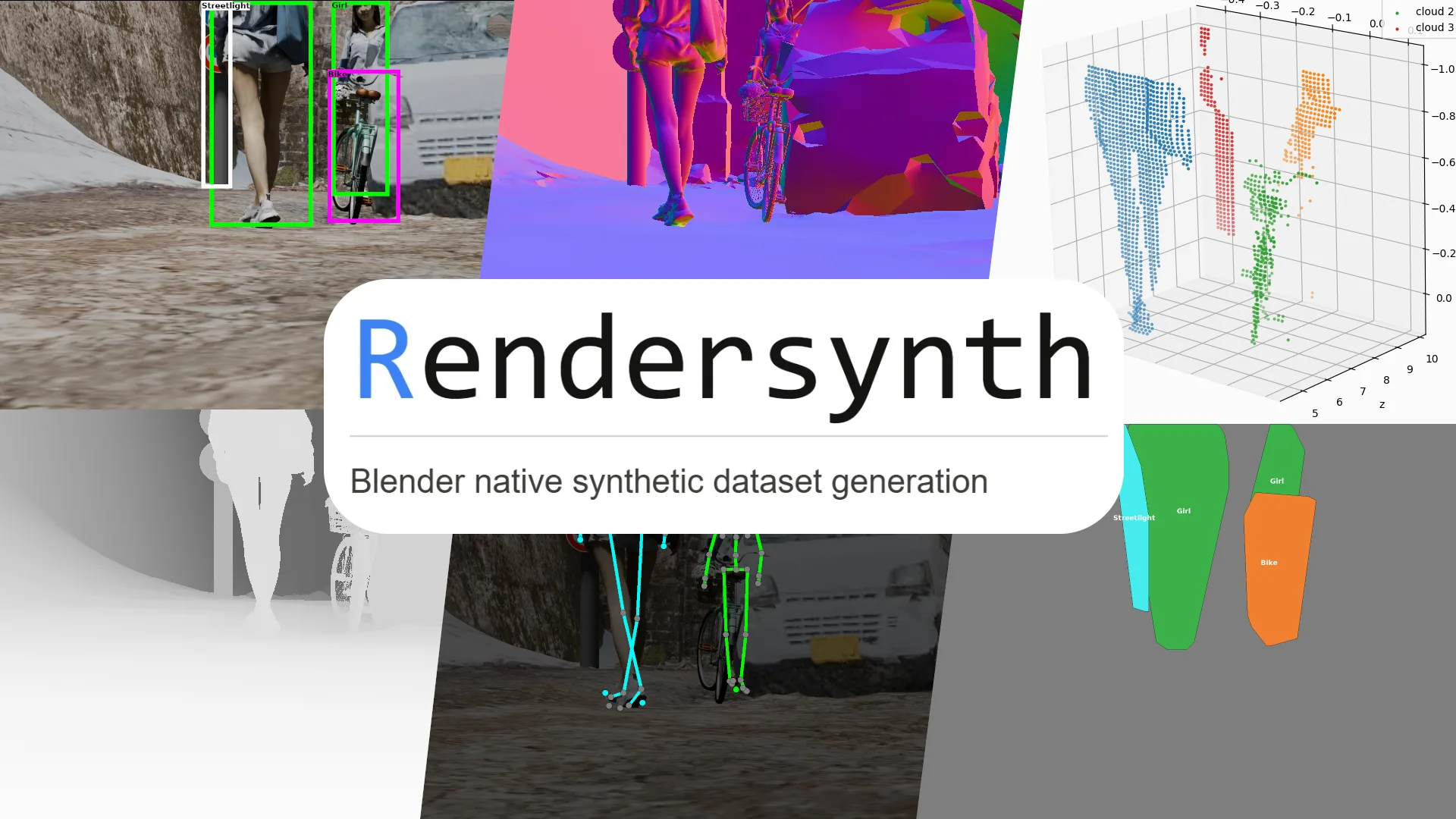
Rendersynth is a Blender extension for generating synthetic computer-vision datasets through procedural randomization and batch rendering. You build a pipeline in Blender by choosing operations that vary a scene, then render images with metadata suitable for training computer-vision models. The Blender Extensions listing describes it as intended for low- to medium-sized projects where ease of generation matters more than the efficiency and generality of tools such as BlenderProc. The listing records version 1.0.0 as its initial beta, released July 24, 2026.
Build a scene randomization pipeline
Rendersynth pipelines combine operations for object transforms, materials, lighting, and cameras. You can vary object position, rotation, and scale; material textures and properties such as roughness and metallic; lighting intensity, temperature, and color; and camera position. The camera can also be locked around a central point.
Each parameter can use a preset distribution, including normal, uniform, or exponential. For more specific variation, a node editor lets you combine constants, continuous or discrete distributions, and selectors into a custom distribution. Pipelines can be saved and loaded as JSON, which supports version control and repeatable setups.
Label objects and preview the output
You can define named classes and assign them to Blender objects. Multiple objects can be grouped into a multi-object entity and treated as one labeled object. Rendersynth's in-Blender preview lets you inspect a pipeline run, including its bounding boxes, labels, and visibility statistics, before committing to a full batch render.
Export formats
The extension lists these output formats for computer-vision datasets:
- Ultralytics YOLO
- COCO, COCO Keypoints, and COCO Segmentation
- Depth maps and normal maps
- Point clouds
Compatibility and current scope
The listing specifies Blender 4.5.0 or later. It also marks constraint operations for overlap, occlusion, and distance rules as in progress. These are separate from the listed randomization options for visibility and occlusion. Rendersynth requests file access to load and save synthetic datasets, configuration, and logs.