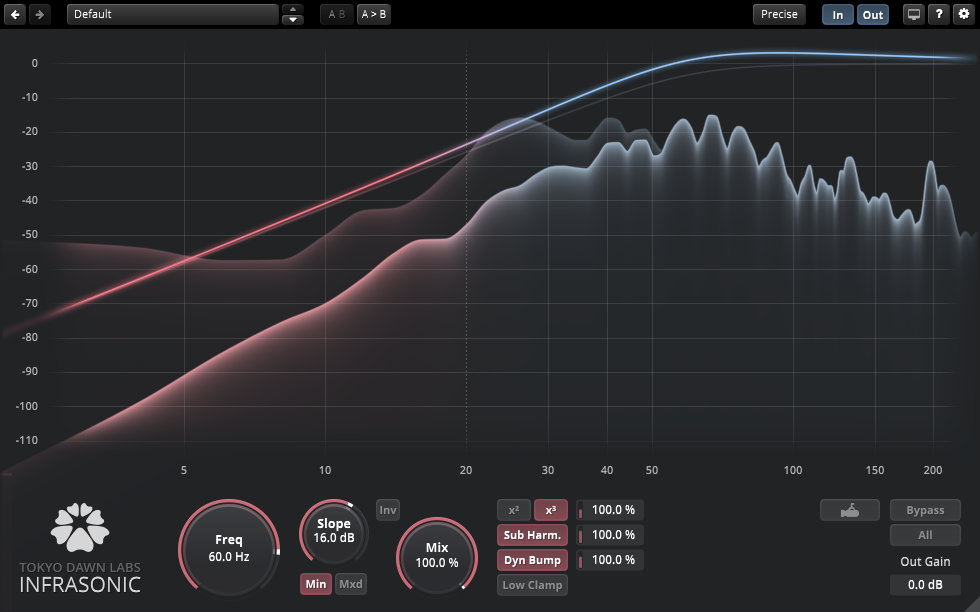
TDR Infrasonic is a low-frequency filter for managing the predominantly inaudible part of a mix. Tokyo Dawn Labs cites disk mastering, audio cassettes, analogue broadcast and PA systems as examples of transfers to a medium or environment with lower spectral bandwidth. The developer also lists recording, mixing, restoration and mastering.
Filter behavior and phase modes
The high-pass filter's frequency control marks the point where attenuation reaches -3 dB. Its slope ranges from 3 to 48 dB per octave. Minimum phase has zero latency but introduces phase distortion that depends on the filter curve. Mixed phase adds latency while keeping the filter phase response above 50 Hz linear.
The Mix control blends the original and processed signals: 0% is fully dry and 100% is fully wet. Invert changes the high-pass filter into a low-pass filter, which can isolate the low-frequency content removed by the high-pass filter or create a subwoofer channel.
Compensation and low-frequency control
Filtering can remove energy along with unwanted low frequencies. Dynamic Bump compensates with an adjustable boost of up to 6 dB. Even and Odd generate their respective harmonic series to replace low-frequency content removed by the filter. Sub Harm adds a subharmonic signal one octave below the input frequency, along with its own odd-numbered harmonics.
Low Clamp provides momentary clipping of low-frequency signals as an alternative way to reduce low-frequency energy. Its threshold sets the clipping level. Output Gain controls the overall level after processing.
Monitoring and workflow
The analyzer can display the input and output spectra, with detail extending down to DC. Click the display to freeze its animation and inspect the spectrum with a crosshair. The DC Level Indicator estimates the input's DC level; the manual notes that finite-length signals can produce false positives.
A practical starting point is to set the cutoff and slope, choose a phase mode, then compare the input and output displays while listening. Add a compensation control only if its harmonic or level change suits the material. Use A/B to compare parameter states, and adjust Mix or Output Gain for the desired processed balance and level.
Compatibility and license
The developer lists VST2, VST3, Audio Unit and AAX formats. The host must support a listed format. Published system requirements are Windows Vista or later, macOS 10.9 or later, or Linux x86-64 with GLIBC 2.14 or later; OpenGL support is required.
Tokyo Dawn Labs lists a personal or small-business license with free updates. The EULA grants each licensed copy a perpetual, non-exclusive license for one user on up to five single computers. Each user on a multi-user platform, server or network needs a separate license.