Twangström is a spring reverb effect plug-in from u-he for shaping guitar, electric piano and other audio with the splashy, metallic tail of amplifier spring tanks. It uses physical modelling to simulate spring behavior, so its controls change the modeled tank in real time. This suits sound design and mixing where the reverb tail needs to be tuned, filtered or moved with the performance.
Three modeled tanks
The three tank models give different starting points for the reverb:
- Type 4 uses two joined springs. Its sound is splashy, with clearly heard echoes.
- Type 8 uses three unsplit springs. It has a denser, more mid-focused sound with less of the characteristic spring-reverb bounce.
- Type 9 is a longer hybrid with three split springs. It sounds more open and produces more echoes.
Decay controls how quickly the tail fades. Tension changes the spring's timbre and echo time: lower tension lengthens the echoes and makes the space feel larger, while higher tension gives a tighter, smaller-space character. Density controls how much the echoes smear together. Coupling controls how the spring systems exchange energy; switching it on makes the tail build into a wash more quickly.
Shape and move the reverb
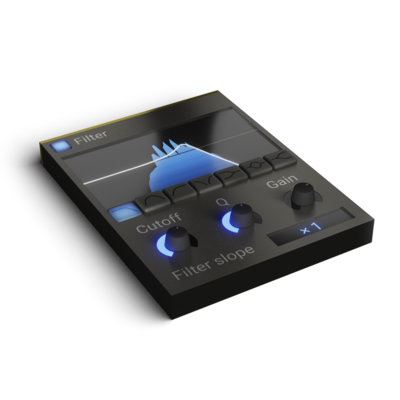
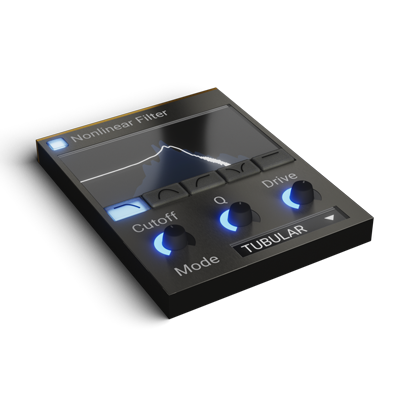
The Drive stage adds saturation before the springs, and its Tone control works as a tilt filter. A 12 dB-per-octave multimode filter can run before or after the tank and blend between low-pass, high-pass, notch and band-pass responses. Its stereo control offsets the filter frequency between left and right channels, which can add movement when the filter is automated or modulated. Independent input and feedback routing supports mono and stereo signal combinations.
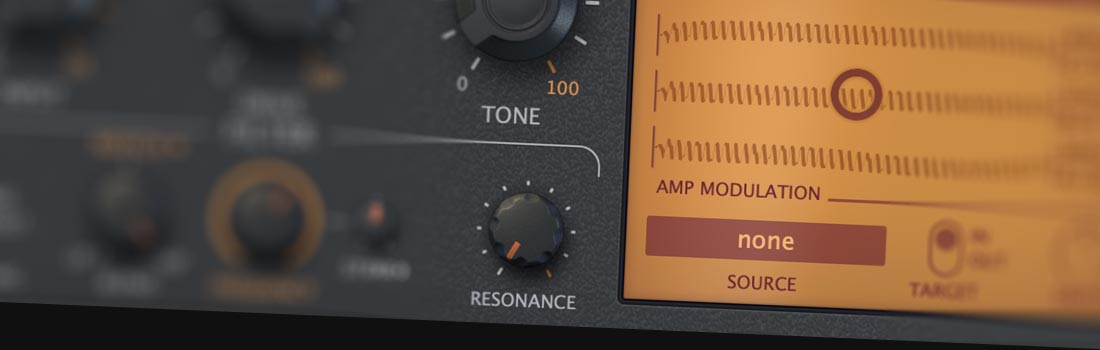
The Twang control shakes the modeled springs. You can move it by hand, automate it, or use modulation to make the reverb respond to the playing. For transient-driven movement, set the envelope source to the input and assign the envelope to Twang. The envelope can also listen to Twangström's processed output or an external sidechain; sidechain routing depends on the host DAW. Its four modes are envelope follower, attack-decay, attack-release and cyclic.
The LFO has eight waveforms and can run freely or sync to the host tempo, including dotted and triplet divisions. Three modulation slots can route sources such as the LFO, envelope or MIDI controls to parameters including the tank, filter and Twang control.
Studio use and practical limits
On an insert, adjust Mix to blend the dry and reverberated signals. For an auxiliary send, the user guide recommends setting Mix to 100% wet. Spring reverb can dominate a part when you are trying to make tracks blend, so check the level in the context of the mix. Bright mode adds high-frequency detail to the tank, with the user guide estimating about 30% more CPU use per instance.
u-he's published examples include a guitar setting based on the Type 8 tank with Bright enabled and a shorter decay, and a Rhodes setting that combines light overdrive with subtle high-pass movement on a long tail.
Host and platform compatibility
Twangström requires a DAW or other plug-in host and does not run as a standalone application. The product page also lists 1 GB of RAM (more recommended), a display of at least 1000 × 600, 30–90 MB of free disk space, and a modern CPU: Intel Nehalem or newer or AMD Bulldozer or newer on Windows and Linux; Intel Nehalem or newer or Apple silicon M1 or newer on Mac. The product page lists OS X 10.10 or newer and CLAP, AUv2, VST3 and AAX; u-he's compatibility FAQ, updated September 23, 2026, lists macOS 27 as the upper OS version for current releases and OS X 10.11 as the AAX minimum. On Windows, the product page lists Windows 7 or newer, VST3 in 32-bit and 64-bit, and CLAP and AAX in 64-bit; u-he's compatibility FAQ, updated September 23, 2026, lists Windows 7, 8.1, 10 and 11 as supported versions. AAX requires Pro Tools 10.3.7 or later. The Linux build provides 64-bit CLAP and VST3 formats and requires glibc 2.28 or newer; u-he classifies its Linux plug-ins as beta and provides less support for them than for macOS and Windows. Twangström is NKS-ready and compatible with Maschine and Komplete Kontrol hardware.
A demo is available. It emits crackling at irregular intervals until you enter a serial number to unlock the full version.