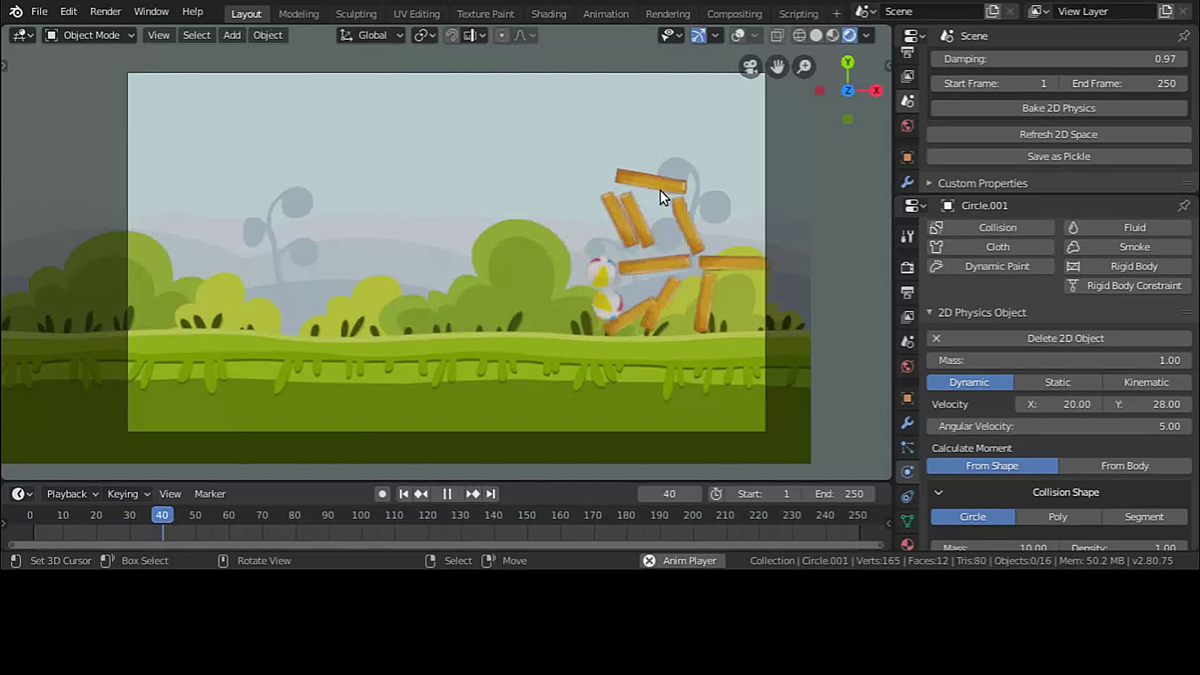
TwoDPhysics is a Blender add-on for 2D rigid-body simulation. It provides a dedicated 2D physics engine for animation made with Grease Pencil or other methods. The product listing describes Blender’s existing physics engine as focused on 3D simulation, which can make 2D setups cumbersome.
Rigid bodies and collision shapes
The documentation lists three rigid-body types: STATIC, DYNAMIC and KINEMATIC. Object settings include mass, moment of inertia, animation state, velocity and angular velocity. The Animated option uses locations from the animation. You can calculate a body’s moment from its shapes or calculate it manually from the body values you provide.
Collision shapes include Circle, Poly and Segment (Line). For a polygon shape, TwoDPhysics can create the shape from a curve or calculate a convex hull. Other shape settings include density, elasticity, friction and surface velocity. The documentation notes that surface velocity affects friction calculations, not collision resolution.
Constraints and connected objects
Documented constraints include Pin Joint, Slide Joint, Pivot Joint, Groove Joint, Damped Spring, Damped Rotary Spring, Rotary Limit Joint, Ratchet Joint, Gear Joint and Simple Motor. Constraint settings identify the two objects and anchor point, and include options for collisions between connected bodies, error correction and maximum force.
Scene controls and baking
The 2D World Settings are in Blender’s Scene tab. They include a world collection, global gravity, solver iterations, and steps per second; iterations control solver accuracy. The documentation says more steps per second improve simulation quality at the cost of speed. Collision bias controls how quickly overlapping shapes are pushed apart; collision persistence is the number of frames the space keeps collision solutions; it helps prevent jittering contacts from getting worse and defaults to three frames. Collision slop and damping are also available.
You can set the simulation’s start and end frames, bake physics to keyframes, and clear a bake.
Check version and operating-system support
The marketplace listing describes TwoDPhysics as an add-on for Blender 2.80 and lists Blender versions 2.8 and 2.81, Windows and Linux availability, and a GPL license. It does not establish compatibility with newer Blender releases or other operating systems. The documentation has the full settings and constraint list.