Autoremesher NOW! is a Blender add-on for remeshing triangle meshes. Its four operations convert triangles to mostly-quad topology, redistribute triangles, reduce triangle count, and repair mesh problems. The user guide covers the controls and notes limits for disconnected, non-manifold, intersecting, or sharp-edged geometry.
Four operations for triangle meshes
- Tris to Quads: Extract mostly-quad topology for downstream modeling, subdivision, or animation. Target Triangle Count controls sampling resolution; Edge Scaling changes inferred edge length. The guide estimates the quad count at roughly one quarter of the target triangle count. Organic mode suits smoother forms, while Hard Surface mode is intended to preserve sharp features.
- Tris to Tris: Uses Geogram CVT to redistribute triangles. Set a target vertex count and adjust iterations, shape adaptation, and size adaptation to affect uniformity and detail.
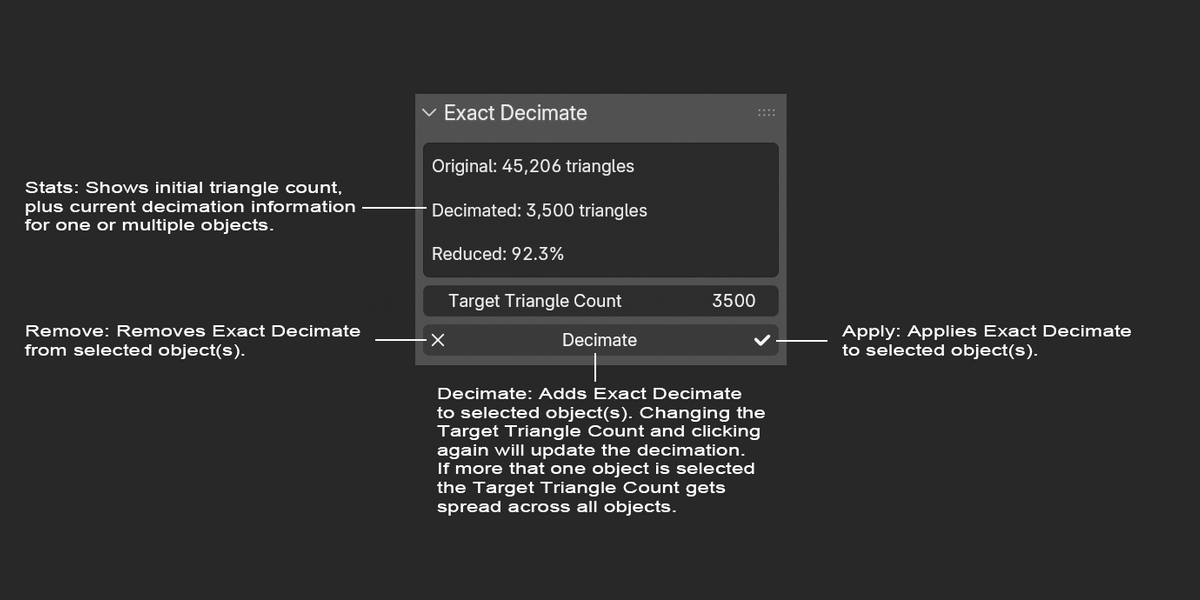
- Decimate: Reduces triangle count while aiming to preserve the overall shape. The Bins setting controls the reduction tradeoff; optional settings preserve open borders or run a repair afterward.
- Repair: Merges nearby vertices and fills holes. Parameters include merge tolerance, hole limits, minimum component area, and intersection removal. The guide describes intersection removal as powerful but very slow.
Workflow and mesh preparation
Select a mesh in Object Mode, choose an operation, set its parameters, and run it. Mechanism I (CLI) is the default and the guide recommends it for reliability. Blender displays progress and status during processing; if an operation fails, it opens a detailed report in the Text Editor.
The remesher expects triangles. To process a quad mesh, triangulate its faces in Edit Mode with Ctrl+T or apply a Triangulate modifier first. For scans or fragile inputs, the guide recommends trying Repair, then Tris to Tris, then Tris to Quads. If a mesh is especially dense and turnaround time matters, decimate it first.
Input limits and processing time
Autoremesher NOW! works best on connected, non-degenerate, 2-manifold surfaces without self-intersections. Loose parts inside one Blender object can still prevent processing. The guide warns that Tris to Quads has higher error rates on complex or degenerate meshes, and sharp-edged models are more likely to fail even though Hard Surface is an available model type.
Processing time depends mainly on the input triangle count and, for Tris to Quads, the target count. The guide gives one example: converting a 1,499,996-triangle mesh took about 25 minutes. It does not guarantee sub-minute processing for meshes above roughly 500,000 faces.
Compatibility and license
The product listing identifies Giambattista Von Nettesheim as the creator and lists the add-on under the GPL license. The documentation says versions 1.0.1 and later are compatible only with Blender 5.1.1. It reports Windows 11 x64 as tested and macOS arm64 as not yet tested, so check the documentation for the specific release you plan to install.