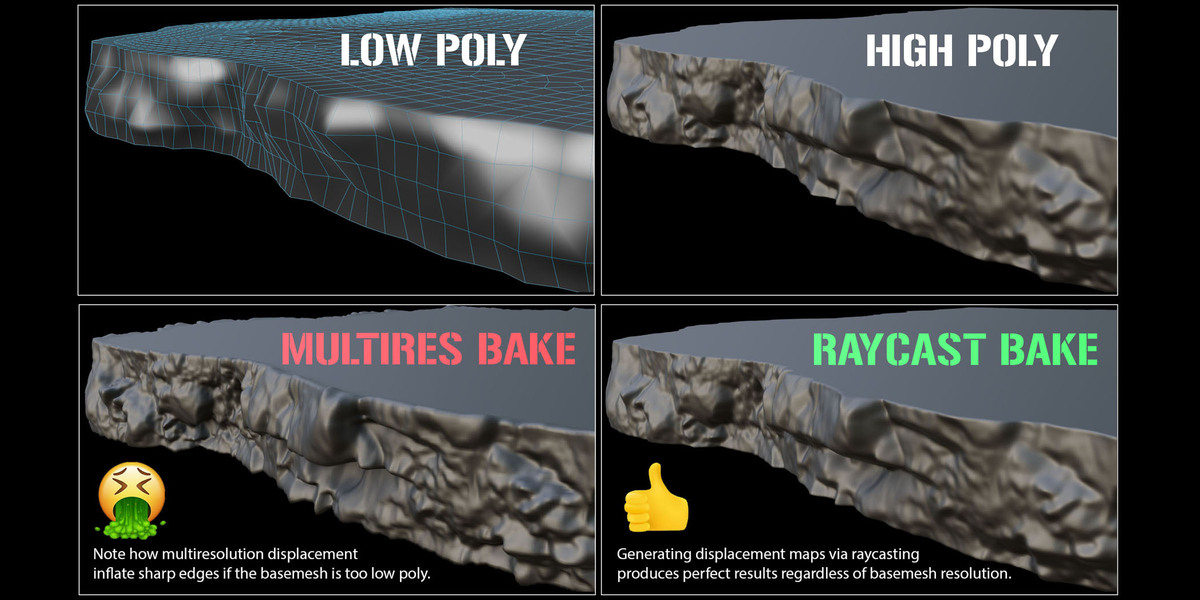
Displacement Baker is a Blender add-on by hodgson3d for baking displacement from high-resolution meshes onto low-resolution targets. It uses raycasting to project from the low mesh toward the high-resolution surface. The developer describes this as a more accurate alternative to Blender's Multiresolution displacement bake. The add-on is intended for high-to-low baking in VFX and game workflows.
Superhive's product details list Blender 5.1 through 5.3, mark the add-on as Blender Extension Compatible, and identify its license as GPL. Check the product listing for current compatibility details.
Set up high-to-low baking
Organize Selected sorts selected meshes into high and low collections using bounding-box size and polygon count. Sub-mesh objects such as decals can be parented to a high-resolution mesh and treated as part of it during baking. For multi-part assets, choose By Name, By Order, or Combined pairing. You can also set subdivision levels and adjust UV and boundary smoothing on the low-resolution mesh.
For projection, use ray distance or cage meshes. The add-on can estimate suitable ray distances and cage sizes, apply a buffer, and let you override settings for individual low-resolution objects. Generated cages can be previewed to check whether they enclose the high-resolution geometry; manual cages can be edited for finer control. The displacement pass is available when baking with Ray Distance; it also has a Borders to Nearest option and an Expand control for the border mask. Its preview applies subdivision and displacement modifiers so you can inspect the result in Blender.
Bake maps and transfer textures
Displacement Baker supports passes for normal maps, world-space normals, world position, object IDs, ambient occlusion, thickness, vertex color, and PBR channels. Custom Output lets you bake selected shader-tree nodes, and the add-on can detect and bake shader AOVs. Curvature options include pointiness, custom bevel curvature, conversion from a baked normal map, and signed mesh curvature using the UCUPaints method.
Transfer mode is designed only for solo objects in the low-resolution collection and can batch-transfer textures between UV sets. The add-on also supports UDIMs and can set up images for the tiles in use. Output controls include the image name, destination, resolution, margin, alpha method, and the option to store baked images inside Blender. Supersampling is available for smoother edges, and raycasted normal and displacement bakes support multithreading.
The product documentation describes the bake modes and controls. Its troubleshooting FAQ covers displacement spikes and mesh pairing.