What EchoBoy Jr. does
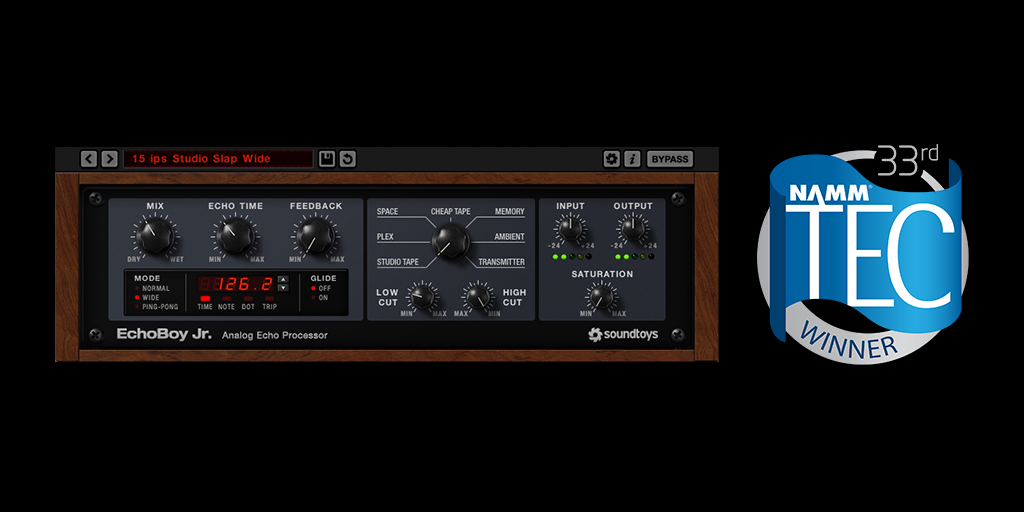
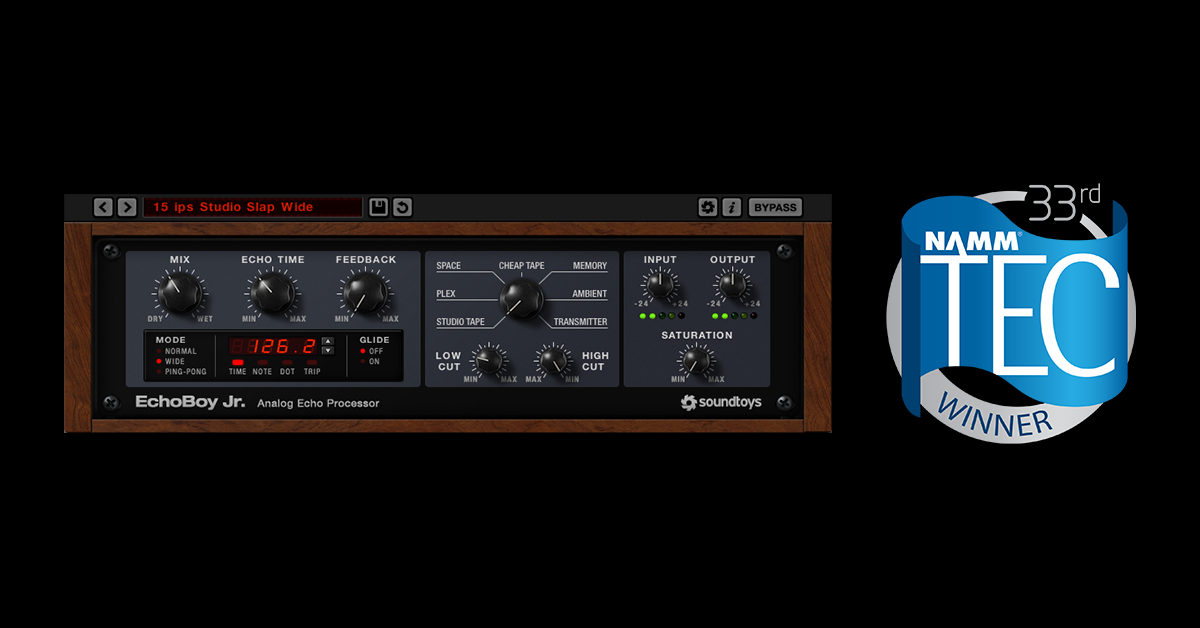
EchoBoy Jr. is Soundtoys' simplified echo and delay plug-in. Its seven modeled styles and direct timing, feedback, mix, and tone controls suit producers who want to shape repeats without the more complex tweak options found in EchoBoy.
It can cover tempo-locked rhythmic echoes, vocal slapback, short doubling effects, or more colored repeats on instruments. The EchoBoy Jr. User's Guide describes the controls and gives practical timing examples.
The seven echo styles
| Style | Character |
|---|---|
| Studio Tape | Subtle distortion and high-frequency compression, modeled after an ATR-102 running at 15 ips. |
| Plex | Modeled on the solid-state EchoPlex EP-3 tape echo. |
| Space | A warm, gritty Roland RE-201 model whose Feedback control can produce self-oscillation. |
| Cheap Tape | A bright, heavily compressed worn-tape sound modeled on vintage consumer-grade tape stock. |
| Memory | A warm, low-bandwidth chorus echo modeled after the Electro-Harmonix Memory Man delay pedal. |
| Ambient | Combines distortion and diffusion for warm, diffuse, chorused echoes suited to long feedback loops and solo instruments. |
| Transmitter | A distorted, resonant midrange that adds echo grit to synths. |
Set timing and repeats
Choose delay time in milliseconds or sync it to the session tempo. The Note, Dot, and Trip modes offer note divisions from half notes to sixty-fourth notes, including dotted and triplet values. This makes it straightforward to match repeats to a groove or try a different rhythmic subdivision.
The manual describes 0 to 10 milliseconds for flanging, 10 to 50 milliseconds for chorus or doubling, and 100 to 200 milliseconds for slapback. These are useful starting ranges when setting time directly.
Feedback controls how much of the delayed signal feeds back into EchoBoy Jr.'s input, increasing the number of repeats as it rises. Near-maximum settings can cause runaway feedback and significantly raise output level. Glide controls pitch behavior while changing delay time: with Glide on, the change can shift pitch like a tape machine; with it off, the delay time can change without that pitch shift.
Stereo placement and tone
Normal keeps the repeats centered, Wide adds a small delay between the left and right channels for a wider image, and Ping Pong alternates successive repeats between the channels. Low Cut and High Cut shape the echoes' frequency content. Saturation adds tube- or tape-like compression and distortion, with the result depending on the selected style.
Purchase and compatibility
Soundtoys says EchoBoy Jr. is included with EchoBoy and the Soundtoys 5 Bundle. It is not sold individually, according to the EchoBoy Jr. product page.
The plug-in is 64-bit and comes in AAX Native, AAX AudioSuite, VST 2, VST 3, and Audio Units formats. Soundtoys lists support for Pro Tools 2020 or later, Logic Pro 10.7 or later, Ableton Live 11 or later, Studio One 5 or later, Cubase and Nuendo 12 or later, Reaper 7 or later, Bitwig Studio 5 or later, and FL Studio 2025.1 or later. Format availability varies by host and operating system.
Soundtoys lists macOS 10.15 or later and Windows 10 or later. Its product page marks Apple Silicon compatibility and says an internet connection is required for activation; EchoBoy Jr. does not support ARM-based Windows machines. Hosts outside the tested list may still work, but Soundtoys does not guarantee support. Check its compatibility page for details and use the official trial to check an unlisted setup.