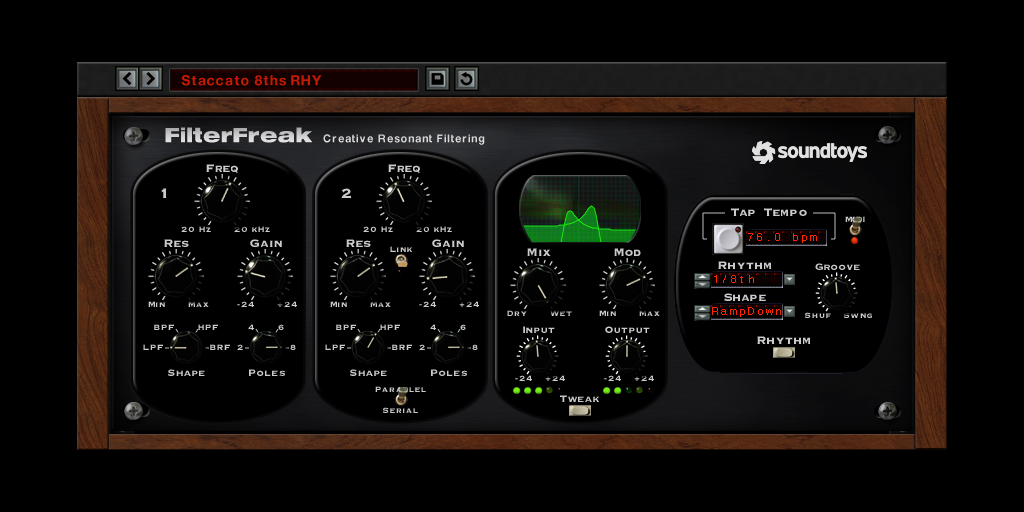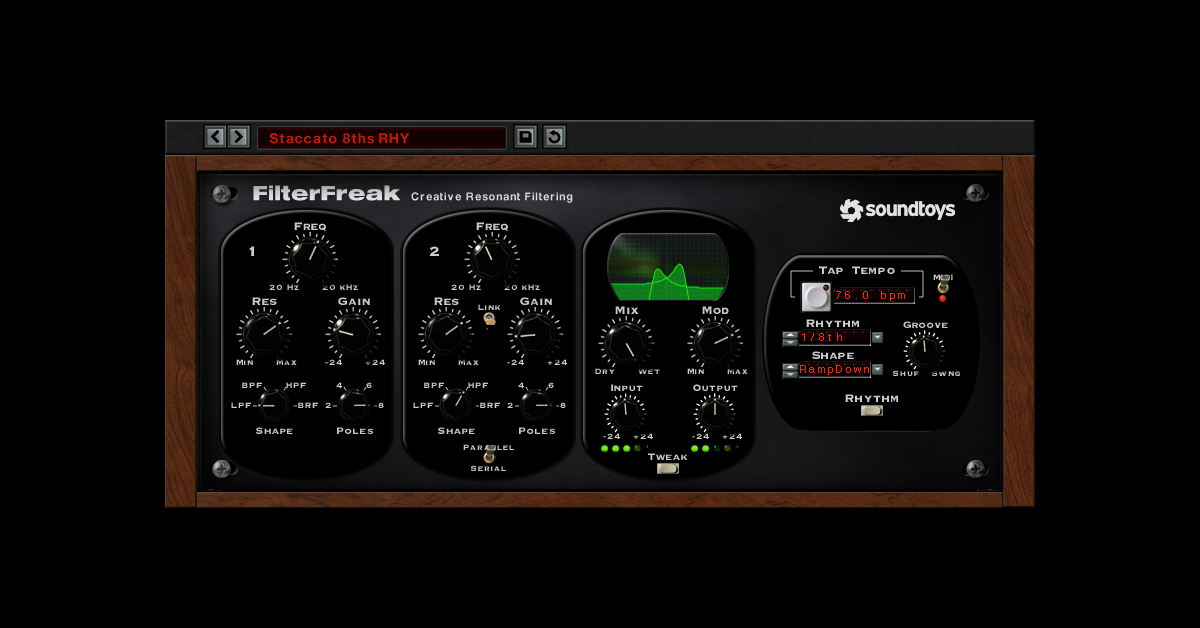
Soundtoys FilterFreak is a resonant filter effect for shaping guitars, bass, drums, synths and vocals. It combines four filter shapes with several ways to move the cutoff or respond to audio, from a steady LFO sweep to tempo-synced patterns and triggered envelopes.
Filter shapes, resonance and saturation
Choose lowpass to reduce frequencies above the cutoff, highpass to reduce those below it, bandpass to emphasize a range around the cutoff, or band reject to notch out a range. The pole control offers 2-, 4-, 6- or 8-pole settings, with higher settings producing steeper attenuation. Resonance emphasizes frequencies near the cutoff and can push the filter into oscillation at high settings, which can produce very high output levels.
Seven Analog Style settings change the filter's saturation character, from Clean to options such as Fat, Dirt, Crunch and Pump. The input and output controls help manage level as you adjust the saturation.
Choose how the filter moves
FilterFreak has six modulation modes. LFO mode produces repeating movement, and its Shape Editor lets you draw and save custom waveforms. Rhythm mode syncs movement to tempo; you can build patterns in the Rhythm Editor and use the Groove control for swing or shuffle.
For input-responsive effects, Envelope mode follows changes in the incoming signal, which the manual describes for dynamic sources such as guitar and drums. Step mode creates a new random value when a trigger occurs. ADSR mode applies a defined attack, decay, sustain and release shape, triggered by an audio threshold, a MIDI note or the trigger button. Random mode changes to random values in time with its selected rhythm.
Single and dual-filter versions
The installation includes FilterFreak 1, with one filter, and FilterFreak 2, with two separately adjustable filters. In FilterFreak 2, run the filters in parallel to process the input through each filter before mixing their outputs, or in series to feed the first filter into the second. Different filter types and modulation amounts on the two sections let you build more involved moving effects.
Compatibility and setup
The product page lists 64-bit AAX Native, AAX AudioSuite, VST 2, VST 3 and Audio Units formats, sample rates from 44.1 to 192 kHz, macOS 10.15 or later and Windows 10 or later. It lists Apple Silicon compatibility, excludes ARM-based Windows machines and requires an internet connection for activation. Supported hosts include Pro Tools, Live, Cubase, Nuendo, Logic, Studio One, Reaper and Bitwig; Soundtoys also supports FL Studio 2025.1 or later. Check the host compatibility guide for version-specific requirements; Soundtoys says unlisted or older host versions are not tested and recommends trying the free trial with your host.
The FilterFreak user guide recommends using the plug-in as a channel insert to avoid possible phase cancellation. For an aux send and return, it describes setting Mix to 100 percent and adjusting the return level. The manual recommends lowering FilterFreak's output before trying high resonance, which can produce levels high enough to damage speakers at high volume.