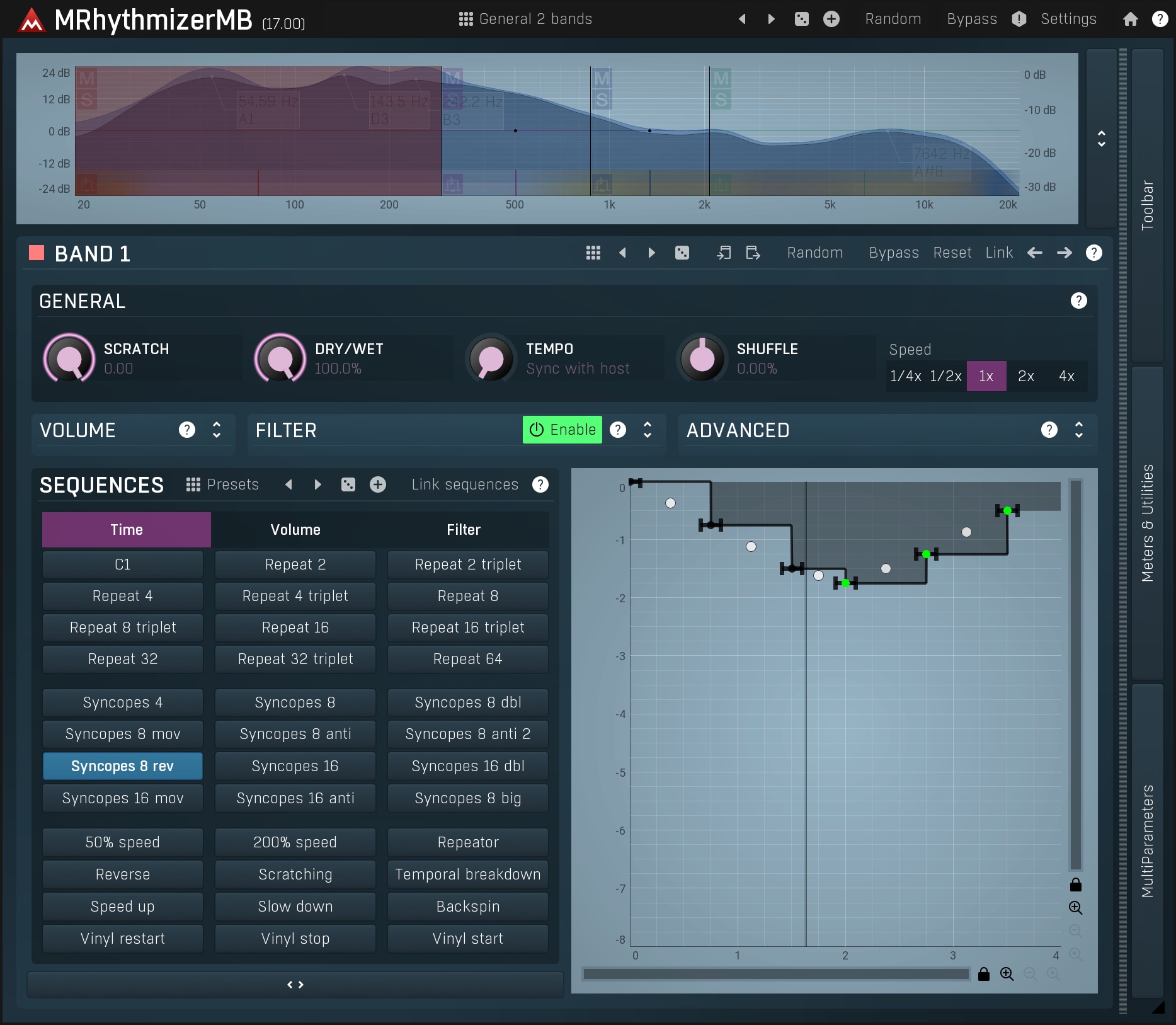
MRhythmizerMB is a multiband time manipulation effect for reshaping audio into rhythmic cuts, repeats, scratches and filter movement. Its three sequencer banks control time, volume and filtering, and the product page shows processing in six bands. That makes it suited to producers who want to change the rhythm or movement of a part through a track, with changes triggered from a DAW or MIDI controller. See Melda's MRhythmizerMB product page.
Three sequencers for rhythmic edits
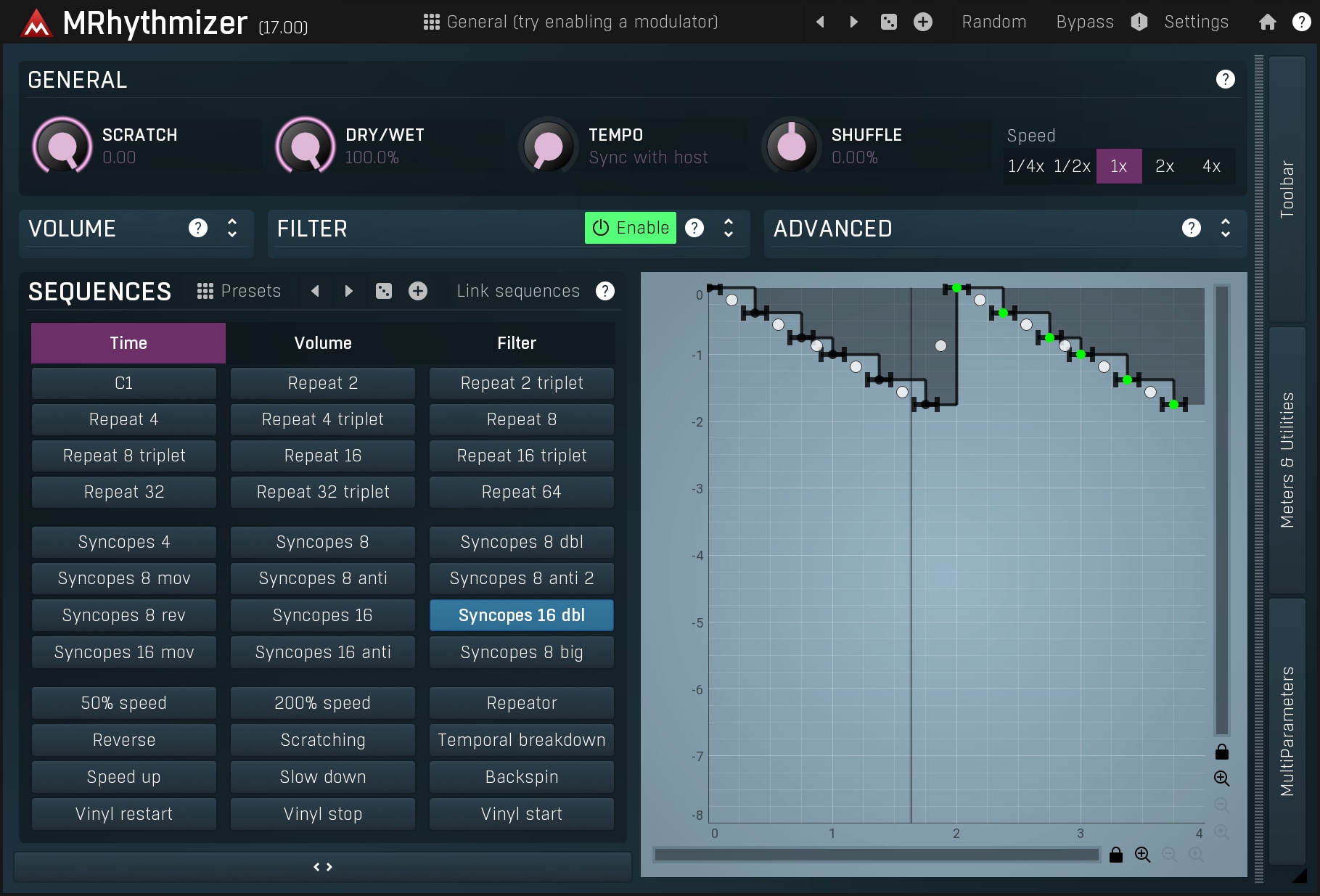
The time sequence graph chooses which quarter-note to play at each step, using the current position or one of the previous seven. A pattern can repeat earlier material or jump between moments in the part. The volume bank shapes level over a sequence, which supports gated or chopped rhythms. The filter bank moves the cutoff of a variable band-pass filter over the same kind of timeline. Each bank has 36 sequences. Melda's quick start guide explains the sequence graphs and controls.
Trigger patterns and add movement
You can select sequences in the plugin, switch them with MIDI, automate switching in the host, or use a modulator to trigger them. The three banks can be linked so a time change also triggers the corresponding volume and filter sequences. Sequence length ranges from 1 to 64 quarter-notes, and the plugin shortens it according to the host time signature. For logical synchronization, the sequence must be at least as long as that signature. A Scratch control offsets playback time without editing the sequence itself.
The product includes four modulators. Each can act as an LFO, level follower, envelope, randomizer or pitch detector, and can use the sidechain. Use the modulators to make parameters respond to audio or the sidechain, or to trigger sequence changes automatically. For timing control, the plugin supports host sync, immediate sequence changes and changes queued for the next bar. MIDI learn lets MIDI controllers control any parameter in real time.
Band and crossover choices
The band editor lets you set band boundaries and mute, solo or bypass individual bands. Along with frequency crossovers, the manual documents level, panorama, mid/side, spectrum and transient crossover modes. These can route different parts of a signal into separate bands for processing.
Analog crossovers add no latency and usually shift phase; the 6 dB/octave type is zero-phase. Linear-phase options add latency without phase shift. The filter sequence uses significant CPU, introduces phase shift and changes the spectrum even in its 100% state, so it is disabled by default. Melda also lists automatic gain compensation and a brickwall safety limiter that keeps output below 0 dB.
Compatibility and licensing
- Windows: Windows 10 or 11, 64-bit, with VST, VST3 or AAX hosts and an Intel or AMD processor with SSE2 support.
- macOS: macOS 10.14 Mojave or newer, 64-bit, with VST, VST3, AU or AAX hosts. Intel, AMD and Apple Silicon CPUs are listed.
- Linux is not directly supported. Melda says Wine may work if the .wine/drive_c/windows/Fonts/ directory contains Microsoft True Type fonts; Linux is not listed as a supported platform.
Melda lists a free trial and a €99 regular price on the product overview. It says a purchase includes free updates for life. The license is assigned to one person and can be used on that person's computers. Activation uses license files and does not require a dongle or internet connection; the optional online preset exchange does use an internet connection. Check the system requirements for current compatibility details, and the pricing page for current pricing.