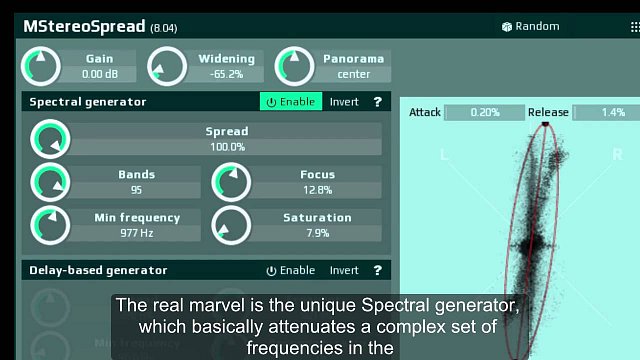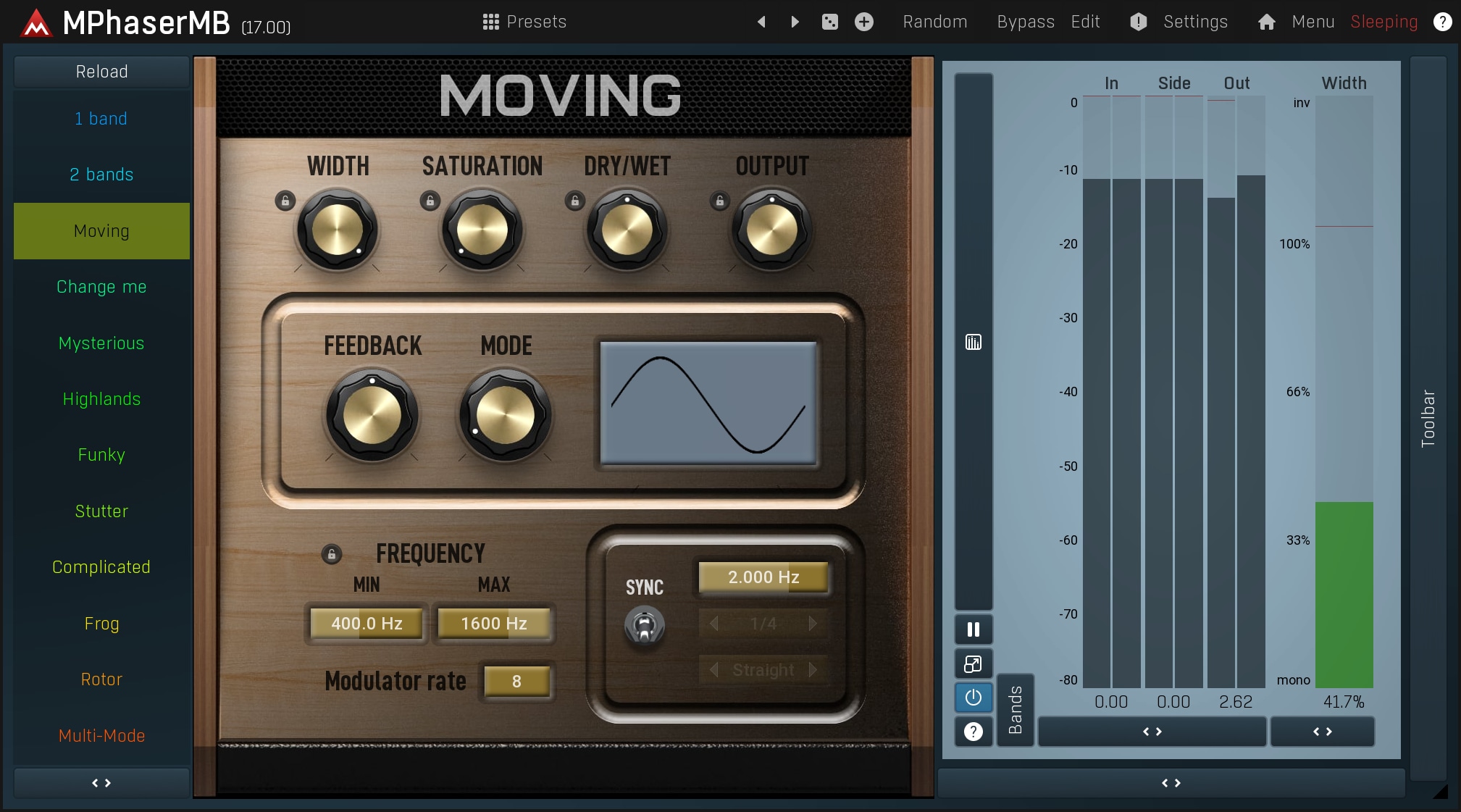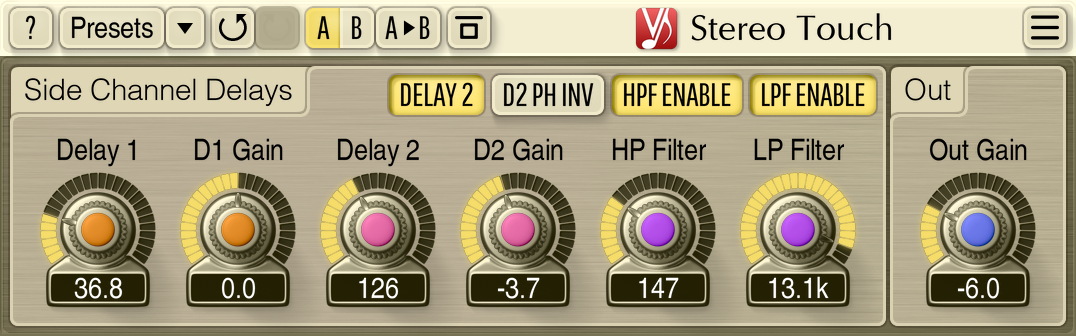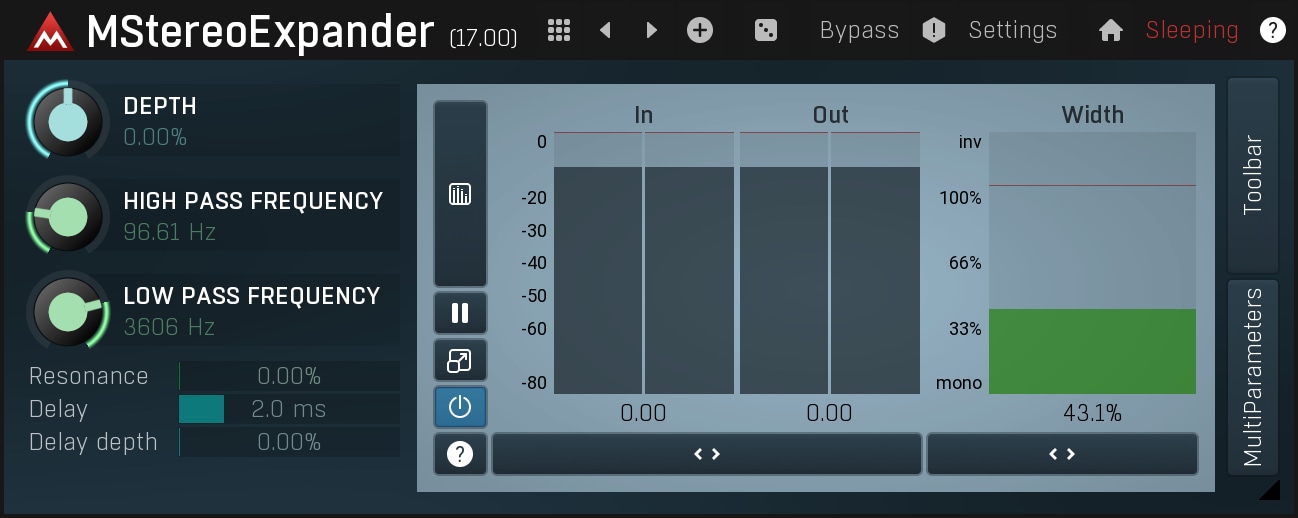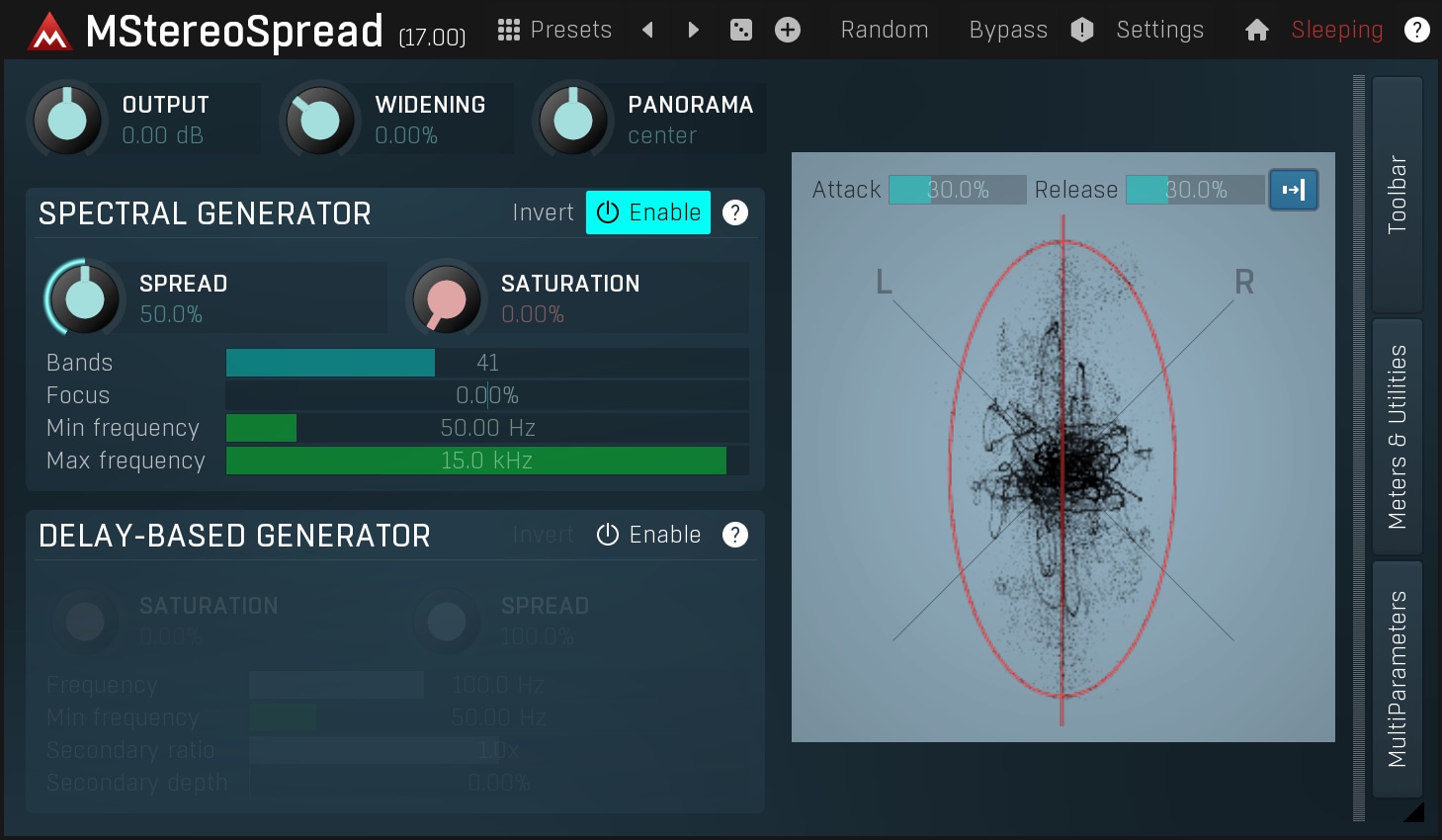
MStereoSpread is a stereo-expansion effect for widening parts or buses in a mix. Its spectral generator creates stereo by altering phase relationships across frequency bands. A second, comb-filtering generator is available for comparison or complementary use, and a stereo field display shows the resulting width.
Choose the spectral generator for controlled widening
The manual recommends the spectral algorithm for most material. Its bands distribute frequencies differently between the left and right channels without delay-based processing. The Spread control sets the effect amount; Focus shifts emphasis toward lower or higher frequencies, and Min and Max frequency limit the range being widened. Invert swaps which frequencies favor each side, which can help when processing similar tracks with the same settings.
Band count changes both the sound and CPU use. Fewer bands use less processing and can create a stronger, less natural spread; more bands usually sound more natural. At very high band counts, phase shifts may affect transient sounds. Raising the minimum frequency leaves more low-frequency content outside the widening range. Melda describes both algorithms as mono compatible, and the manual separately warns that excessive spectral spread can sound fatiguing. The width meter marks 66% to 100% as a range where phase-coherence problems may begin; above 100%, the side signal exceeds the mid signal and may be highly mono-incompatible. Check the mono fold-down and adjust the amount to suit the source.
Where the second algorithm fits
The delay-based mode uses comb filtering. It can provide an alternative color, though the manual describes possible echo, tonal coloration, and pitch-dependent movement across the stereo field. Melda recommends the spectral mode as the main option and the delay-based mode as a complement. Compare the modes on sustained pads or other steady-state material; at high delay settings, the manual says the audible echo makes the delay-based mode unsuitable for drums.
Automation, metering, and multichannel work
Four modulators can act as LFOs, level followers, MIDI or audio-triggered envelopes, randomizers, or pitch detectors. They can control parameters and respond to a side-chain signal. MIDI learn maps controllers, while multiparameters group several controls for automation or morphing between settings.
A to H switching lets you keep up to eight settings for comparison; four can be morphed with an X-Y pad. Automatic gain compensation helps keep output level close to input while comparing changes. The plugin also has a safety limiter designed to keep output below 0 dB. Its meters show stereo width, input and output levels, waveforms, loudness, bands, gain reduction, and side-chain signals.
Channel modes include mono and stereo, mid-side, separate left and right or mid and side paths, surround up to eight channels, and ambisonics up to seventh order (64 channels). This can suit stereo mixing and multichannel film, game, or VR sessions when the host supports the required channel layout.
Compatibility, license, and access
MStereoSpread supports 64-bit VST, VST3, and AAX hosts on Windows 10 or 11, and VST, VST3, AU, and AAX hosts on macOS 10.14 Mojave or later. Melda lists Intel or AMD processors with SSE2 for Windows, and Intel, AMD, or Apple Silicon processors for Mac. Linux is not directly supported; Melda notes that Wine may work if Microsoft TrueType fonts are installed in Wine's Windows fonts folder.
The product page lists a regular price of €79 and offers a free trial. A purchase includes free lifetime updates. Melda says each license belongs to one user and covers that user's computers, with no activation dongle or internet connection required. See the support page and MStereoSpread PDF guide for setup details.