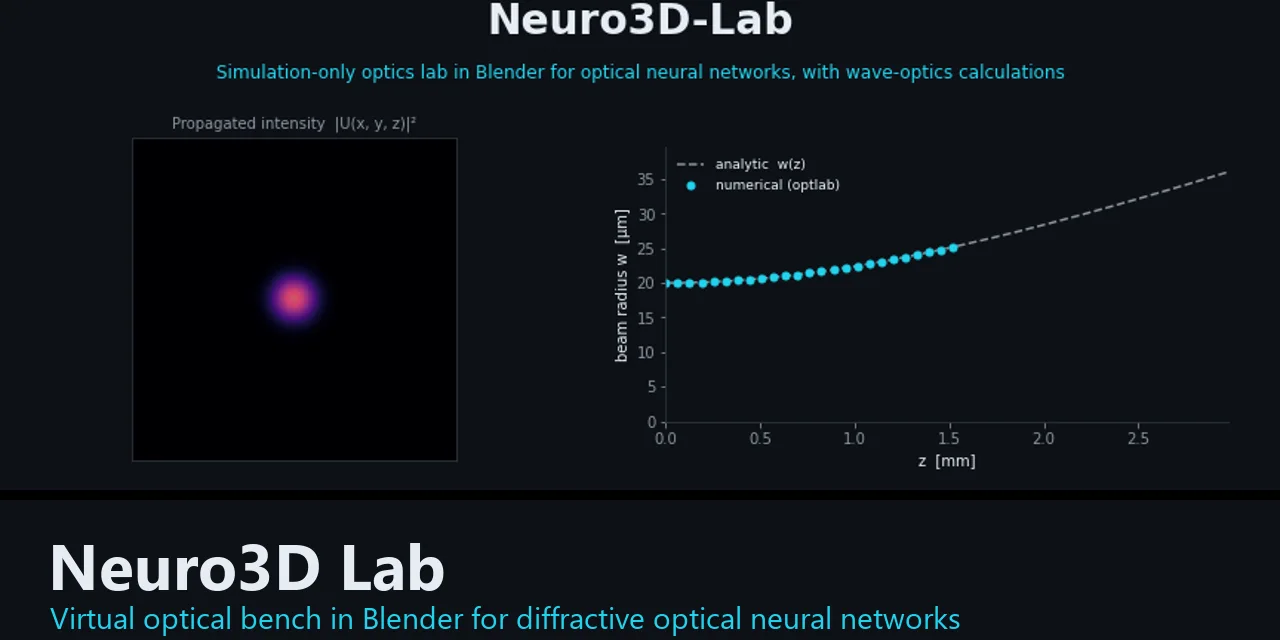
Neuro3D Lab is a Blender add-on for building a virtual optical bench for diffractive optical neural networks. Create a source plane, phase layers and a detector, then export the bench and run a coherent scalar wave propagation simulation. The result is detector intensity that you can import into Blender as an image.
From Blender scene to detector image
Open the Neuro3D Lab panel in the 3D Viewport sidebar and click Build Demo Bench. Choose an output folder and click Export Bench. The bench uses the optlab.bench/1 format, with JSON geometry and NumPy height maps for the phase layers. Click Run Bench to run the bundled simulation, then Import Intensity to display its result on the detector.
Numerical options and validation
The default propagation path checks its numerical validity domain and rejects geometry outside it. For the optional finite-support path, place numerical_config.json beside bench.json and set padding, refinement, boundary and filter_mode. The result records the numerical settings and file hashes. Both numerical backends are included, so they do not need separate installation.
What the simulation can show
Neuro3D Lab provides scalar optical simulation and visualization. It does not supply measurements from physical hardware or predict the behavior of a fabricated device without additional validation. The demo uses random phase patterns, so it is not a trained neural-network result. Simulation settings and convergence matter when interpreting the output. The project documentation describes the numerical assumptions, validation records and limitations.
Version, compatibility and licensing
Version 0.2.1 supports Blender 4.2 LTS and newer. Its Blender Extensions listing reports validation on Blender 4.5.14 LTS, including 15 passing legacy self-tests, 8 passing finite-support self-tests, manifest validation, a ZIP build and installation in a clean profile. These are release validation results, not measurements of a physical device. The add-on is licensed under GPL-3.0-or-later. Its bundled numerical libraries are Apache-2.0, with license files included.