Voxengo Marquis Compressor combines dynamics processing with a modeled tube amplifier stage. It is intended for individual tracks, stems and mixes in mixing or mastering sessions where you want to choose both the compression response and the amount of harmonic coloration. Voxengo lists three compressor modes and four amplifier modes on its features and compatibility page.
Choose a compression response
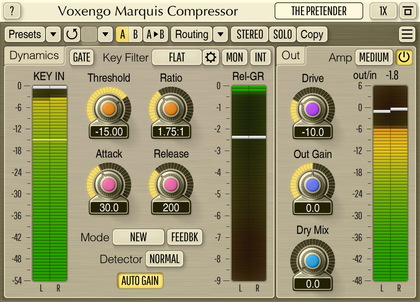
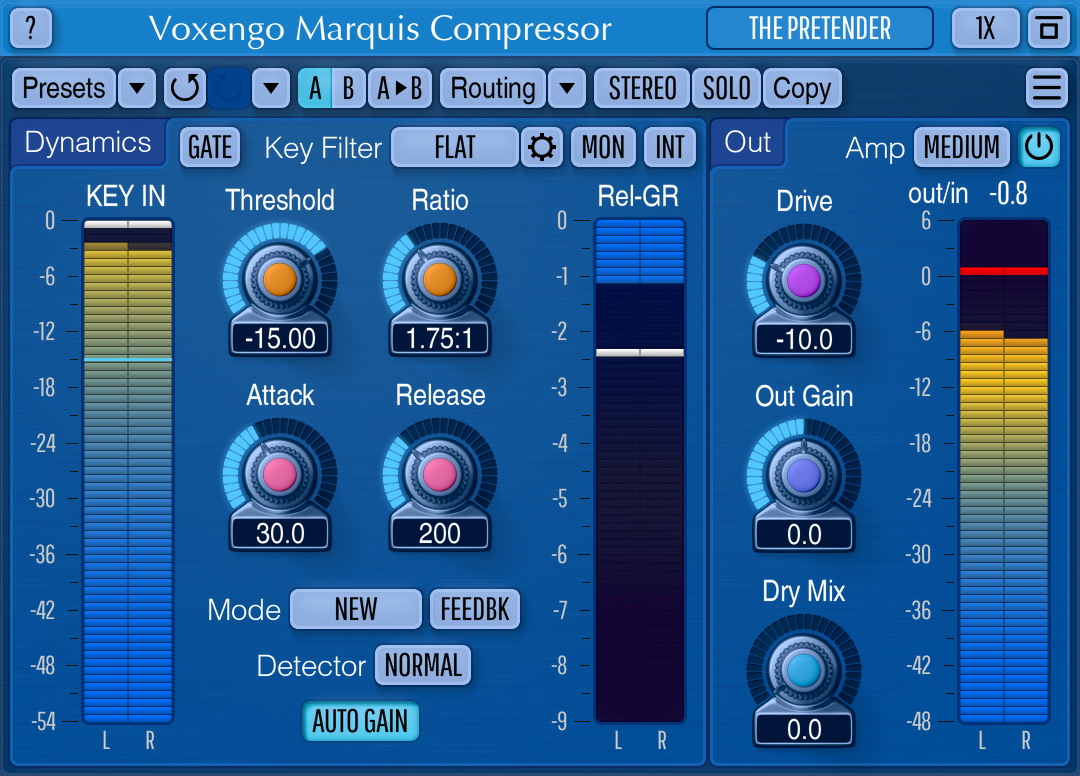
The three compressor algorithms include T3, which Voxengo describes as modeled after a classic analog compressor. You can switch between feedback and feed-forward compression. The user guide says feedback mode tends to give a more controlled, less fluctuating result and can sound snappier on drums. The Round detector has a smoother, more fluid response; Normal gives a more conventional compression sound. Threshold, ratio, attack and release control the compression curve and timing.
The Gate switch changes the processor to gate operation, useful for reducing drum bleed. In this mode, Attack and Release become Gate Open and Gate Close times. Voxengo recommends a fast gate-open time to avoid smoothing the attack of transients.
Shape the key signal and tube drive
For frequency-selective compression or external ducking, Marquis can use an internal or external key signal. Using an external side-chain signal also requires an appropriate Routing setting. Its key-filter section loads presets or lets you draw a filter shape, and a monitor switch lets you hear the filtered key. Frequency regions that are louder in the key signal receive more compression. Voxengo lists de-essing among the plug-in's applications.
The amplifier stage can be switched off or driven before compression. The guide suggests setting Drive to -10 dB or lower for a clear sound. For more saturation, raise Drive, then use Dry Mix to blend the original signal back in. Dry Mix is applied after output gain, so this can reduce distortion while retaining some of the processed sound, a parallel-compression approach.
Check channel and system support
Voxengo lists mono, stereo, mid-side, 5.1 and 7.1 applications, along with internal channel routing and channel grouping. Other technical features include up to 8x oversampling, 64-bit floating-point processing and zero processing latency. The user guide specifies AAX, AudioUnit, VST and VST3 hosts. Voxengo's downloads page shows version 2.9, dated April 8, 2026, with Mac AU, AAX and VST3 packages and Windows VST, VST3 and AAX packages.
The feature page lists 32- and 64-bit Windows XP, Vista, 7, 8, 10 and later, plus macOS 10.12 and later, in each case only for versions not announced as unsupported; it also lists native Apple Silicon support and requires a dual-core processor of 2.5 GHz or faster with at least 4 GB of RAM. Voxengo labels Marquis Compressor as trial software. During the trial, processing output is muted briefly every 45 seconds. The demo is authorized with a product key; the feature page says it requires neither a dongle nor a connection to Voxengo's website. See the product page for current product details.