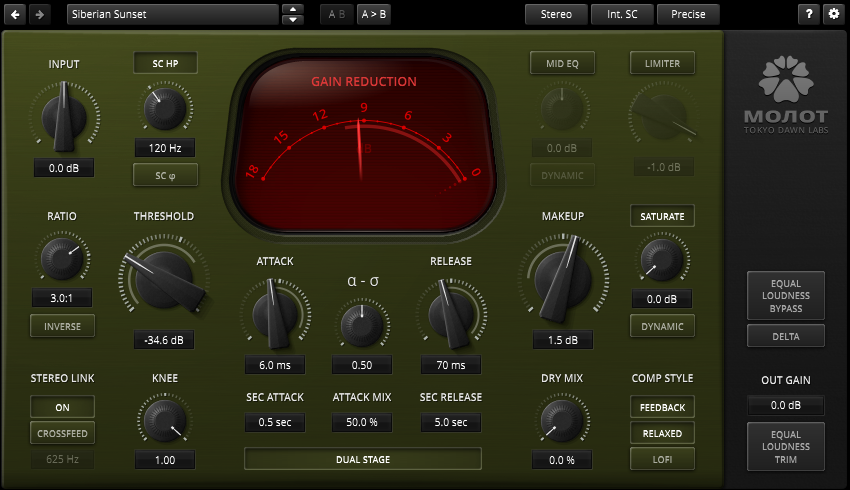
TDR Molot GE is a dynamic-range compressor for shaping both gain reduction and tone. It combines compression with saturation, a tone-control section and a peak limiter. Tokyo Dawn Labs describes it for work on drums, vocals, guitars and bass. It draws on characteristics of older compression designs but does not emulate a specific vintage device.
Shape the compressor response
Set compression with Threshold or Input gain, then adjust attack, release, ratio and knee. The Alpha-Sigma control changes the attack curve: Alpha responds almost immediately, while Sigma lets more of the initial transient pass. The manual recommends Alpha for suppressing transients and Sigma for shaping them. Feedforward and feedback modes provide different compression curves and tone. Instant and Relaxed modes also change the response to sharper peaks and small amounts of gain reduction.
Dual-stage timing makes release depend on how long compression has been active. Its secondary attack and release controls let you adjust that behavior; Tokyo Dawn suggests this mode for bus compression. For external sidechain ducking, route a key signal to the plug-in and select the external sidechain input. The sidechain high-pass filter can keep low frequencies from triggering compression. Dry Mix blends the processed and original signals, which the manual describes as useful for bringing back transients after aggressive compression.
Add tone, control peaks and compare processing
The Mid EQ uses a fixed curve at 500 Hz, 1.5 kHz, 3.5 kHz and 10 kHz. Its Dynamic mode ties EQ gain to the compressor's gain reduction. Saturation can be applied at a steady amount or in Dynamic mode, where more gain reduction produces more saturation. A brick-wall peak limiter is also included; it has no lookahead and operates at zero latency. The manual cautions that heavy limiter use can sound dirty.
Equal Loudness Bypass and Equal Loudness Trim help compare processed and bypassed signals at matched loudness. The Delta mode lets you listen to the difference produced by the compressor, with the EQ, limiter, saturation and makeup gain inactive in that mode.
Choose stereo processing and quality modes
Stereo Link can leave the left and right channels independent, link their gain reduction, or use crossover-based linking so the low frequencies stay linked while higher frequencies can respond separately. Sum Diff mode processes both mid (Sum) and side (Diff) channels, with separate threshold and makeup controls for the Diff channel; Sum and Diff modes process one of those channels while leaving the other unprocessed. These channel options depend on host support and are unavailable on mono or multi-mono tracks.
Four processing quality modes cover different workloads. Live is zero latency, Eco is intended to reduce CPU use, Precise is the default high-fidelity mode, and Insane increases processing quality and CPU load. Saturation controls are inactive in Live and Eco modes.
Compatibility and license
Tokyo Dawn Labs lists VST2, VST3, Audio Unit and AAX-compatible hosts, with Windows 7 or later or Mac OS X 10.9 or later and OpenGL support. Its product page lists a personal or small-business license with free updates. The EULA grants a perpetual, non-exclusive license and permits one user to use a licensed copy on up to five individual computers. Each user on a multi-user, server or network installation needs a separate license. The purchase page says sales are final and asks buyers to confirm the demo runs on their system before purchasing.