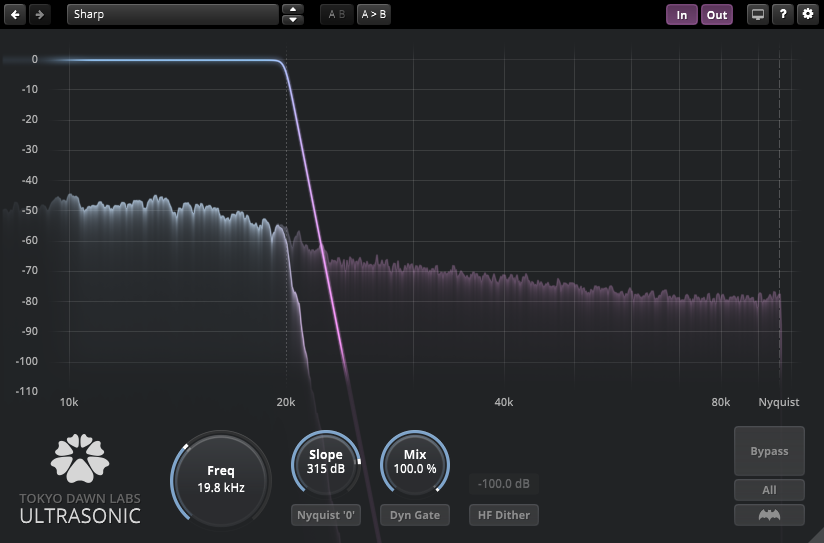
TDR Ultrasonic is a filter for managing ultrasonic content in oversampled recording, processing, and playback chains. Nonlinear devices such as compressors, limiters, distortion processors, and modulation effects can turn that content into intermodulation products, some of which may fall into the audible range. The plugin is designed to reduce that interaction before signals reach those stages.
Set the filter and inspect its effect
Set the low-pass cutoff with the Freq control, defined at the point where attenuation reaches -3 dB. Slope ranges from 24 dB per octave at 0% to almost 600 dB per octave at 100%. Nyquist 0 enforces infinite attenuation at the Nyquist frequency. The Mix control blends the dry input and processed output, so you can compare partial and full filtering.
The magnitude display shows the filter response and can show input and output spectra. It marks the audible and system bandwidths, and you can freeze the display to inspect the spectrum. The Dynamic Gate bypasses filtering when ultrasonic levels are very low and activates it when significant levels are detected.
Listen to ultrasonics or try HF dither
Bat Mode shifts content from 15-30 kHz down to 0-15 kHz, making ultrasonic material audible while you adjust the cutoff. It remains active when the plugin is bypassed, which lets you compare the monitored sound. The separate Bypass All control bypasses every TDR Ultrasonic instance in the session for a whole-project comparison.
HF Dither adds noise above the cutoff frequency up to Nyquist. It offers an alternative to filtering by randomizing ultrasonic content rather than removing it. The developer says the added high-frequency noise can evoke DSD audio, which typically has strong noise in that range.
Check host, system, and license requirements
The developer lists VST2, VST3, Audio Unit, and AAX formats, with 32-bit and 64-bit builds. The required host must support one of those formats. Listed system requirements are Windows Vista or higher, macOS 10.9 or higher, or Linux x86-64 with GLIBC 2.14 or higher, plus OpenGL support. The product page lists sample rates up to 20 MHz.
TDR Ultrasonic is sold under a personal or small-business license with free updates. Its EULA grants a perpetual, non-exclusive license and allows one user to use a licensed copy on up to five computers. The time-unlimited demo blocks automatic recall, so try it in your host before buying. The developer states that purchases are final.