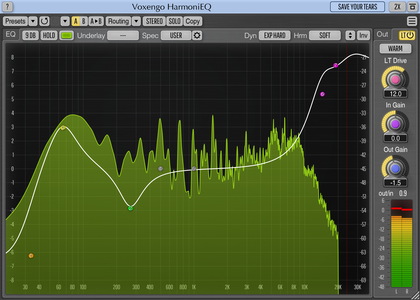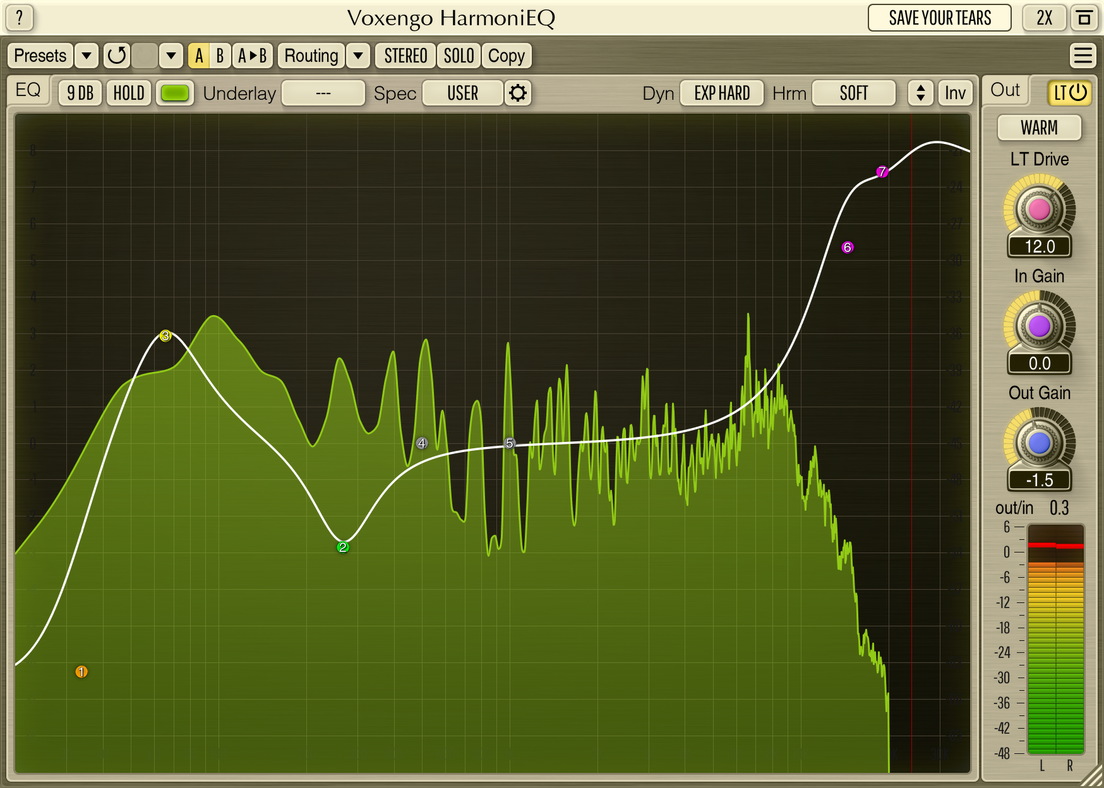
Voxengo HarmoniEQ is a parametric equalizer for music production, combining conventional filters, dynamic equalization and harmonic coloration; Voxengo describes its dynamic modes as suitable for mastering. Its curve is edited by dragging points on one control surface, with up to seven filters available. The design suits engineers who want to shape tone and add harmonic character in the same plug-in.
Shape the curve and its dynamics
Filter choices include peaking, low- and high-shelf, low- and high-pass, notch and band-pass. The control surface reaches 38 kHz, which Voxengo identifies as useful for smooth high-frequency “air” boosts. A real-time spectrum display and narrow-band sweeping help when locating or checking frequency changes.
Dynamic modes change how EQ boosts and cuts affect transients. Expanding modes slightly raise transient levels with a boost and add a broadband loudness increase, so smaller boosts can produce a stronger effect. Compressing modes lower transient levels with a boost and allow EQ changes without increasing peak levels. With a single filter, a cut reverses the mode's dynamic-range effect; with mixed boosts and cuts, the result depends on which prevails. If the adjusted band has no signal energy, the original dynamic range is unchanged. The dynamics are broadband and channel-linked; use the Dual Mono routing preset when the input channels need independent processing.
Set harmonic coloration and saturation
The Hrm control adjusts harmonic coloration from Clean to Very Hard. It produces mainly second and third harmonics, with the third at a low level, and it works only after at least one filter is enabled. Input Gain affects the strength of this coloration, so Voxengo recommends treating it as an important control for keeping the result smooth and avoiding distortion, especially with Lampthruster enabled.
The LT switch activates HarmoniEQ’s Lampthruster saturation module. Its modes and Drive control let you change the saturation character, and the module interacts with the EQ, dynamics and harmonics. In rare cases, Lampthruster saturation may produce unwanted transient distortion. It may also behave poorly with high-pass filters; the manual suggests switching LT off or trying Tube 2 mode in that situation. Some LT modes can produce clicks when changing modes or restarting playback.
Routing and practical workflow
HarmoniEQ supports stereo and multichannel processing, mid-side work, internal channel routing and channel groups. The spectrum can be held temporarily for comparison, while Underlay displays another channel group’s curve and spectrum. Preset management, undo and redo history, and A/B comparisons help with auditioning changes. Processing uses 64-bit floating point and supports up to 8x oversampling; the listed latency is 11 ms with compensation.
Compatibility and trial limits
The plug-in is available in VST, VST3, AudioUnit and AAX formats for compatible hosts. Voxengo lists Windows XP and later in 32- and 64-bit versions and macOS 10.12 or later, subject to any versions it has announced as unsupported; the features page also lists native Apple Silicon support and macOS Sonoma, Sequoia and Tahoe. Its stated minimum is a 2.5 GHz dual-core processor and 4 GB of RAM.
Voxengo labels HarmoniEQ downloads as trial software. In demo mode, output is muted briefly every 45 seconds. Demo authorization uses a text product key and does not require a dongle, challenge-response process or connection to the Voxengo website.