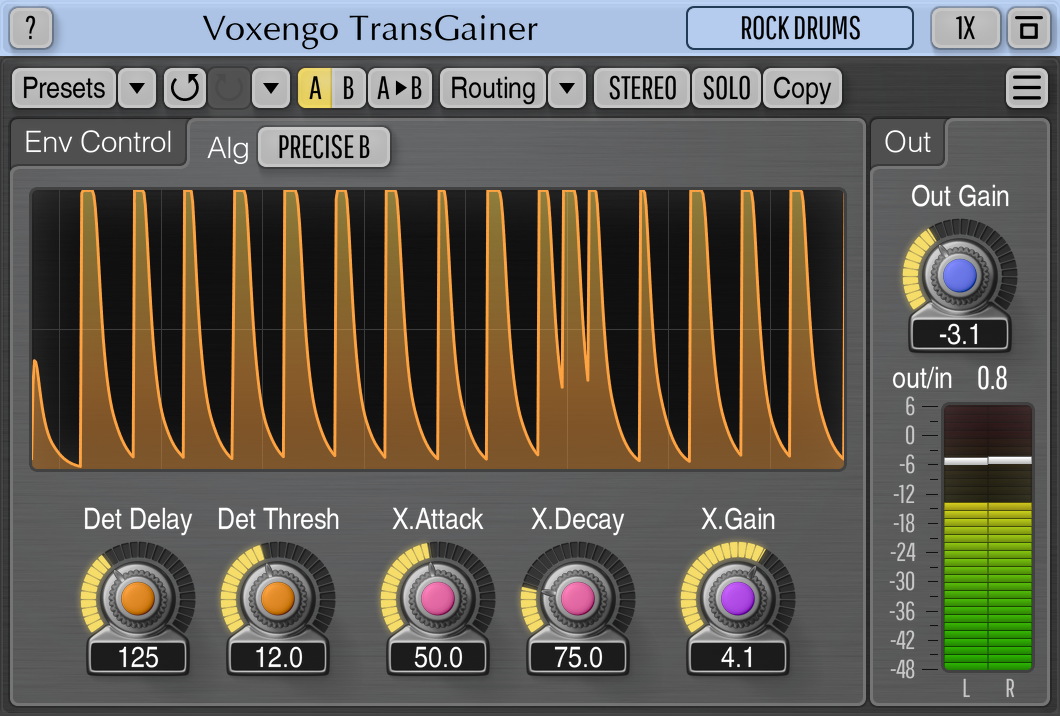
Voxengo TransGainer adjusts the attack and sustain levels of audio by following transient events. It is designed for individual tracks and full mixes, with uses that include transient shaping, using it instead of a gate or expander in many cases, recording restoration, remastering and reverb-tail modification.
Choose an algorithm for the source
TransGainer has four algorithms: Legacy, Precise, Precise U and Precise B. Legacy includes five modes: Mellow for a smoother response, LF Focus and HF Focus for low- or high-frequency emphasis, Round for a rounder sound, and Sharp for weakly defined transients. Voxengo notes that Sharp may sound less controlled.
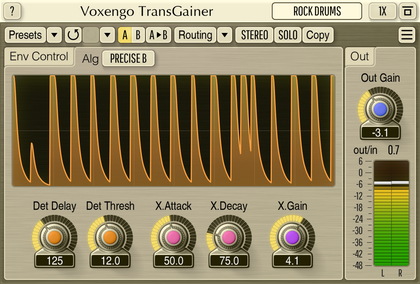
Precise U offers greater transient selectivity, while Precise B is intended for broadband mix and bus processing. Precise has no separate Sustain Gain control; its X.Gain and X.Decay controls can shape the sustain portion of the sound.
Shape the transient response
In Legacy mode, Trans Gain sets the maximum gain adjustment from a transient; the actual adjustment is usually lower, and only the fastest transients that drive the detection meter to 1.0 may reach it. Sustain Gain sets the maximum adjustment during the sustain stage. Det Delay sets the expected average time between transients. Lower values make the plugin react to more transients; overly low values may produce an unstable or dirty sound. Voxengo suggests matching Det Delay to the song's tempo. Contour controls the additional release between transients; increasing it can reduce unwanted fluctuations at low Det Delay settings, but it also smooths the sound and reduces punch.
In the Precise algorithms, Det Thresh can skip weak transients if the result sounds wobbly or dirty. X.Attack sets how long a detected transient stays at its peak, and X.Decay sets its duration. Lower X.Attack values favor pronounced transients and a snappier sound; higher values can increase selectivity for short, high-frequency transients.
If loud hits receive much more gain than quieter hits, the user guide suggests placing a compressor or saturator before TransGainer to even out the source dynamics.
Channels, hosts and system requirements
TransGainer supports stereo and multichannel processing, internal channel routing, channel grouping and mid/side processing. Voxengo lists zero processing latency, up to 8x oversampling and 64-bit floating-point processing. The plugin supports AAX, AudioUnit, VST and VST3 hosts, with separate Windows and macOS installers. Voxengo lists Windows and macOS support, including native Apple Silicon support. Its stated minimum system requirement is a 2.5 GHz dual-core processor and 4 GB of RAM.
Trial conditions
Voxengo labels TransGainer trial software. In demo mode, the output is muted briefly every 45 seconds. Demo authorization uses a product-key text string and does not require challenge-response, a dongle or a connection to Voxengo's website.